Liu Huiwen, Liu Ying, Hai Rihan, Liao Weihua, Luo Xiangjian
Key Laboratory of Carcinogenesis and Invasion, Chinese Ministry of Education, Department of Radiology, Xiangya Hospital, Central South University, Changsha, Hunan 410078, China.
Cancer Research Institute, School of Basic Medicine, Central South University, Changsha, Hunan 410078, China.
Genes Dis. 2022 May 28;10(4):1279-1290. doi: 10.1016/j.gendis.2022.05.014. eCollection 2023 Jul.
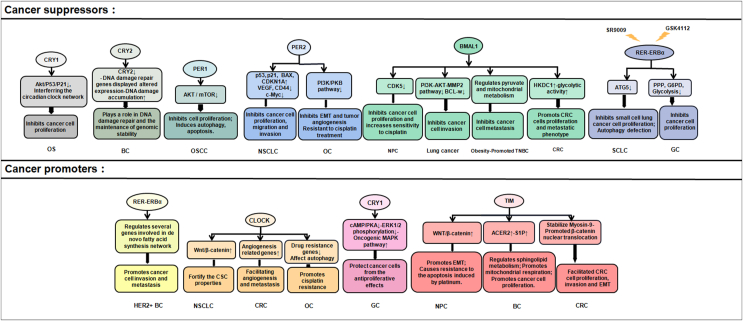
Circadian rhythm refers to the inherent 24-h cycle oscillation of biochemical, physiological and behavioral functions, which is almost universal in eukaryotes. At least 14 core clock genes have been reported to form multiple chain feedback loops that confer intrinsic circadian rhythmicity onto the molecular clock. Accumulating evidence has shown that the circadian gene dysfunction resulted from single nucleotide polymorphisms (SNPs), deletions, epigenetic modification, and deregulation is strongly associated with cancer risk. In the present review, we describe the composition of circadian rhythm system. We highlight the function and mechanism of clock genes in cancer pathogenesis and progression. Moreover, their potential clinical implications as prognostic biomarkers and therapeutic targets have been addressed.
昼夜节律是指生物化学、生理和行为功能固有的24小时周期振荡,这在真核生物中几乎是普遍存在的。据报道,至少有14个核心时钟基因形成多个链式反馈环,赋予分子时钟内在的昼夜节律性。越来越多的证据表明,由单核苷酸多态性(SNP)、缺失、表观遗传修饰和失调导致的昼夜节律基因功能障碍与癌症风险密切相关。在本综述中,我们描述了昼夜节律系统的组成。我们重点介绍了时钟基因在癌症发病机制和进展中的功能和机制。此外,还探讨了它们作为预后生物标志物和治疗靶点的潜在临床意义。