Tanksley Peter T, Brislin Sarah J, Wertz Jasmin, de Vlaming Ronald, Courchesne-Krak Natasia S, Mallard Travis T, Raffington Laurel L, Linnér Richard Karlsson, Koellinger Philipp, Palmer Abraham, Sanchez-Roige Alexandra, Waldman Irwin, Dick Danielle, Moffitt Terrie E, Caspi Avshalom, Harden K Paige
Department of Psychology, The University of Texas at Austin, Austin, TX, USA.
Population Research Center, The University of Texas at Austin, Austin, TX, USA.
medRxiv. 2023 Jun 4:2023.05.31.23290802. doi: 10.1101/2023.05.31.23290802.
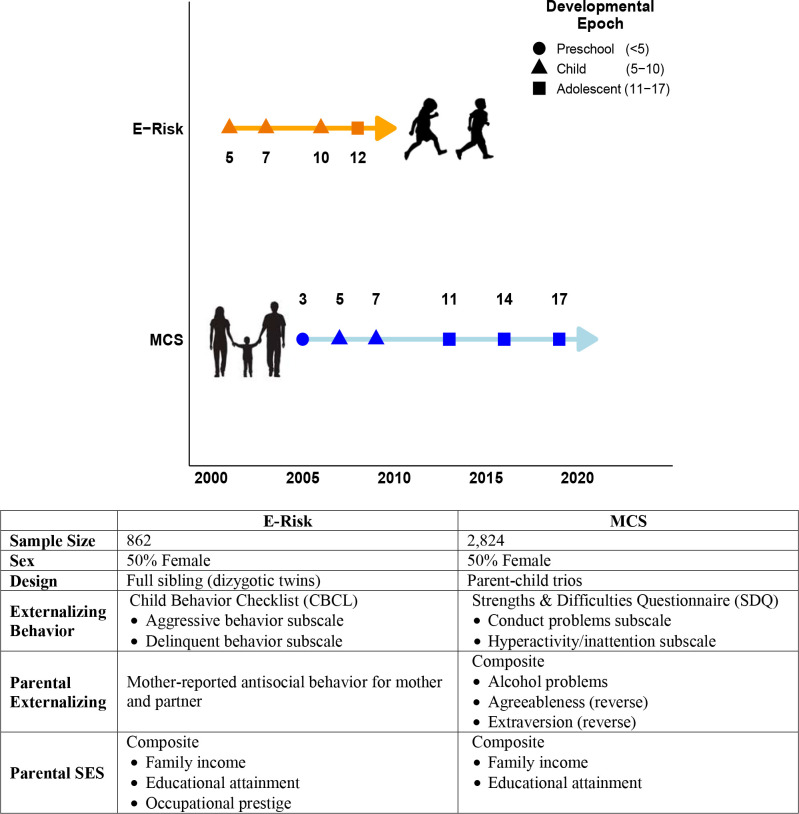
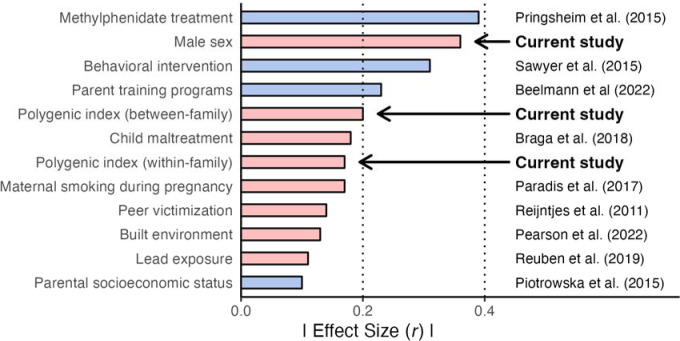
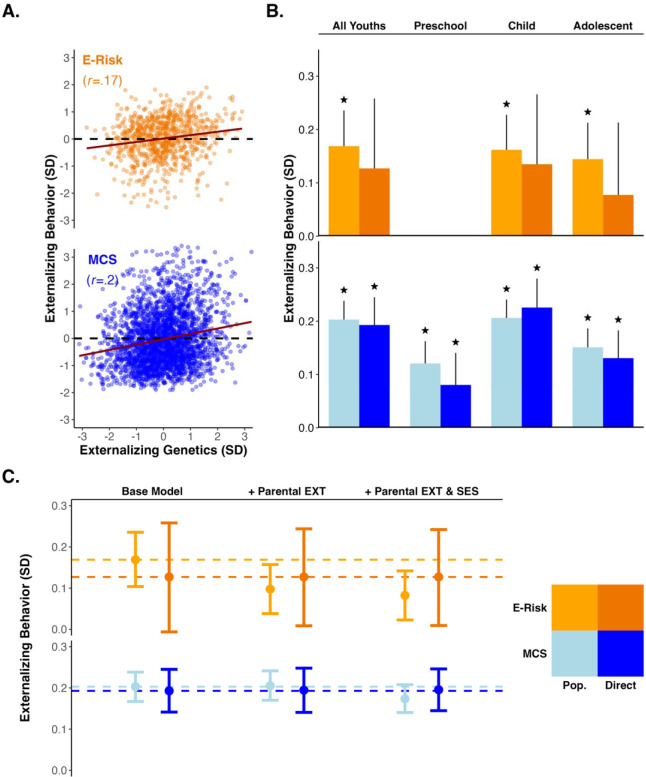
Behaviors and disorders characterized by difficulties with self-regulation, such as problematic substance use, antisocial behavior, and symptoms of attention-deficit/hyperactivity disorder (ADHD), incur high costs for individuals, families, and communities. These externalizing behaviors often appear early in the life course and can have far-reaching consequences. Researchers have long been interested in direct measurements of genetic risk for externalizing behaviors, which can be incorporated alongside other known risk factors to improve efforts at early identification and intervention. In a preregistered analysis drawing on data from the Environmental Risk (E-Risk) Longitudinal Twin Study ( twins) and the Millennium Cohort Study (MCS; parent-child trios), two longitudinal cohorts from the UK, we leveraged molecular genetic data and within-family designs to test for genetic effects on externalizing behavior that are unbiased by the common sources of environmental confounding. Results are consistent with the conclusion that an externalizing polygenic index (PGI) captures causal effects of genetic variants on externalizing problems in children and adolescents, with an effect size that is comparable to those observed for other established risk factors in the research literature on externalizing behavior. Additionally, we find that polygenic associations vary across development (peaking from age 5-10 years), that parental genetics (assortment and parent-specific effects) and family-level covariates affect prediction little, and that sex differences in polygenic prediction are present but only detectable using within-family comparisons. Based on these findings, we believe that the PGI for externalizing behavior is a promising means for studying the development of disruptive behaviors across child development.
以自我调节困难为特征的行为和障碍,如物质使用问题、反社会行为以及注意力缺陷多动障碍(ADHD)症状,给个人、家庭和社区带来了高昂代价。这些外化行为往往在生命早期出现,并可能产生深远影响。长期以来,研究人员一直对直接测量外化行为的遗传风险感兴趣,这种风险可以与其他已知风险因素结合起来,以改进早期识别和干预工作。在一项预先注册的分析中,我们利用了来自英国的两个纵向队列研究——环境风险(E-Risk)纵向双胞胎研究(双胞胎)和千禧年队列研究(MCS;亲子三人组)的数据,借助分子遗传数据和家庭内部设计,来检验遗传效应对外化行为的影响,这些影响不受常见环境混杂因素的偏倚。结果与以下结论一致:外化多基因指数(PGI)捕捉了基因变异对儿童和青少年外化问题的因果效应,其效应大小与外化行为研究文献中其他已确定风险因素所观察到的效应大小相当。此外,我们发现多基因关联在整个发育过程中有所不同(在5至10岁达到峰值),父母的基因(分类和父母特异性效应)以及家庭层面的协变量对预测影响很小,并且多基因预测中存在性别差异,但只有通过家庭内部比较才能检测到。基于这些发现,我们认为外化行为的PGI是研究儿童发育过程中破坏性行为发展的一种有前景的方法。