Department of Endocrinology, Division of Life Science and Medicine, The First Affiliated Hospital of USTC, University of Science and Technology of China, Hefei, 230001, Anhui, China.
Department of Epidemiology and Biostatistics, School of Public Health, Anhui Medical University, 81 Meishan Road, Hefei, 230032, Anhui, China.
J Epidemiol Glob Health. 2023 Sep;13(3):566-576. doi: 10.1007/s44197-023-00138-9. Epub 2023 Jul 3.
Diabetes is a life-long disease that poses a serious threat to safety and health. We aimed to assess the disease burden attributable to diabetes globally and by different subgroups, and to predict future disease burden using statistical models.
This study was divided into three stages. Firstly, we evaluated the disease burden attributable to diabetes globally and by different subgroups in 2019. Second, we assessed the trends from 1990 to 2019. We estimated the annual percentage change of disease burden by applying a linear regression model. Finally, the age-period-cohort model was used to predict the disease burden from 2020 to 2044. Sensitivity analysis was performed with time-series models.
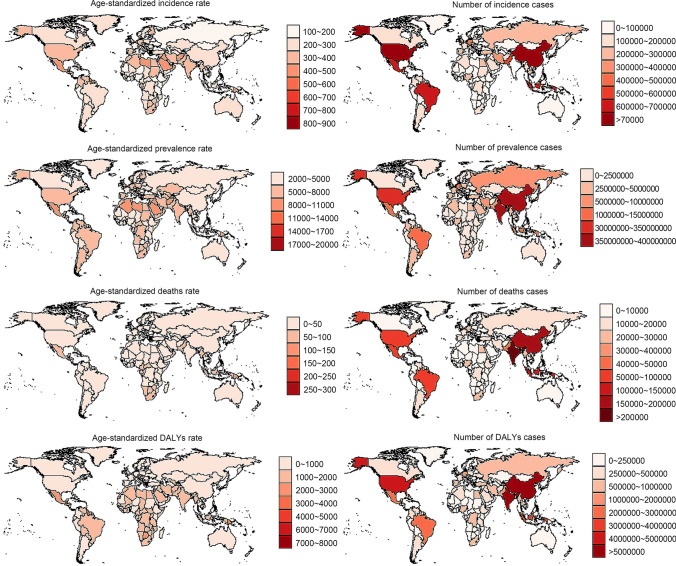
In 2019, the number of incidence cases of diabetes globally was 22239396 (95% uncertainty interval (UI): 20599519-24058945). The number of prevalence cases was 459875371 (95% UI 423474244-497980624) the number of deaths cases was 1551170 (95% UI 1445555-1650675) and the number of disability-adjusted life years cases was 70880155 (95% UI 59707574-84174005). The disease burden was lower in females than males and increased with age. The disease burden associated with type 2 diabetes mellitus was greater than that with type 1; the burden also varied across different socio-demographic index regions and different countries. The global disease burden of diabetes increased significantly over the past 30 years and will continue to increase in the future.
The disease burden of diabetes contributed significantly to the global disease burden. It is important to improve treatment and diagnosis to halt the growth in disease burden.
糖尿病是一种对安全和健康构成严重威胁的终身疾病。我们旨在评估全球和不同亚组糖尿病的疾病负担,并使用统计模型预测未来的疾病负担。
本研究分为三个阶段。首先,我们评估了 2019 年全球和不同亚组糖尿病的疾病负担。其次,我们评估了 1990 年至 2019 年的趋势。我们应用线性回归模型来评估疾病负担的年变化百分比。最后,使用年龄-时期-队列模型预测 2020 年至 2044 年的疾病负担。采用时间序列模型进行敏感性分析。
2019 年,全球糖尿病发病病例数为 22239396 例(95%不确定区间[UI]:20599519-24058945)。流行病例数为 459875371 例(95% UI 423474244-497980624),死亡病例数为 1551170 例(95% UI 1445555-1650675),残疾调整生命年病例数为 70880155 例(95% UI 59707574-84174005)。女性的疾病负担低于男性,且随年龄增长而增加。2 型糖尿病的疾病负担大于 1 型糖尿病;负担在不同社会人口指数地区和不同国家也存在差异。过去 30 年,全球糖尿病疾病负担显著增加,未来还将继续增加。
糖尿病的疾病负担对全球疾病负担有显著贡献。改善治疗和诊断对于遏制疾病负担的增长至关重要。