Division of Allergy and Clinical Immunology, Department of Internal Medicine.
Mary H. Weiser Food Allergy Center.
J Clin Invest. 2023 Aug 15;133(16):e168965. doi: 10.1172/JCI168965.
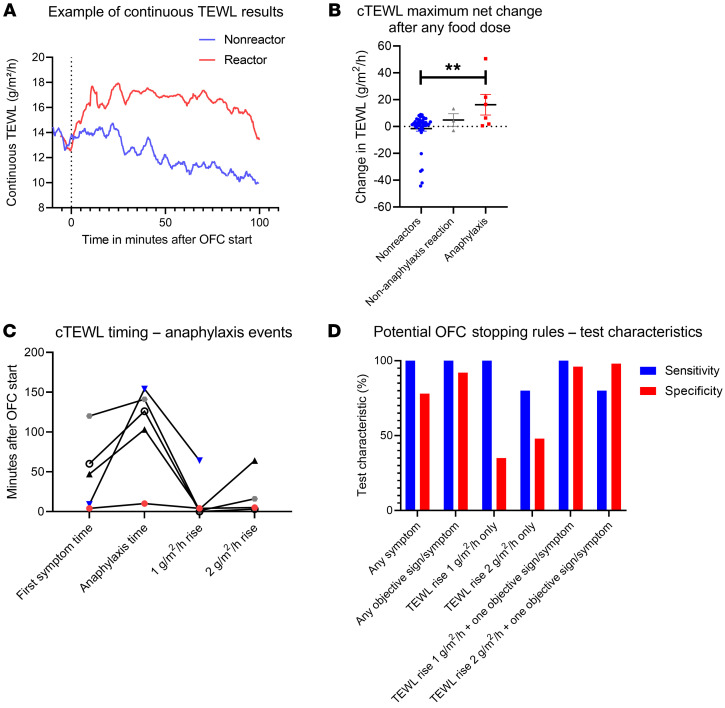
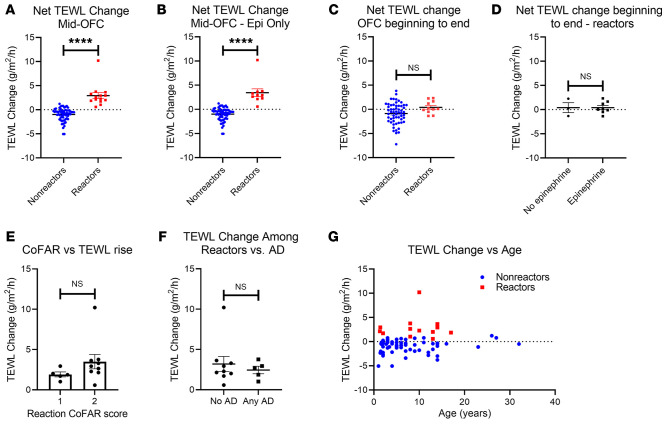
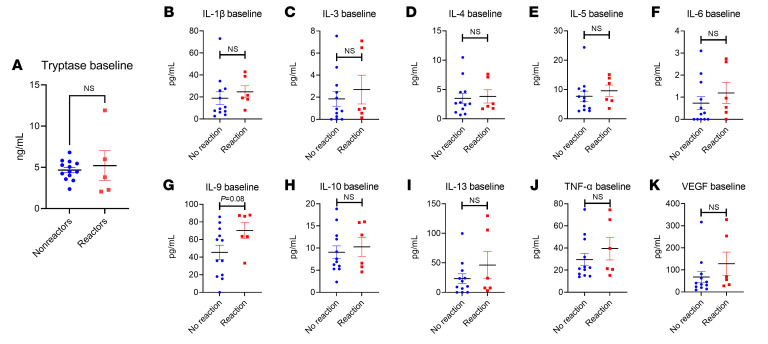
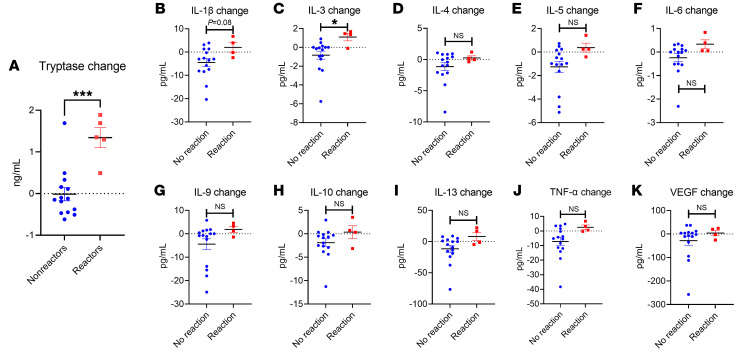
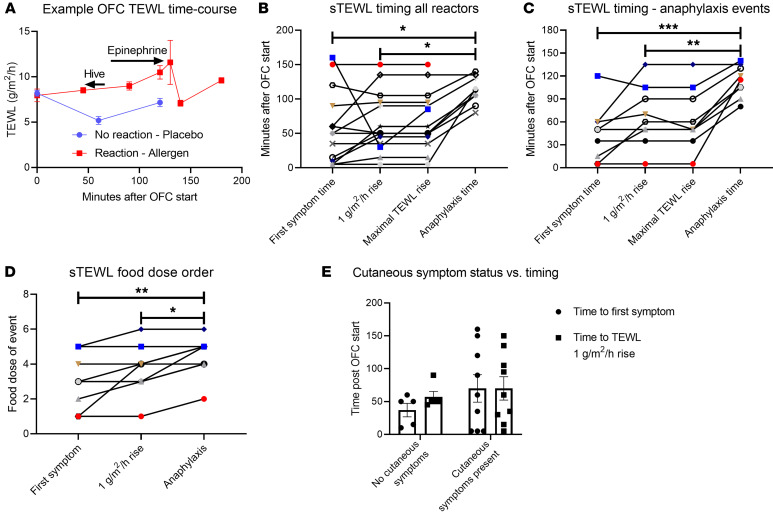
BACKGROUNDFood allergy (FA) is a growing health problem requiring physiologic confirmation via the oral food challenge (OFC). Many OFCs result in clinical anaphylaxis, causing discomfort and risk while limiting OFC utility. Transepidermal water loss (TEWL) measurement provides a potential solution to detect food anaphylaxis in real time prior to clinical symptoms. We evaluated whether TEWL changes during an OFC could predict anaphylaxis onset.METHODSPhysicians and nurses blinded to the TEWL results conducted and adjudicated the results of all 209 OFCs in this study. A study coordinator measured TEWL throughout the OFC and had no input on the OFC conduct. TEWL was measured 2 ways in 2 separate groups. First, TEWL was measured using static, discrete measurements. Second, TEWL was measured using continuous monitoring. Participants who consented provided blood samples before and after the OFCs for biomarker analyses.RESULTSTEWL rose significantly (2.93 g/m2/h) during reactions and did not rise during nonreacting OFCs (-1.00 g/m2/h). Systemic increases in tryptase and IL-3 were also detected during reactions, providing supporting biochemical evidence of anaphylaxis. The TEWL rise occurred 48 minutes earlier than clinically evident anaphylaxis. Continuous monitoring detected a significant rise in TEWL that presaged positive OFCs, but no rise was seen in the OFCs that resulted in no reaction, providing high predictive specificity (96%) for anaphylaxis against nonreactions 38 minutes prior to anaphylaxis onset.CONCLUSIONSDuring OFCs, a TEWL rise anticipated a positive clinical challenge. TEWL presents a monitoring modality that may predict food anaphylaxis and facilitate improvements in OFC safety and tolerability.
食物过敏(FA)是一个日益严重的健康问题,需要通过口服食物挑战(OFC)进行生理确认。许多 OFC 导致临床过敏反应,在限制 OFC 实用性的同时引起不适和风险。经皮水分丢失(TEWL)测量提供了一种实时检测食物过敏的潜在方法,可在出现临床症状之前。我们评估了 OFC 过程中的 TEWL 变化是否可以预测过敏反应的发生。
医生和护士在不知道 TEWL 结果的情况下进行并裁定了这项研究中所有 209 次 OFC 的结果。一名研究协调员在整个 OFC 过程中测量 TEWL,并且对 OFC 的进行没有任何意见。TEWL 通过两种方式在两组中进行测量。首先,使用静态离散测量测量 TEWL。其次,使用连续监测测量 TEWL。同意的参与者在 OFC 前后提供血液样本进行生物标志物分析。
TEWL 在反应期间显着升高(2.93 g/m2/h),而在非反应性 OFC 中没有升高(-1.00 g/m2/h)。在反应过程中还检测到血清素和 IL-3 的系统性增加,为过敏反应提供了支持的生化证据。TEWL 升高比临床明显的过敏反应早 48 分钟。连续监测检测到 TEWL 的显着升高,预示着阳性 OFC,但在没有反应的 OFC 中没有看到升高,在过敏反应发作前 38 分钟对过敏反应具有高预测特异性(96%)。
在 OFC 过程中,TEWL 升高预示着阳性临床挑战。TEWL 提供了一种监测方式,可预测食物过敏并改善 OFC 的安全性和耐受性。