Li Lan, Zhang Xue-Yuan, Yu Jin-Sheng, Zhou Hui-Min, Qin Yan, Xie Wen-Rui, Ding Wen-Jing, He Xing-Xiang
Department of Gastroenterology, The First Affiliated Hospital of Guangdong Pharmaceutical University, Guangzhou 510080, Guangdong Province, China.
Washing Microbiota Transplantation, Engineering Techniques of Microbiota-Targeted Therapies of Guangdong Province, Guangzhou 510080, Guangdong Province, China.
World J Gastrointest Surg. 2023 Jun 27;15(6):1138-1148. doi: 10.4240/wjgs.v15.i6.1138.
While colorectal polyps are not cancerous, some types of polyps, known as adenomas, can develop into colorectal cancer over time. Polyps can often be found and removed by colonoscopy; however, this is an invasive and expensive test. Thus, there is a need for new methods of screening patients at high risk of developing polyps.
To identify a potential association between colorectal polyps and small intestine bacteria overgrowth (SIBO) or other relevant factors in a patient cohort with lactulose breath test (LBT) results.
A total of 382 patients who had received an LBT were classified into polyp and non-polyp groups that were confirmed by colonoscopy and pathology. SIBO was diagnosed by measuring LBT-derived hydrogen (H) and methane (M) levels according to 2017 North American Consensus recommendations. Logistic regression was used to assess the ability of LBT to predict colorectal polyps. Intestinal barrier function damage (IBFD) was determined by blood assays.
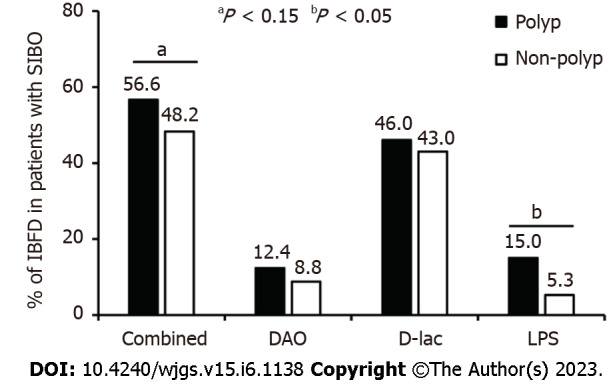
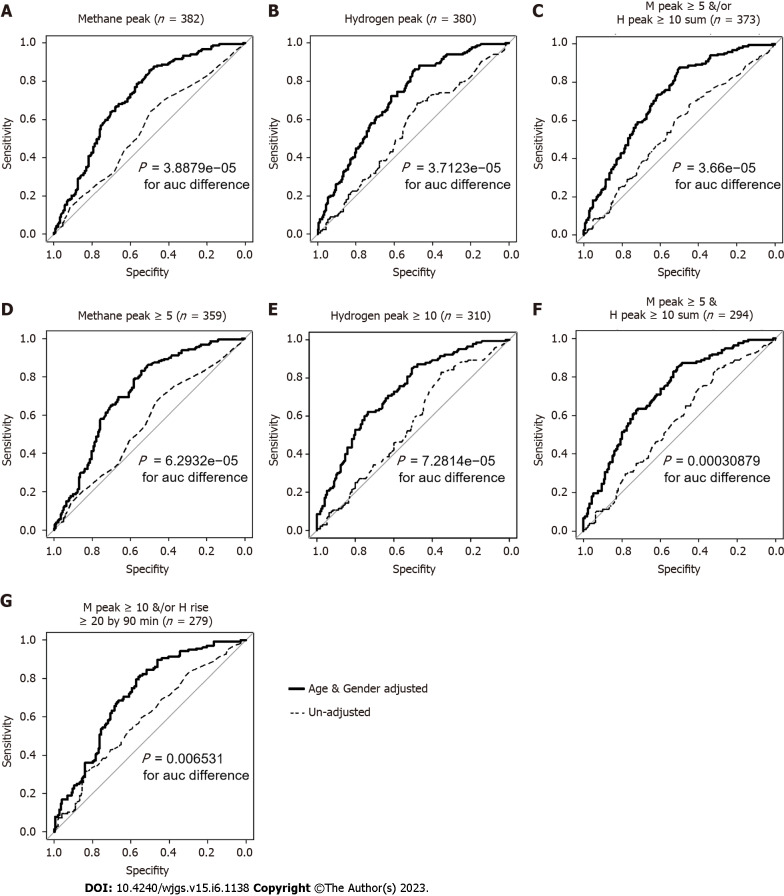
H and M levels revealed that the prevalence of SIBO was significantly higher in the polyp group than in the non-polyp group (41% 23%, < 0.01; 71% 59%, < 0.05, respectively). Within 90 min of lactulose ingestion, the peak H values in the adenomatous and inflammatory/hyperplastic polyp patients were significantly higher than those in the non-polyp group ( < 0.01, and = 0.03, respectively). In 227 patients with SIBO defined by combining H and M values, the rate of IBFD determined by blood lipopolysaccharide levels was significantly higher among patients with polyps than those without (15% 5%, < 0.05). In regression analysis with age and gender adjustment, colorectal polyps were most accurately predicted with models using M peak values or combined H and M values limited by North American Consensus recommendations for SIBO. These models had a sensitivity of ≥ 0.67, a specificity of ≥ 0.64, and an accuracy of ≥ 0.66.
The current study made key associations among colorectal polyps, SIBO, and IBFD and demonstrated that LBT has moderate potential as an alternative noninvasive screening tool for colorectal polyps.
虽然结肠息肉不是癌性的,但某些类型的息肉,即腺瘤,随着时间的推移可能发展为结直肠癌。息肉通常可以通过结肠镜检查发现并切除;然而,这是一种侵入性且昂贵的检查。因此,需要新的方法来筛查息肉发生风险高的患者。
在一组有乳果糖呼气试验(LBT)结果的患者队列中,确定结肠息肉与小肠细菌过度生长(SIBO)或其他相关因素之间的潜在关联。
总共382例接受LBT的患者根据结肠镜检查和病理结果分为息肉组和非息肉组。根据2017年北美共识建议,通过测量LBT衍生的氢气(H)和甲烷(M)水平来诊断SIBO。使用逻辑回归评估LBT预测结肠息肉的能力。通过血液检测确定肠道屏障功能损害(IBFD)。
H和M水平显示,息肉组中SIBO的患病率显著高于非息肉组(分别为41%对23%,P<0.01;71%对59%,P<0.05)。在摄入乳果糖的90分钟内,腺瘤性息肉和炎症性/增生性息肉患者的H峰值显著高于非息肉组(分别为P<0.01和P=0.03)。在227例通过结合H和M值定义为SIBO的患者中,息肉患者中由血脂多糖水平确定的IBFD发生率显著高于无息肉患者(15%对5%,P<0.05)。在调整年龄和性别的回归分析中,使用M峰值或结合北美SIBO共识建议限制的H和M值的模型对结肠息肉的预测最为准确。这些模型的敏感性≥0.67,特异性≥0.64,准确性≥0.66。
本研究确定了结肠息肉、SIBO和IBFD之间的关键关联,并证明LBT作为结肠息肉的替代非侵入性筛查工具具有中等潜力。