Department of Restorative Dentistry, University Hospitals Bristol and Weston Foundation Trust, Bristol Dental Hospital, Lower Maudlin Street, Bristol, BS1 2LY, UK.
Department of Oral and Maxillofacial Surgery, Universtitair Medisch Centrum Gronigen, Groningen, The Netherlands.
Int J Implant Dent. 2023 Jul 5;9(1):21. doi: 10.1186/s40729-023-00479-x.
The purpose of this study was to perform a systematic review with meta-analysis on the long-term survival rates of zygomatic implants (ZI). ZI success, prostheses survival and success, sinus pathology and patient reported outcomes were also investigated.
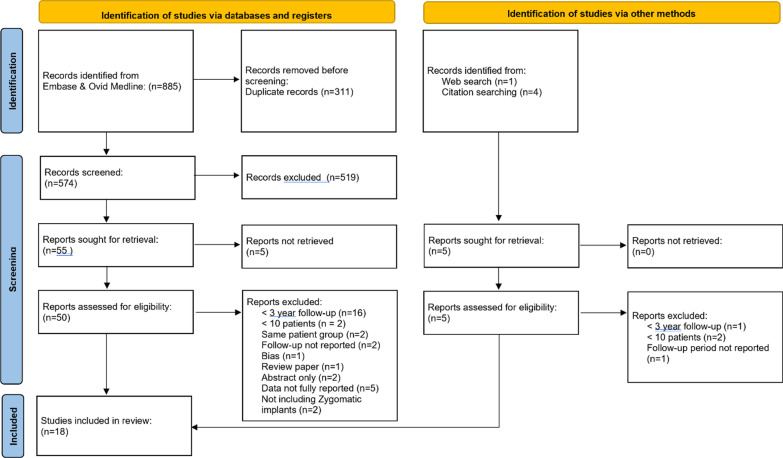
Preferred Reporting Items for Systematic Review and Meta-Analyses (PRISMA) guidelines were followed. Embase and OvidMedline databases were searched alongside the grey literature. The systematic review was recorded in PROSPERO (CRD42022358024). Studies reporting titanium/titanium alloy ZI survival data, ZI-supported prosthesis data, ZIs directly compared to any other implant therapy including grafted sites, a minimum follow-up time of 3 years and a minimum number of 10 patients were included. All study designs were considered if they met the inclusion criteria. Studies not involving ZIs, ZIs not made from titanium/titanium alloy, a follow-up time of < 3 years or < 10 patients, animal studies and in vitro studies were excluded. Long-term follow-up has not been defined in the literature. A minimum of 3 years follow-up was considered acceptable to capture survival after initial healing, alongside in-function prosthesis data via delayed or immediate load protocols. ZI success, was predominantly defined as ZI survival without biological or neurological complications. Meta-analyses were performed for ZI survival, ZI failure incidence, ZI success, loading protocol, prosthesis survival, and prevalence of sinusitis using random effects models. Descriptive analysis was used for ZI success, prosthesis success and patient reported outcome measures.
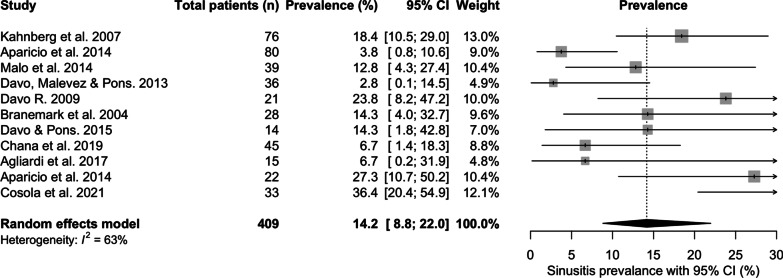
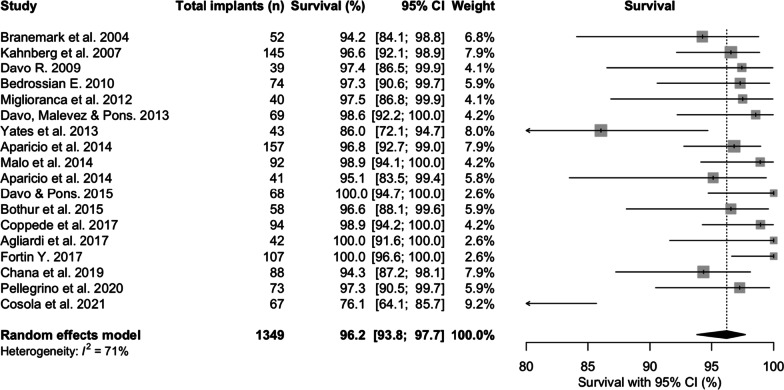
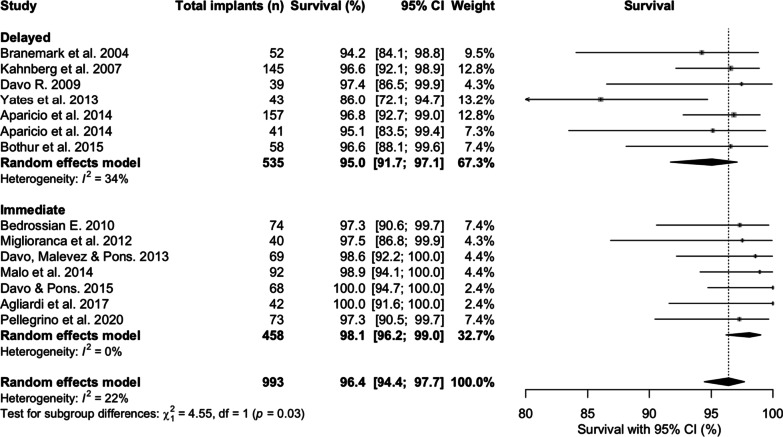
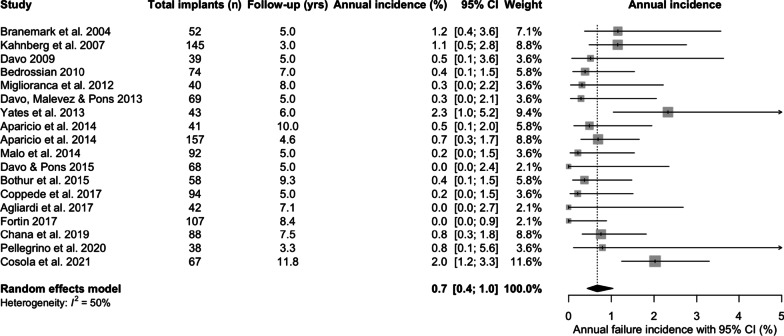
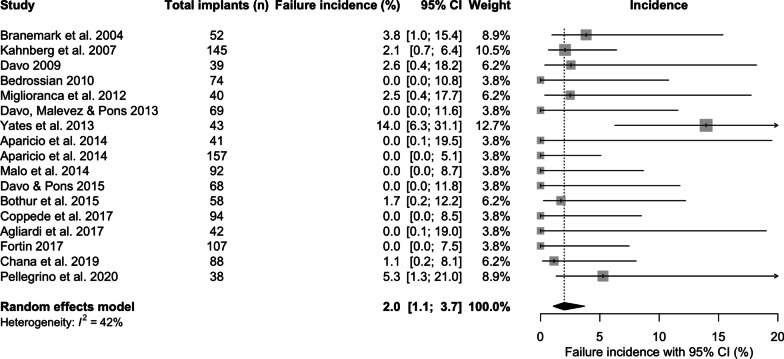
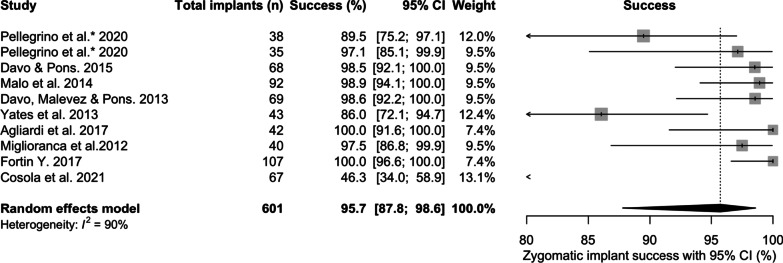
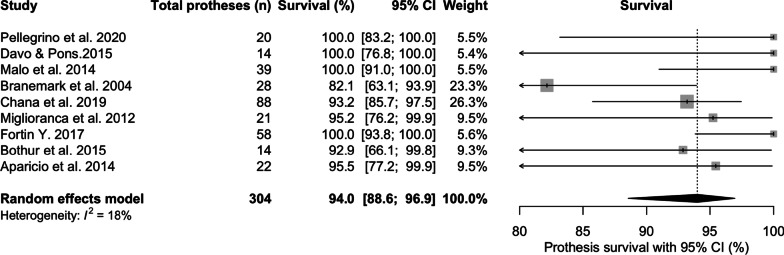
Five hundred and seventy-four titles were identified, of which 18 met the inclusion criteria. Eligible studies included 1349 ZIs in 623 patients. Mean follow-up period was 75.4 months (range 36-141.6). The mean survival of ZIs was 96.2% [95% CI: 93.8; 97.7] at 6 years. Mean survival for delayed loading was 95% [95% CI: 91.7; 97.1] and 98.1% [95% CI: 96.2; 99.0] for immediate loading (p = 0.03). Annual incidence rate of ZI failure was 0.7% [95% CI 0.4; 1.0]. Mean ZI success was 95.7% [95% CI 87.8; 98.6]. Mean prosthesis survival was 94% [95% CI 88.6; 96.9]. Sinusitis prevalence was 14.2% [95% CI 8.8; 22.0] at 5 years. Patients' reported increased satisfaction with ZIs.
ZIs have long-term survival comparable to conventional implants. Immediate loading showed a statistically significant increase in survival over delayed loading. Prosthesis survival was similar to that of prostheses supported by conventional implants, with similar complications. Sinusitis was the most frequently encountered biological complication. Patients reported improved outcome measures with ZI use.
本研究旨在对颧骨种植体(ZI)的长期存活率进行系统评价和荟萃分析。还调查了 ZI 成功率、修复体存活率和成功率、窦病理和患者报告的结果。
遵循系统评价和荟萃分析的首选报告项目(PRISMA)指南。搜索了 Embase 和 OvidMedline 数据库以及灰色文献。系统评价记录在 PROSPERO(CRD42022358024)中。纳入报告钛/钛合金 ZI 存活率数据、ZI 支持修复体数据、ZI 与任何其他植入物治疗(包括移植物部位)直接比较的研究,随访时间至少 3 年,至少有 10 例患者。如果符合纳入标准,所有研究设计均被考虑。不涉及 ZI、ZI 不是由钛/钛合金制成、随访时间<3 年或<10 例患者、动物研究和体外研究的研究被排除在外。文献中未定义长期随访。考虑到在初始愈合后捕获存活率,以及通过延迟或即刻负载方案的功能修复体数据,至少 3 年的随访被认为是可以接受的。ZI 成功率主要定义为 ZI 存活,无生物学或神经并发症。使用随机效应模型对 ZI 存活率、ZI 失败发生率、ZI 成功率、加载方案、修复体存活率和窦炎患病率进行荟萃分析。使用描述性分析对 ZI 成功率、修复体成功率和患者报告的结果进行分析。
共确定了 574 个标题,其中 18 个符合纳入标准。合格研究包括 623 名患者的 1349 个 ZI。平均随访时间为 75.4 个月(范围 36-141.6)。ZI 的平均存活率为 6 年时为 96.2%[95%CI:93.8;97.7]。延迟加载的平均存活率为 95%[95%CI:91.7;97.1],即刻加载的平均存活率为 98.1%[95%CI:96.2;99.0](p=0.03)。ZI 失败的年发生率为 0.7%[95%CI 0.4;1.0]。ZI 的平均成功率为 95.7%[95%CI 87.8;98.6]。修复体的平均存活率为 94%[95%CI 88.6;96.9]。窦炎的患病率为 5 年时为 14.2%[95%CI 8.8;22.0]。患者报告对 ZI 的满意度增加。
ZI 的长期存活率与传统植入物相当。即刻加载在存活率方面显示出与延迟加载相比具有统计学意义的显著提高。修复体存活率与传统植入物支持的修复体相似,具有相似的并发症。窦炎是最常见的生物学并发症。患者报告使用 ZI 后改善了结果指标。