Department of Chemistry, Emory University, Atlanta, Georgia 30322, United States.
Wallace H. Coulter Department of Biomedical Engineering, Georgia Institute of Technology and Emory University, Atlanta, Georgia 30322, United States.
ACS Appl Mater Interfaces. 2023 Jul 19;15(28):33362-33372. doi: 10.1021/acsami.3c04826. Epub 2023 Jul 6.
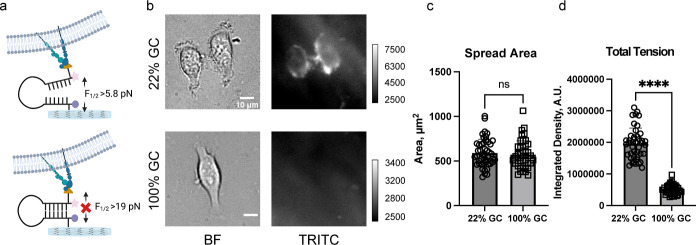
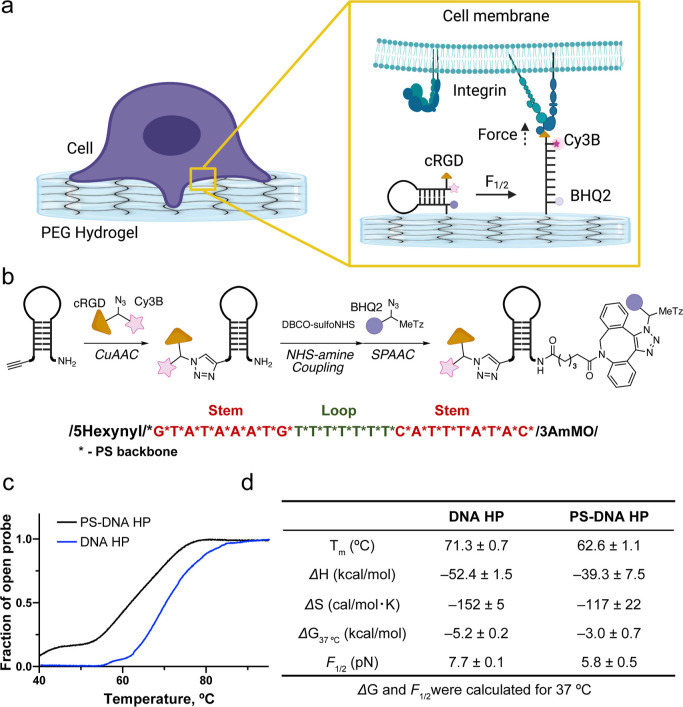
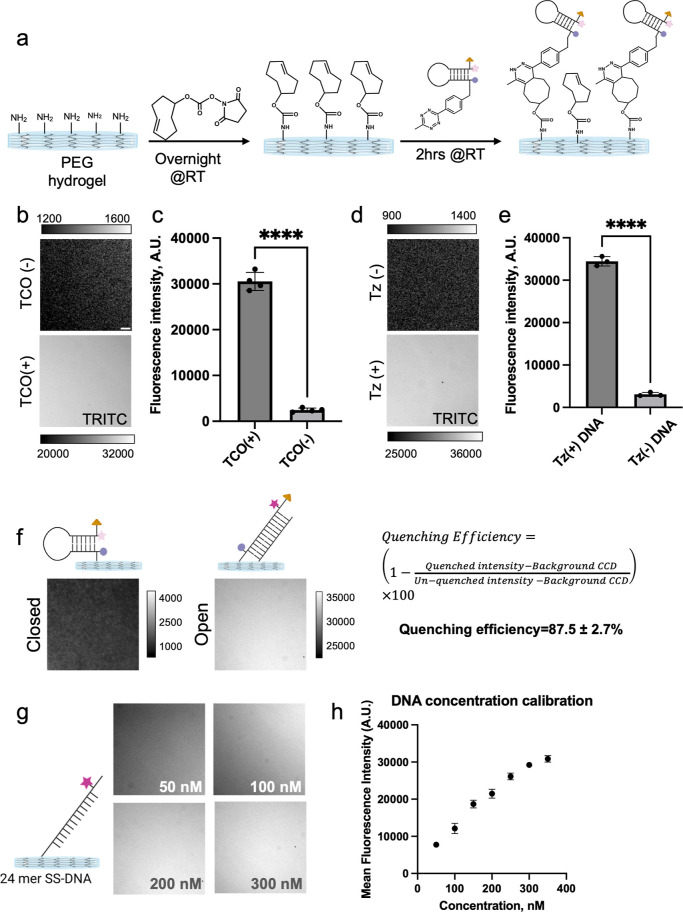
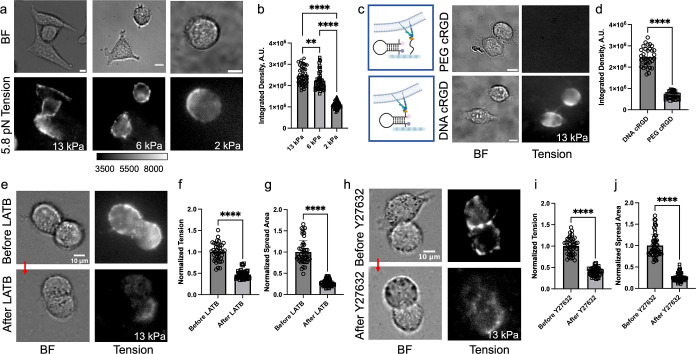
Cells sense and respond to the physical properties of their environment through receptor-mediated signaling, a process known as mechanotransduction, which can modulate critical cellular functions such as proliferation, differentiation, and survival. At the molecular level, cell adhesion receptors, such as integrins, transmit piconewton (pN)-scale forces to the extracellular matrix, and the magnitude of the force plays a critical role in cell signaling. The most sensitive approach to measuring integrin forces involves DNA hairpin-based sensors, which are used to quantify and map forces in living cells. Despite the broad use of DNA hairpin sensors to study a variety of mechanotransduction processes, these sensors are typically anchored to rigid glass slides, which are orders of magnitude stiffer than the extracellular matrix and hence modulate native biological responses. Here, we have developed nuclease-resistant DNA hairpin probes that are all covalently tethered to PEG hydrogels to image cell traction forces on physiologically relevant substrate stiffness. Using HeLa cells as a model cell line, we show that the molecular forces transmitted by integrins are highly sensitive to the bulk modulus of the substrate, and cells cultured on the 6 and 13 kPa gels produced a greater number of hairpin unfolding events compared to the 2 kPa substrates. Tension signals are spatially colocalized with pY118-paxillin, confirming focal adhesion-mediated probe opening. Additionally, we found that integrin forces are greater than 5.8 pN but less than 19 pN on 13 kPa gels. This work provides a general strategy to integrate molecular tension probes into hydrogels, which can better mimic in vivo mechanotransduction.
细胞通过受体介导的信号转导感知和响应其环境的物理特性,这个过程被称为力学转导,它可以调节细胞的关键功能,如增殖、分化和存活。在分子水平上,细胞黏附受体,如整合素,将皮牛顿(pN)级别的力传递到细胞外基质,力的大小在细胞信号转导中起着关键作用。测量整合素力最敏感的方法涉及基于 DNA 发夹的传感器,该传感器用于量化和绘制活细胞中的力。尽管 DNA 发夹传感器被广泛用于研究各种力学转导过程,但这些传感器通常被锚定在刚性玻璃载玻片上,其刚性比细胞外基质高出几个数量级,因此会调节细胞的固有生物学反应。在这里,我们开发了耐核酸酶的 DNA 发夹探针,这些探针都共价连接到 PEG 水凝胶上,以在生理相关的基质硬度上成像细胞牵引力。使用 HeLa 细胞作为模型细胞系,我们表明整合素传递的分子力对基质的体积模量高度敏感,与 2 kPa 基质相比,在 6 和 13 kPa 凝胶上培养的细胞产生了更多的发夹展开事件。张力信号与 pY118-桩蛋白在空间上共定位,证实了粘着斑介导的探针打开。此外,我们发现整合素力在 13 kPa 凝胶上大于 5.8 pN 但小于 19 pN。这项工作提供了一种将分子张力探针整合到水凝胶中的通用策略,这可以更好地模拟体内力学转导。