Lee Evan M, Verma Megha, Palaniappan Nila, Pope Emiko M, Lee Sammie, Blacher Lindsey, Neerumalla Pooja, An William, Campbell Toko, Brown Cris, Hurst Stacy, Marshall Bess, Hershey Tamara, Nunes Virginia, López de Heredia Miguel, Urano Fumihiko
Division of Endocrinology and Lipid Research, Department of Medicine, Washington University School of Medicine, St. Louis, MO, United States.
Department of Pathology and Immunology, Washington University School of Medicine, St. Louis, MO, United States.
Front Genet. 2023 Jun 21;14:1198171. doi: 10.3389/fgene.2023.1198171. eCollection 2023.
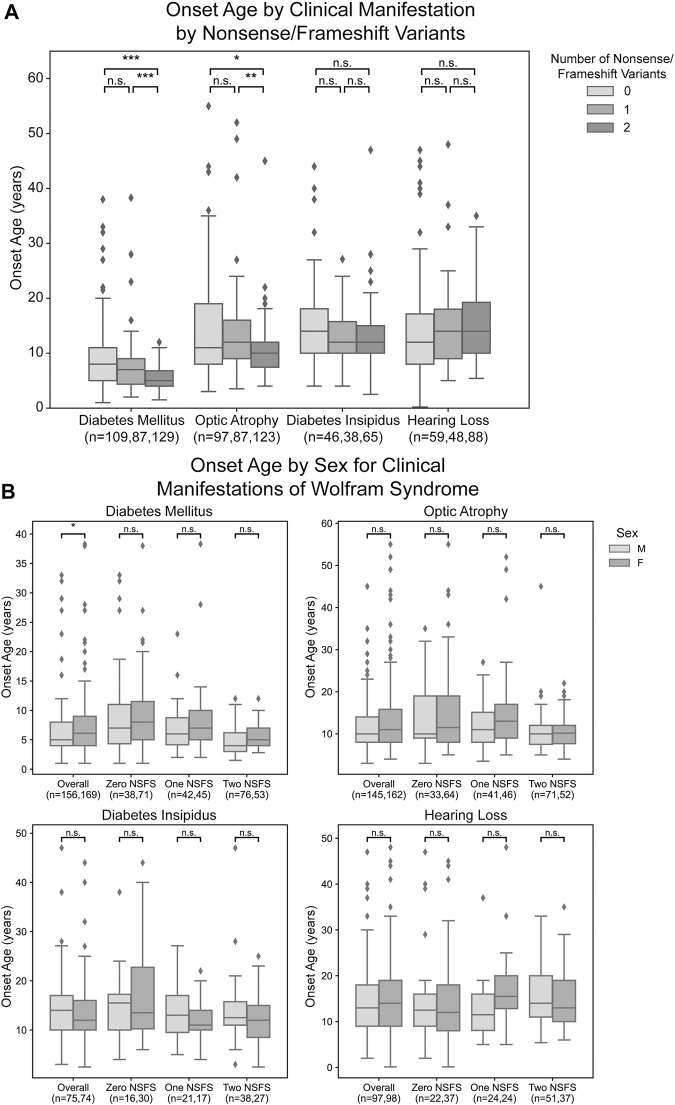
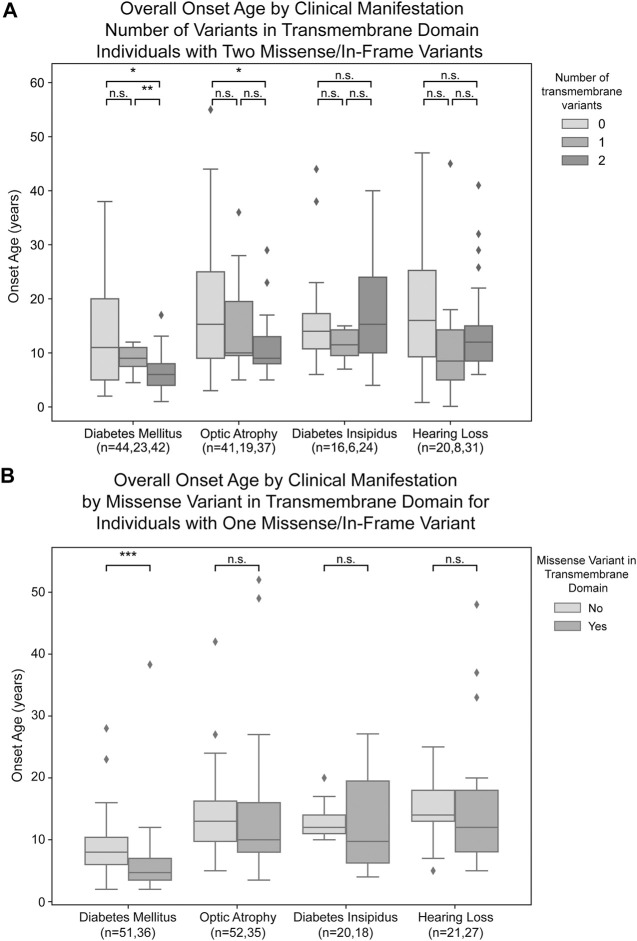
Wolfram syndrome (WFS) is an autosomal recessive disorder associated with juvenile-onset diabetes mellitus, optic atrophy, diabetes insipidus, and sensorineural hearing loss. We sought to elucidate the relationship between genotypic and phenotypic presentations of Wolfram syndrome which would assist clinicians in classifying the severity and prognosis of Wolfram syndrome more accurately. Patient data from the Washington University International Registry and Clinical Study for Wolfram Syndrome and patient case reports were analyzed to select for patients with two recessive mutations in the WFS1 gene. Mutations were classified as being either nonsense/frameshift variants or missense/in-frame insertion/deletion variants. Missense/in-frame variants were further classified as transmembrane or non-transmembrane based on whether they affected amino acid residues predicted to be in transmembrane domains of WFS1. Statistical analysis was performed using Wilcoxon rank-sum tests with multiple test adjustment applied via the Bonferonni correction. A greater number of genotype variants correlated with earlier onset and a more severe presentation of Wolfram syndrome. Secondly, non-sense and frameshift variants had more severe phenotypic presentations than missense variants, as evidenced by diabetes mellitus and optic atrophy emerging significantly earlier in patients with two nonsense/frameshift variants compared with zero or one nonsense/frameshift variants. In addition, the number of transmembrane in-frame variants demonstrated a statistically significant dose-effect on age of onset of diabetes mellitus and optic atrophy among patients with either one or two in-frame variants. The results contribute to our current understanding of the genotype-phenotype relationship of Wolfram syndrome, suggesting that alterations in coding sequences result in significant changes in the presentation and severity of Wolfram. The impact of these findings is significant, as the results will aid clinicians in predicting more accurate prognoses and pave the way for personalized treatments for Wolfram syndrome.
沃夫勒姆综合征(WFS)是一种常染色体隐性疾病,与青少年期发病的糖尿病、视神经萎缩、尿崩症和感音神经性听力损失相关。我们试图阐明沃夫勒姆综合征基因型与表型之间的关系,这将有助于临床医生更准确地对沃夫勒姆综合征的严重程度和预后进行分类。对来自华盛顿大学沃夫勒姆综合征国际登记处和临床研究的患者数据以及患者病例报告进行分析,以筛选出WFS1基因有两个隐性突变的患者。突变被分类为无义/移码变体或错义/框内插入/缺失变体。错义/框内变体根据其是否影响预测位于WFS1跨膜结构域的氨基酸残基进一步分类为跨膜或非跨膜变体。使用Wilcoxon秩和检验进行统计分析,并通过Bonferonni校正进行多重检验调整。更多的基因型变体与沃夫勒姆综合征更早发病和更严重的表现相关。其次,无义变体和移码变体的表型表现比错义变体更严重,这在患有两个无义/移码变体的患者中糖尿病和视神经萎缩出现的时间明显早于无或有一个无义/移码变体的患者中得到证明。此外,对于有一个或两个框内变体的患者,跨膜框内变体的数量对糖尿病和视神经萎缩的发病年龄显示出统计学上显著的剂量效应。这些结果有助于我们目前对沃夫勒姆综合征基因型-表型关系的理解,表明编码序列的改变会导致沃夫勒姆综合征的表现和严重程度发生显著变化。这些发现的影响重大,因为结果将帮助临床医生预测更准确的预后,并为沃夫勒姆综合征的个性化治疗铺平道路。