Ji Wenye, Chang Jin, Xu He-Xiu, Gao Jian Rong, Gröblacher Simon, Urbach H Paul, Adam Aurèle J L
Department of Imaging Physics, Delft University of Technology, Lorentzweg 1, 2628 CJ, Delft, The Netherlands.
Department of Quantum Nanoscience, Delft University of Technology, Lorentzweg 1, 2628 CJ, Delft, The Netherlands.
Light Sci Appl. 2023 Jul 7;12(1):169. doi: 10.1038/s41377-023-01218-y.
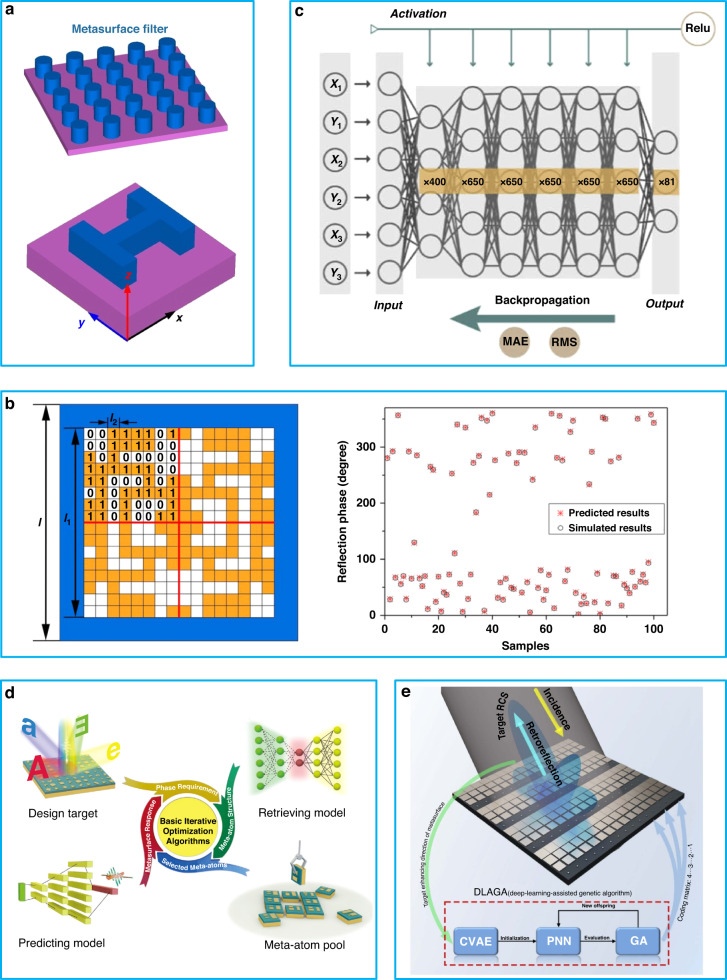
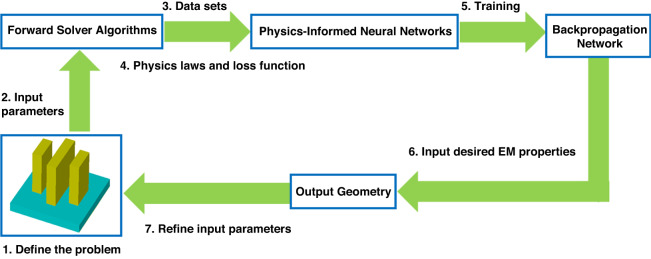
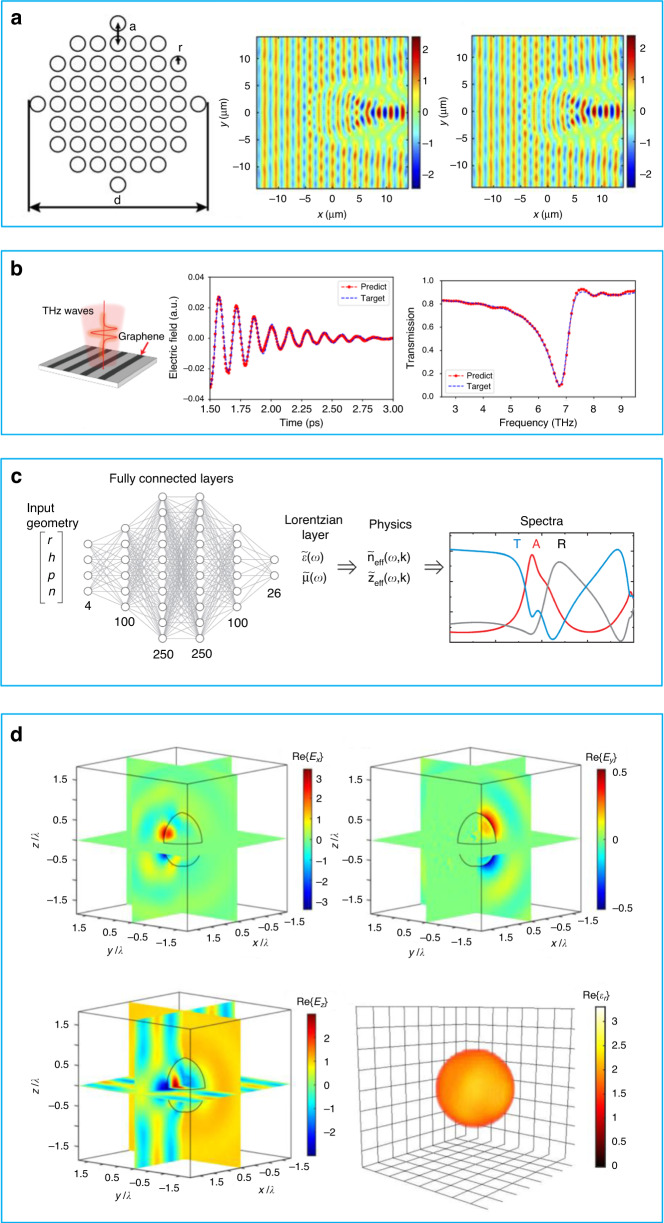
As a two-dimensional planar material with low depth profile, a metasurface can generate non-classical phase distributions for the transmitted and reflected electromagnetic waves at its interface. Thus, it offers more flexibility to control the wave front. A traditional metasurface design process mainly adopts the forward prediction algorithm, such as Finite Difference Time Domain, combined with manual parameter optimization. However, such methods are time-consuming, and it is difficult to keep the practical meta-atom spectrum being consistent with the ideal one. In addition, since the periodic boundary condition is used in the meta-atom design process, while the aperiodic condition is used in the array simulation, the coupling between neighboring meta-atoms leads to inevitable inaccuracy. In this review, representative intelligent methods for metasurface design are introduced and discussed, including machine learning, physics-information neural network, and topology optimization method. We elaborate on the principle of each approach, analyze their advantages and limitations, and discuss their potential applications. We also summarize recent advances in enabled metasurfaces for quantum optics applications. In short, this paper highlights a promising direction for intelligent metasurface designs and applications for future quantum optics research and serves as an up-to-date reference for researchers in the metasurface and metamaterial fields.
作为一种具有低深度轮廓的二维平面材料,超表面可以在其界面处为透射和反射的电磁波生成非经典相位分布。因此,它为控制波前提供了更大的灵活性。传统的超表面设计过程主要采用正向预测算法,如时域有限差分法,并结合手动参数优化。然而,这些方法耗时且难以使实际的超原子光谱与理想光谱保持一致。此外,由于在超原子设计过程中使用了周期性边界条件,而在阵列模拟中使用了非周期性条件,相邻超原子之间的耦合导致了不可避免的不准确性。在这篇综述中,介绍并讨论了超表面设计的代表性智能方法,包括机器学习、物理信息神经网络和拓扑优化方法。我们详细阐述了每种方法的原理,分析了它们的优缺点,并讨论了它们的潜在应用。我们还总结了用于量子光学应用的超表面的最新进展。简而言之,本文突出了智能超表面设计和应用在未来量子光学研究中的一个有前景的方向,并为超表面和超材料领域的研究人员提供了最新的参考。