Preventive Cardiology and Preventive Medicine, Department of Cardiology, University Medical Center of the Johannes Gutenberg University Mainz, Langenbeckstr. 1, 55131, Mainz, Germany.
German Center for Cardiovascular Research (DZHK), Partner Site Rhine-Main, Mainz, Germany.
Clin Res Cardiol. 2024 Sep;113(9):1317-1330. doi: 10.1007/s00392-023-02248-7. Epub 2023 Jul 9.
To establish reference values and clinically relevant determinants for measures of heart rate variability (HRV) and to assess their relevance for clinical outcome prediction in individuals with heart failure.
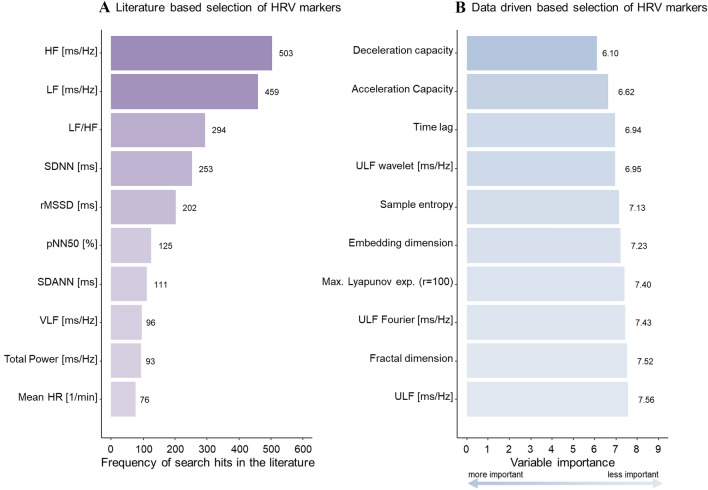
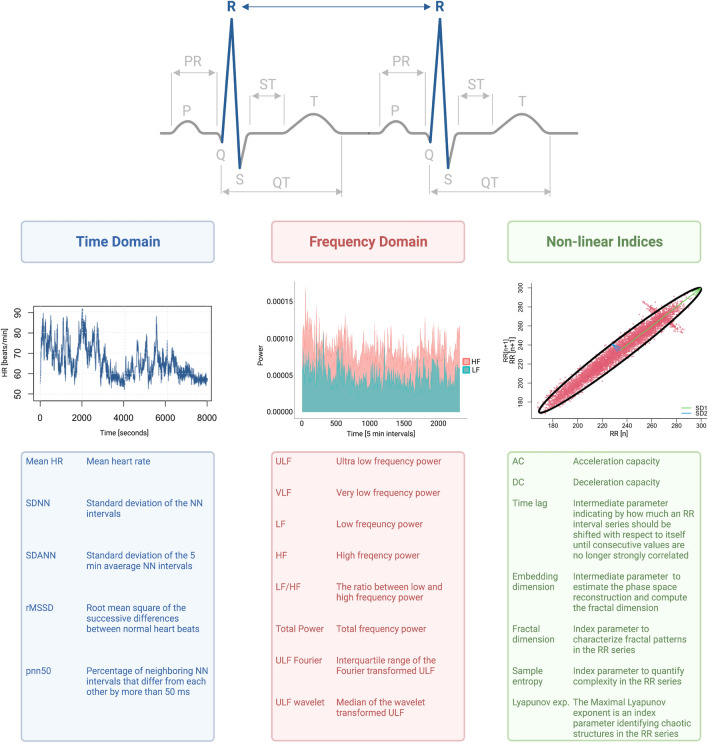
Data from the MyoVasc study (NCT04064450; N = 3289), a prospective cohort on chronic heart failure with a highly standardized, 5 h examination, and Holter ECG recording were investigated. HRV markers were selected using a systematic literature screen and a data-driven approach. Reference values were determined from a healthy subsample. Clinical determinants of HRV were investigated via multivariable linear regression analyses, while their relationship with mortality was investigated by multivariable Cox regression analyses.
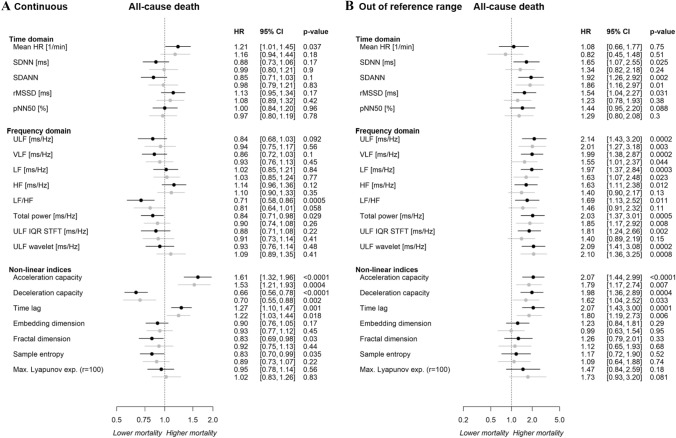
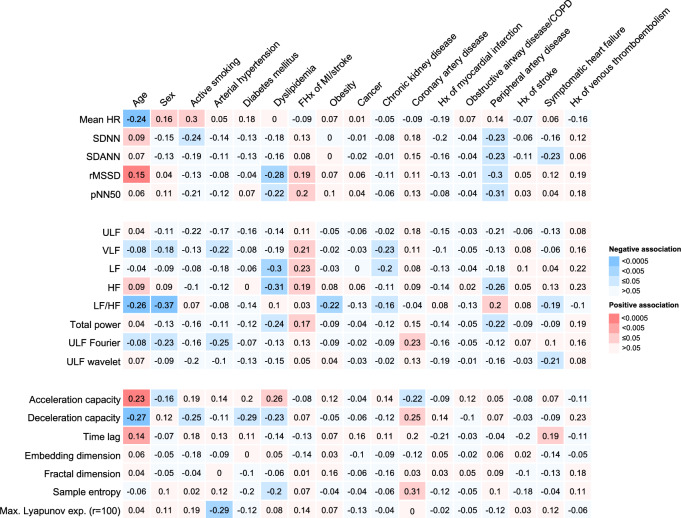
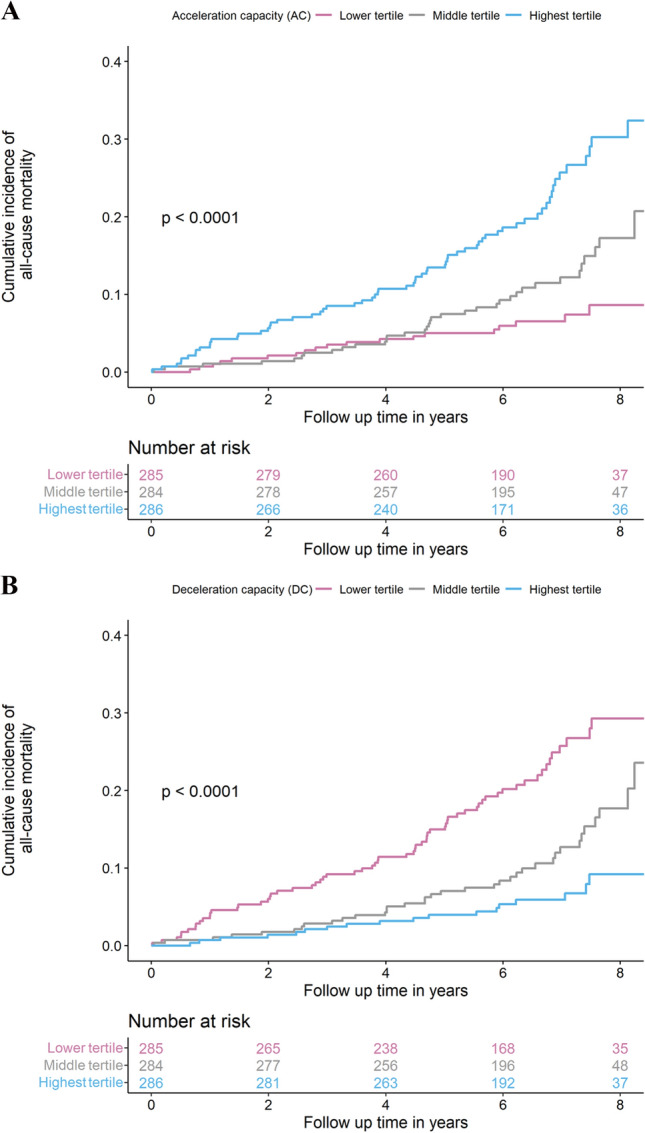
Holter ECG recordings were available for analysis in 1001 study participants (mean age 64.5 ± 10.5 years; female sex 35.4%). While the most frequently reported HRV markers in literature were from time and frequency domains, the data-driven approach revealed predominantly non-linear HRV measures. Age, sex, dyslipidemia, family history of myocardial infarction or stroke, peripheral artery disease, and heart failure were strongly related to HRV in multivariable models. In a follow-up period of 6.5 years, acceleration capacity [HR 1.53 (95% CI 1.21/1.93), p = 0.0004], deceleration capacity [HR: 0.70 (95% CI 0.55/0.88), p = 0.002], and time lag [HR 1.22 (95% CI 1.03/1.44), p = 0.018] were the strongest predictors of all-cause mortality in individuals with heart failure independently of cardiovascular risk factors, comorbidities, and medication.
HRV markers are associated with the cardiovascular clinical profile and are strong and independent predictors of survival in heart failure. This underscores clinical relevance and interventional potential for individuals with heart failure.
NCT04064450.
建立心率变异性(HRV)测量指标的参考值和临床相关决定因素,并评估其在心力衰竭患者临床预后预测中的相关性。
对 MyoVasc 研究(NCT04064450;N=3289)的数据进行了调查,该前瞻性队列研究纳入了慢性心力衰竭患者,进行了高度标准化的 5 小时检查和动态心电图记录。使用系统文献筛选和数据驱动方法选择 HRV 标志物。从健康亚组中确定参考值。通过多变量线性回归分析研究 HRV 的临床决定因素,通过多变量 Cox 回归分析研究其与死亡率的关系。
1001 名研究参与者的动态心电图记录可用于分析(平均年龄 64.5±10.5 岁;女性 35.4%)。虽然文献中报道的最常见 HRV 标志物来自时间和频率域,但数据驱动方法揭示了主要的非线性 HRV 测量指标。年龄、性别、血脂异常、心肌梗死或中风家族史、外周动脉疾病和心力衰竭在多变量模型中与 HRV 密切相关。在 6.5 年的随访期间,加速度能力[HR 1.53(95%CI 1.21/1.93),p=0.0004]、减速能力[HR:0.70(95%CI 0.55/0.88),p=0.002]和时滞[HR 1.22(95%CI 1.03/1.44),p=0.018]是心力衰竭患者全因死亡率的最强预测指标,独立于心血管危险因素、合并症和药物治疗。
HRV 标志物与心血管临床特征相关,是心力衰竭患者生存的强有力且独立的预测指标。这突出了心力衰竭患者的临床相关性和干预潜力。
NCT04064450。