Zhang Yongni, Ren Jiayi, Zang Yaning, Guo Wenhao, Disantis Ashley, Martin Robroy L
Rangos School of Health Sciences Duquesne- China Health Institute.
Shuguang Hospital of Shanghai University of Traditional Chinese Medicine.
Int J Sports Phys Ther. 2023 Jun 1;V18(3):653-686. doi: 10.26603/001c.74528. eCollection 2023.
A large number of patient reported outcome measures (PROMs) have been developed in the English language for various lower extremity orthopaedic pathologies. Twenty different PROMs were recommended for 15 specific musculoskeletal lower extremity pathologies or surgeries. However, the availability of cross-culturally adapted versions of these recommended PROMs is unknown.
The purpose of this study was to identify the cross-culturally adapted versions of recommended PROMs for individuals experiencing orthopedic lower extremity pathologies or undergoing surgeries, and to identify the psychometric evidence that supports their utilization.
Literature Review.
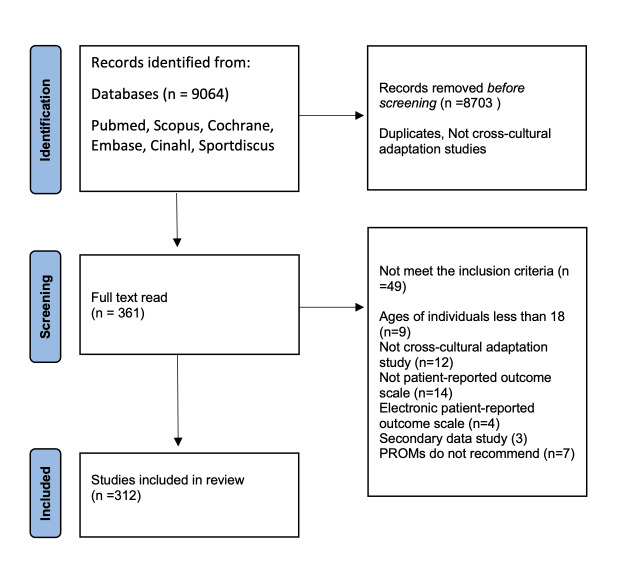
PubMed, Embase, Medline, Cochrane, CINAHL, SPORTDisucs and Scopus were searched for cross-culturally adapted translated studies through May 2022. The search strategy included the names of the 20 recommended PROMs from previous umbrella review along with the following terms: reliability, validity, responsiveness, psychometric properties and cross-cultural adaptation. Studies that presented a non-English language version of the PROM with evidence in at least one psychometric property to support its use were included. Two authors independently evaluated the studies for inclusion and independently extracted data.
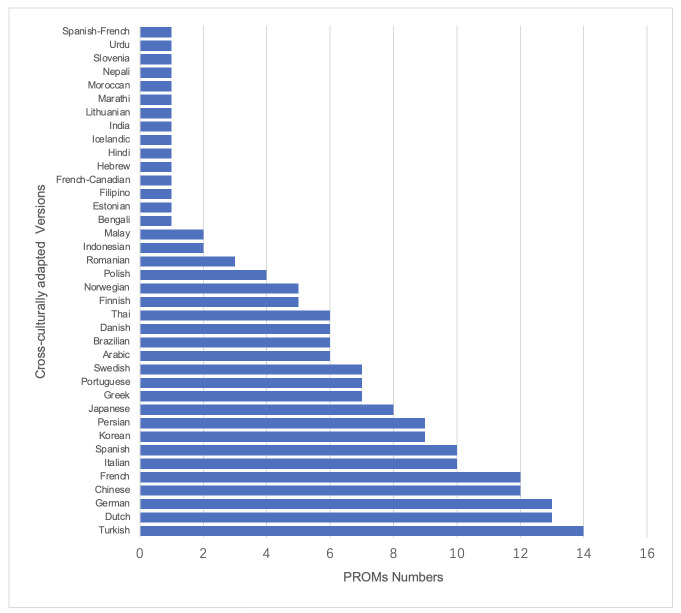
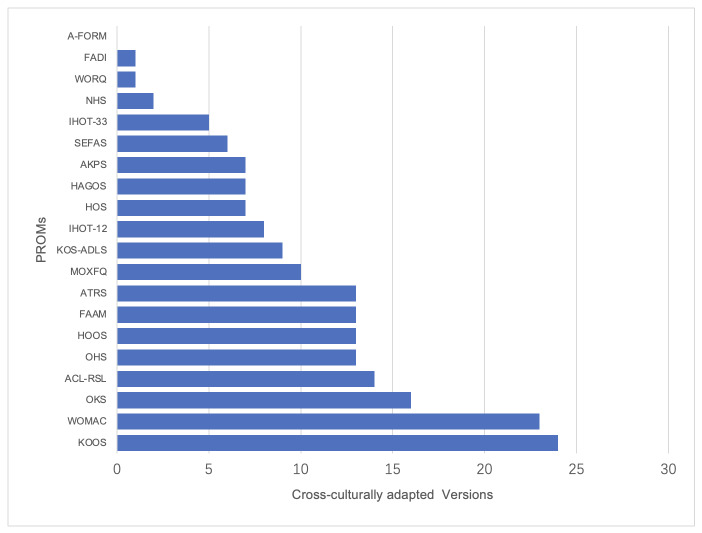
Nineteen PROMS had cross-culturally adapted and translated language versions. The KOOS, WOMAC, ACL-RSL, FAAM, ATRS, HOOS, OHS, MOXFQ and OKS were available in over 10 different language versions. Turkish, Dutch, German, Chinese and French were the most common languages, with each language having more than 10 PROMs with psychometric properties supporting their use. The WOMAC and KOOS were both available in 10 languages and had all three psychometric properties of reliability, validity, and responsiveness supporting their use.
Nineteen of the 20 recommended instruments were available in multiple languages. The PROM most frequently cross-culturally adapted and translated were the KOOS and WOMAC. PROMs were most frequently cross-culturally adapted and translated into Turkish. International researchers and clinicians may use this information to more consistently implement PROMs with the most appropriate psychometric evidence available to support their use.
3a.
针对各种下肢骨科疾病,已经开发了大量以英语表述的患者报告结局测量工具(PROMs)。针对15种特定的下肢肌肉骨骼疾病或手术推荐了20种不同的PROMs。然而,这些推荐的PROMs的跨文化适应版本的可用性尚不清楚。
本研究的目的是确定针对患有下肢骨科疾病或接受手术的个体的推荐PROMs的跨文化适应版本,并确定支持其使用的心理测量学证据。
文献综述。
检索了PubMed、Embase、Medline、Cochrane、CINAHL、SPORTDisucs和Scopus数据库,以查找截至2022年5月的跨文化适应翻译研究。检索策略包括先前综合评价中推荐的20种PROMs的名称以及以下术语:信度、效度、反应度、心理测量学特性和跨文化适应。纳入呈现PROM非英语版本且至少有一项心理测量学特性证据支持其使用的研究。两位作者独立评估纳入研究并独立提取数据。
19种PROMs有跨文化适应和翻译的语言版本。膝关节损伤和骨关节炎疗效评分(KOOS)、西安大略和麦克马斯特大学骨关节炎指数(WOMAC)、前交叉韧带康复评分(ACL-RSL)、功能活动评估量表(FAAM)、跟腱修复术后评分(ATRS)、髋关节损伤和骨关节炎疗效评分(HOOS)、全膝关节置换术后评分(OHS)、改良牛津足部问卷(MOXFQ)和牛津膝关节评分(OKS)有超过10种不同的语言版本。土耳其语、荷兰语、德语、中文和法语是最常见的语言,每种语言都有超过10种具有支持其使用的心理测量学特性的PROMs。WOMAC和KOOS均有10种语言版本,并且具有支持其使用的信度、效度和反应度这三种心理测量学特性。
20种推荐工具中有19种有多种语言版本。跨文化适应和翻译最频繁的PROMs是KOOS和WOMAC。PROMs最常被跨文化适应并翻译成土耳其语。国际研究人员和临床医生可以利用这些信息,更一致地应用具有最适当心理测量学证据支持其使用的PROMs。
3a。