Darnell Julia C, Lou Mimi, Goldstone Lisa W
College of Pharmacy, Western University of Health Sciences, Pomona, CA, United States.
Alfred E. Mann School of Pharmacy and Pharmaceutical Sciences, University of Southern California, Los Angeles, CA, United States.
JMIR Med Educ. 2023 Jul 10;9:e43313. doi: 10.2196/43313.
The use of technology in health care, often referred to as digital health, has expanded rapidly because of the need to provide remote care during the COVID-19 pandemic. In light of this rapid boom, it is clear that health care professionals need to be trained in these technologies in order to provide high-level care. Despite the growing number of technologies used across health care, digital health is not a commonly taught topic in health care curricula. Several pharmacy organizations have called attention to the need to teach digital health to student pharmacists; however, there is currently no consensus on best methods to do so.
The objective of this study was to determine if there was a significant change in student pharmacist scores on the Digital Health Familiarity, Attitudes, Comfort, and Knowledge Scale (DH-FACKS) after exposure to digital health topics in a yearlong discussion-based case conference series.
Student pharmacists' initial comfort, attitudes, and knowledge were gathered by a baseline DH-FACKS score at the beginning of the fall semester. Digital health concepts were integrated into a number of cases in the case conference course series throughout the academic year. The DH-FACKS was administered again to students after completion of the spring semester. Results were matched, scored, and analyzed to assess any difference in DH-FACKS scores.
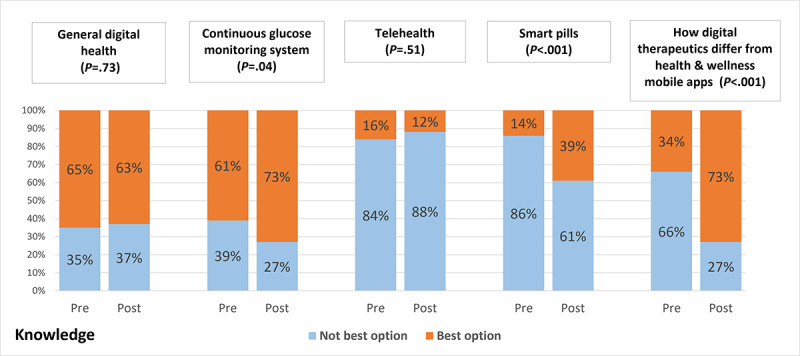
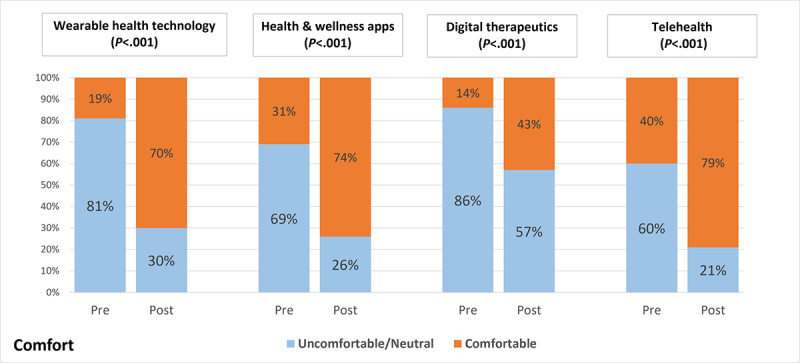
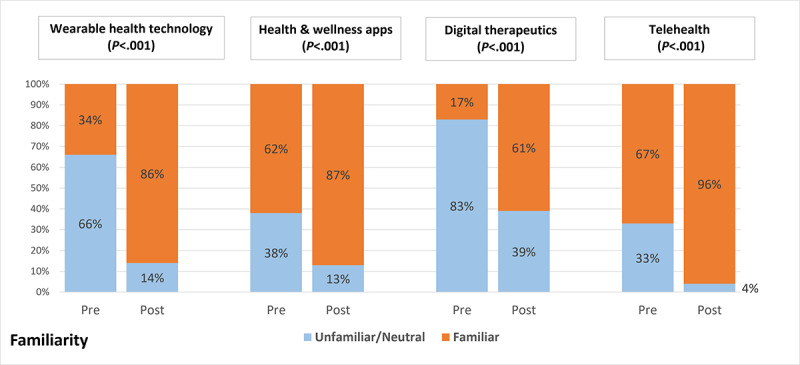
A total of 91 of 373 students completed both the pre- and postsurvey (response rate of 24%). Using a scale from 1 to 10, the mean student-reported knowledge of digital health increased from 4.5 (SD 2.5) before intervention to 6.6 (SD 1.6) after intervention (P<.001) and the mean self-reported comfort increased from 4.7 (SD 2.5) before intervention to 6.7 (SD 1.8) after intervention (P<.001). There was a significant increase in scores for all 4 elements of the DH-FACKS. The mean familiarity scores increased from 11.6 (SD 3.7) to 15.8 (SD 2.2), out of a maximum of 20 (P<.001). The mean attitudes scores increased from 15.6 (SD 2.1) to 16.5 (SD 1.9), out of a maximum of 20 (P=.001). The mean comfort scores increased from 10.1 (SD 3.9) to 14.8 (SD 3.1), out of a maximum of 20 (P<.001). The mean knowledge scores increased from 9.9 (SD 3.4) to 12.8 (SD 3.9), out of a maximum of 20 (P<.001).
Including digital health topics in a case conference series is an effective and approachable way of providing education on important digital health concepts to students. Students experienced an increase in familiarity, attitudes, comfort, and knowledge after the yearlong intervention. As case-based discussions are an important component of most pharmacy and other medical curricula, this method can be easily applied by other programs that wish to give their students practice applying their knowledge of digital health to complex case-based scenarios.
由于在新冠疫情期间需要提供远程护理,医疗保健领域对技术的应用(通常称为数字健康)迅速扩展。鉴于这种迅速发展的态势,显然医疗保健专业人员需要接受这些技术的培训,以便提供高水平的护理。尽管医疗保健领域使用的技术数量不断增加,但数字健康并非医疗保健课程中常见的教学主题。一些药学组织已呼吁关注向学生药剂师传授数字健康知识的必要性;然而,目前对于最佳教学方法尚无共识。
本研究的目的是确定在为期一年的基于讨论的病例会议系列中接触数字健康主题后,学生药剂师在数字健康熟悉度、态度、舒适度和知识量表(DH - FACKS)上的得分是否有显著变化。
在秋季学期开始时,通过基线DH - FACKS得分收集学生药剂师的初始舒适度、态度和知识。在整个学年的病例会议课程系列中,将数字健康概念融入多个病例中。在春季学期结束后,再次对学生进行DH - FACKS测试。对结果进行匹配、评分和分析,以评估DH - FACKS得分的任何差异。
373名学生中有91名完成了前后两次调查(回复率为24%)。使用1至10的评分标准,学生报告的数字健康知识平均得分从干预前的4.5(标准差2.5)提高到干预后的6.6(标准差1.6)(P <.001),自我报告的平均舒适度从干预前的4.7(标准差2.5)提高到干预后的6.7(标准差1.8)(P <.001)。DH - FACKS的所有4个要素得分均显著提高。熟悉度平均得分从11.6(标准差3.7)提高到15.8(标准差2.2),满分20分(P <.001)。态度平均得分从15.6(标准差2.1)提高到16.5(标准差1.9),满分20分(P =.001)。舒适度平均得分从10.1(标准差3.9)提高到14.8(标准差3.1),满分20分(P <.001)。知识平均得分从9.9(标准差3.4)提高到12.8(标准差3.9),满分20分(P <.001)。
在病例会议系列中纳入数字健康主题是向学生提供重要数字健康概念教育的有效且可行的方式。经过为期一年的干预,学生在熟悉度、态度、舒适度和知识方面都有所提高。由于基于病例的讨论是大多数药学和其他医学课程的重要组成部分,其他希望让学生练习将数字健康知识应用于复杂病例场景的课程可以轻松采用这种方法。