Department of Psychology, University of British Columbia.
Department of Psychology, Arizona State University.
Perspect Psychol Sci. 2024 Jan;19(1):151-172. doi: 10.1177/17456916231178695. Epub 2023 Jul 10.
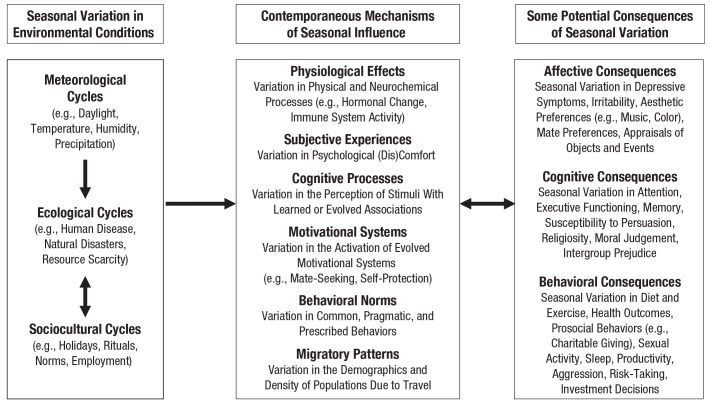
Many animal species exhibit seasonal changes in their physiology and behavior. Yet despite ample evidence that humans are also responsive to seasons, the impact of seasonal changes on human psychology is underappreciated relative to other sources of variation (e.g., personality, culture, development). This is unfortunate because seasonal variation has potentially profound conceptual, empirical, methodological, and practical implications. Here, we encourage a more systematic and comprehensive collective effort to document and understand the many ways in which seasons influence human psychology. We provide an illustrative summary of empirical evidence showing that seasons impact a wide range of affective, cognitive, and behavioral phenomena. We then articulate a conceptual framework that outlines a set of causal mechanisms through which seasons can influence human psychology-mechanisms that reflect seasonal changes not only in meteorological variables but also in ecological and sociocultural variables. This framework may be useful for integrating many different seasonal effects that have already been empirically documented and for generating new hypotheses about additional seasonal effects that have not yet received empirical attention. The article closes with a section that provides practical suggestions to facilitate greater appreciation for, and systematic study of, seasons as a fundamental source of variation in human psychology.
许多动物物种在生理和行为上表现出季节性变化。然而,尽管有充分的证据表明人类也对季节有反应,但相对于其他变异源(如个性、文化、发展),季节变化对人类心理的影响被低估了。这很不幸,因为季节性变化具有潜在的深刻的概念、经验、方法和实际意义。在这里,我们鼓励更系统和全面的集体努力来记录和理解季节影响人类心理的许多方式。我们提供了一个说明性的摘要,展示了季节如何影响广泛的情感、认知和行为现象。然后,我们阐述了一个概念框架,概述了一系列通过这些机制季节可以影响人类心理的因果机制,这些机制反映了气象变量变化之外的生态和社会文化变量的季节性变化。这个框架可以用于整合已经被经验证明的许多不同的季节性效应,并生成关于尚未受到经验关注的其他季节性效应的新假设。文章最后一节提供了一些实用的建议,以促进对季节作为人类心理基本变异源的更深入理解和系统研究。