Google Quantum AI, Venice, CA, USA.
Department of Physics and Astronomy, Macquarie University, Sydney, NSW, Australia.
Nat Commun. 2023 Jul 10;14(1):4058. doi: 10.1038/s41467-023-39024-0.
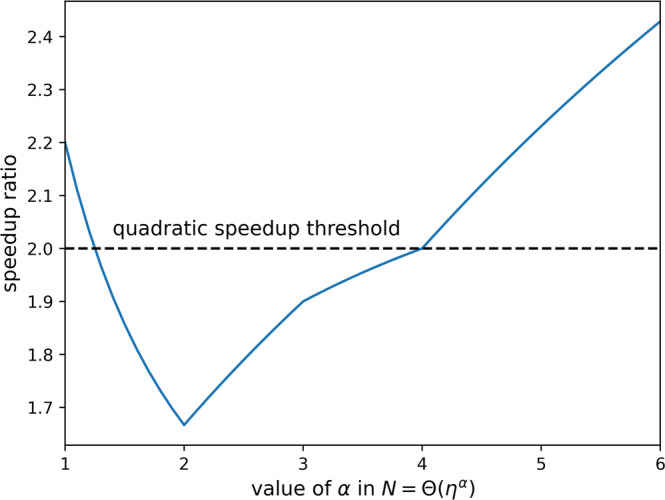
Quantum algorithms for simulating electronic ground states are slower than popular classical mean-field algorithms such as Hartree-Fock and density functional theory but offer higher accuracy. Accordingly, quantum computers have been predominantly regarded as competitors to only the most accurate and costly classical methods for treating electron correlation. However, here we tighten bounds showing that certain first-quantized quantum algorithms enable exact time evolution of electronic systems with exponentially less space and polynomially fewer operations in basis set size than conventional real-time time-dependent Hartree-Fock and density functional theory. Although the need to sample observables in the quantum algorithm reduces the speedup, we show that one can estimate all elements of the k-particle reduced density matrix with a number of samples scaling only polylogarithmically in basis set size. We also introduce a more efficient quantum algorithm for first-quantized mean-field state preparation that is likely cheaper than the cost of time evolution. We conclude that quantum speedup is most pronounced for finite-temperature simulations and suggest several practically important electron dynamics problems with potential quantum advantage.
用于模拟电子基态的量子算法比流行的经典平均场算法(如 Hartree-Fock 和密度泛函理论)慢,但具有更高的准确性。因此,量子计算机主要被视为仅与最准确和最昂贵的经典方法竞争,以处理电子相关。然而,在这里,我们收紧了界限,表明某些第一量子化量子算法能够以比传统实时含时 Hartree-Fock 和密度泛函理论少得多的空间和多项式少的操作数来精确地进行电子系统的时间演化。尽管在量子算法中需要对可观测量进行采样会降低加速比,但我们表明,可以用仅对数多项式规模的样本数来估计 k 粒子约化密度矩阵的所有元素。我们还引入了一种更有效的用于第一量子化平均场态制备的量子算法,其成本可能低于时间演化的成本。我们的结论是,量子加速在有限温度模拟中最为明显,并提出了几个具有潜在量子优势的实际重要电子动力学问题。