Department of Preventive Medicine, Keimyung University School of Medicine, 1095 Dalgubeol-daero, Dalseo- gu, Daegu, 42601, Korea.
Department of Preventive Medicine, Seoul National University College of Medicine, Seoul, Korea.
BMC Cancer. 2023 Jul 10;23(1):643. doi: 10.1186/s12885-023-11105-9.
With the availability of health insurance claim data, pharmacovigilance for various drugs has been suggested; however, it is necessary to establish an appropriate analysis method. To detect unintended drug effects and to generate new hypotheses, we conducted a hypothesis-free study to systematically examine the relationship between all prescription nonanticancer drugs and the mortality of colorectal cancer patients.
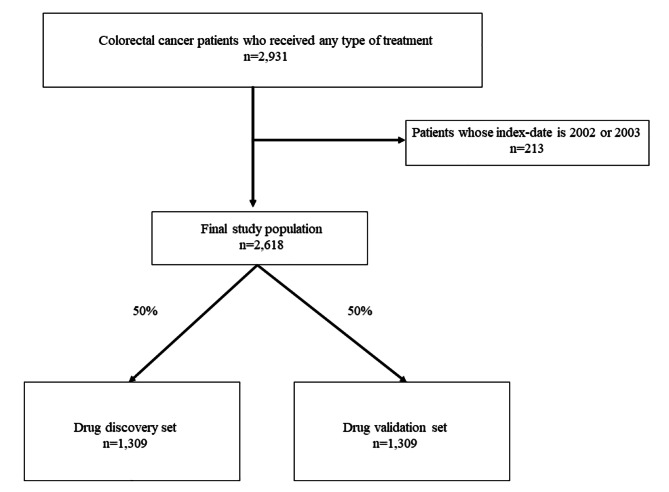
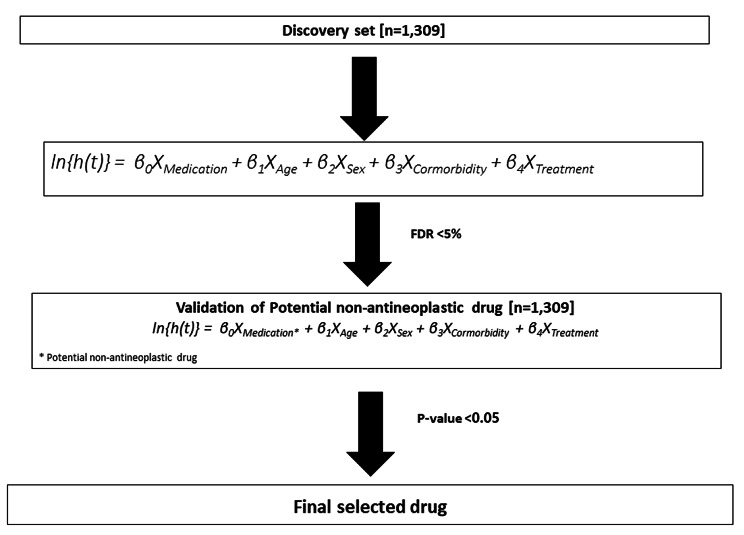
We used the Korean National Health Insurance Service-National Sample Cohort database. A total of 2,618 colorectal cancer patients diagnosed between 2004 and 2015 were divided into drug discovery and drug validation sets (1:1) through random sampling. Drugs were classified using the Anatomical Therapeutic Chemical (ATC) classification system: 76 drugs classified as ATC level 2 and 332 drugs classified as ATC level 4 were included in the analysis. We used a Cox proportional hazard model adjusted for sex, age, colorectal cancer treatment, and comorbidities. The relationship between all prescription nonanticancer drugs and the mortality of colorectal cancer patients was analyzed, controlling for multiple comparisons with the false discovery rate.
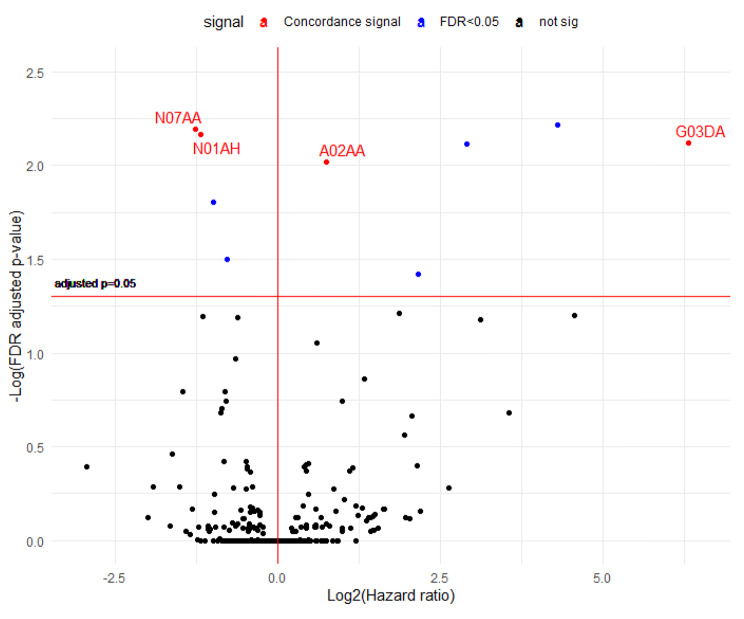
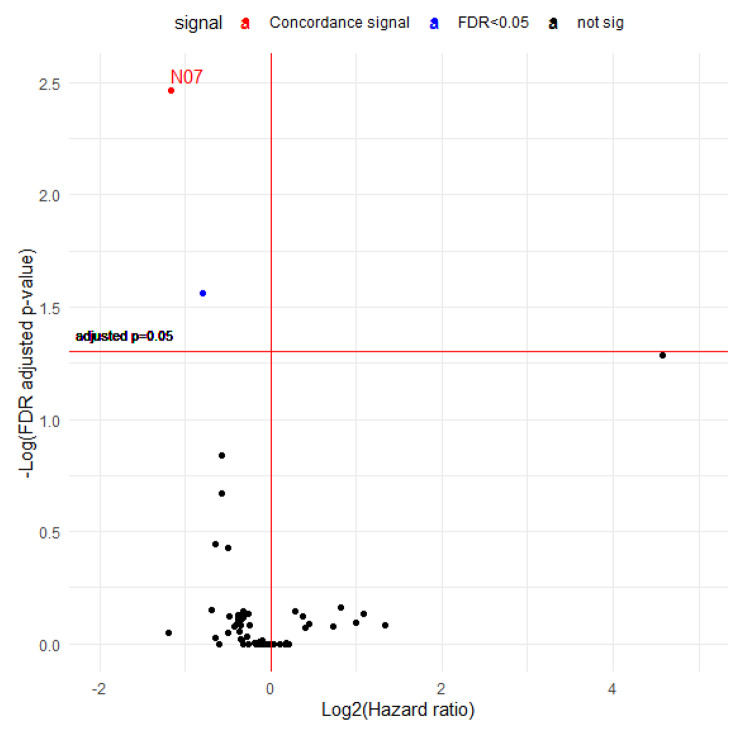
We found that one ATC level-2 drug (drugs that act on the nervous system, including parasympathomimetics, addictive disorder drugs, and antivertigo drugs) showed a protective effect related to colorectal cancer prognosis. At the ATC level 4 classification, 4 drugs were significant: two had a protective effect (anticholinesterases and opioid anesthetics), and the other two had a detrimental effect (magnesium compounds and Pregnen [4] derivatives).
In this hypothesis-free study, we identified four drugs linked to colorectal cancer prognosis. The MWAS method can be useful in real-world data analysis.
随着医疗保险索赔数据的可用性,已经有人建议对各种药物进行药物警戒;然而,有必要建立一种适当的分析方法。为了检测非预期的药物作用并产生新的假说,我们进行了一项无假设研究,系统地检查了所有处方非抗癌药物与结直肠癌患者死亡率之间的关系。
我们使用了韩国国家健康保险服务-国家样本队列数据库。通过随机抽样,将 2004 年至 2015 年间诊断为结直肠癌的 2618 名患者分为药物发现组和药物验证组(1:1)。我们使用解剖治疗化学(ATC)分类系统对药物进行分类:包括 76 种 ATC 二级药物和 332 种 ATC 四级药物。我们使用 Cox 比例风险模型调整了性别、年龄、结直肠癌治疗和合并症。在控制多重比较的假发现率的情况下,分析了所有处方非抗癌药物与结直肠癌患者死亡率之间的关系。
我们发现一种 ATC 二级药物(作用于神经系统的药物,包括拟副交感神经药、成瘾障碍药物和抗晕动病药物)与结直肠癌预后相关,具有保护作用。在 ATC 四级分类中,有 4 种药物具有统计学意义:两种药物具有保护作用(胆碱酯酶抑制剂和阿片类麻醉剂),另外两种药物具有不良作用(镁化合物和孕烯[4]衍生物)。
在这项无假设研究中,我们确定了四种与结直肠癌预后相关的药物。MWAS 方法在真实世界数据分析中可能是有用的。