Department of Electronics Engineering, Indian Institute of Technology (BHU), Varanasi 221005, India.
Department of Electronics and Communication Engineering, Santhiram Engineering College, Nandyal 518501, India.
Sensors (Basel). 2023 May 19;23(10):4885. doi: 10.3390/s23104885.
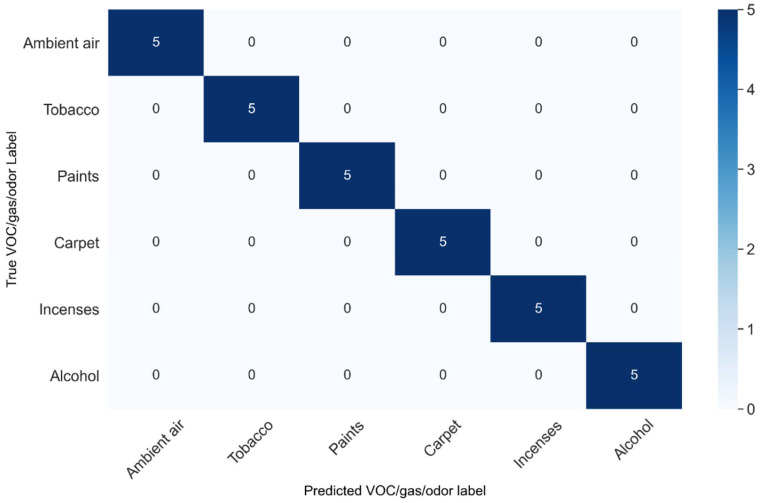
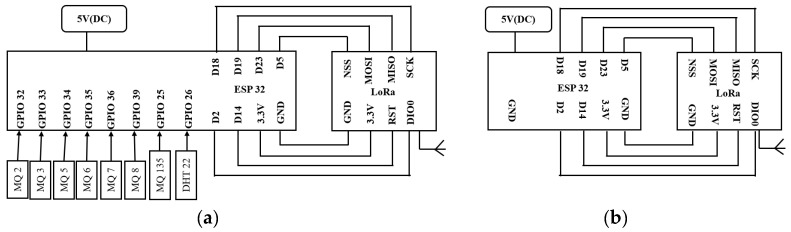
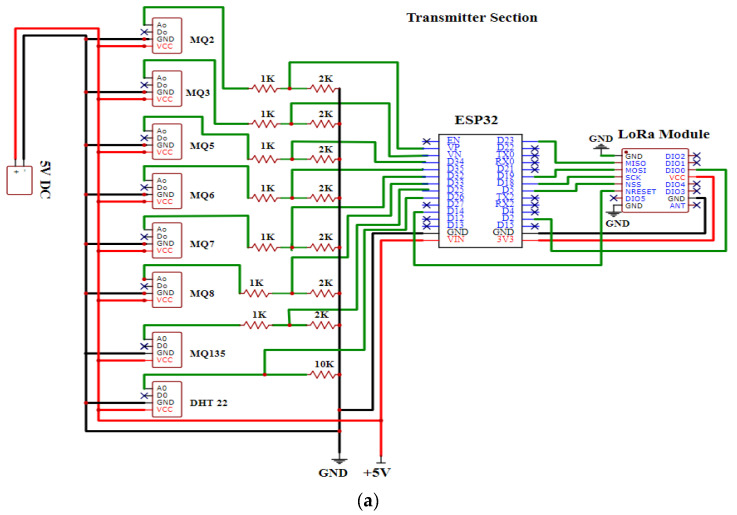
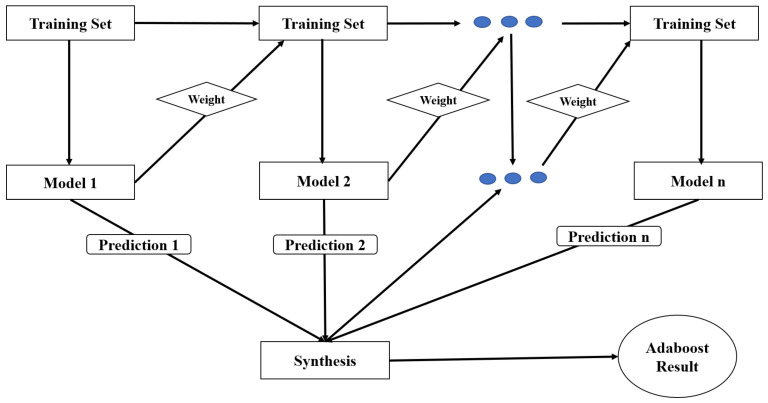
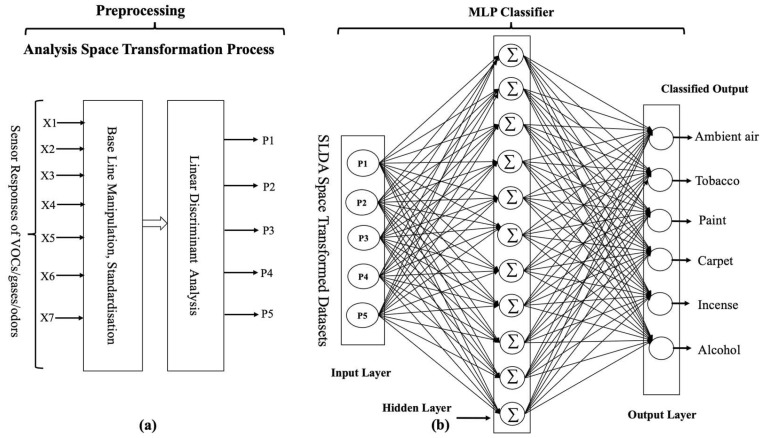
Detection and monitoring of airborne hazards using e-noses has been lifesaving and prevented accidents in real-world scenarios. E-noses generate unique signature patterns for various volatile organic compounds (VOCs) and, by leveraging artificial intelligence, detect the presence of various VOCs, gases, and smokes onsite. Widespread monitoring of airborne hazards across many remote locations is possible by creating a network of gas sensors using Internet connectivity, which consumes significant power. Long-range (LoRa)-based wireless networks do not require Internet connectivity while operating independently. Therefore, we propose a networked intelligent gas sensor system (N-IGSS) which uses a LoRa low-power wide-area networking protocol for real-time airborne pollution hazard detection and monitoring. We developed a gas sensor node by using an array of seven cross-selective tin-oxide-based metal-oxide semiconductor (MOX) gas sensor elements interfaced with a low-power microcontroller and a LoRa module. Experimentally, we exposed the sensor node to six classes i.e., five VOCs plus ambient air and as released by burning samples of tobacco, paints, carpets, alcohol, and incense sticks. Using the proposed two-stage analysis space transformation approach, the captured dataset was first preprocessed using the standardized linear discriminant analysis (SLDA) method. Four different classifiers, namely AdaBoost, XGBoost, Random Forest (RF), and Multi-Layer Perceptron (MLP), were then trained and tested in the SLDA transformation space. The proposed N-IGSS achieved "all correct" identification of 30 unknown test samples with a low mean squared error (MSE) of 1.42 × 10 over a distance of 590 m.
使用电子鼻检测和监测空气中的危害已经挽救了生命,并防止了现实场景中的事故。电子鼻为各种挥发性有机化合物(VOC)生成独特的特征模式,并通过利用人工智能,现场检测各种 VOC、气体和烟雾的存在。通过使用互联网连接创建气体传感器网络,可以在许多远程位置广泛监测空气中的危害,这需要消耗大量的电力。基于远距离(LoRa)的无线网络在独立运行时不需要互联网连接。因此,我们提出了一种网络化智能气体传感器系统(N-IGSS),该系统使用 LoRa 低功耗广域网协议进行实时空中污染危害检测和监测。我们通过使用由七个交叉选择性锡氧化物基金属氧化物半导体(MOX)气体传感器元件组成的阵列、一个低功耗微控制器和一个 LoRa 模块来开发气体传感器节点。在实验中,我们将传感器节点暴露于六种物质,即五种 VOC 加上环境空气,以及燃烧烟草、油漆、地毯、酒精和香棒样本时释放的物质。使用所提出的两阶段分析空间变换方法,首先使用标准化线性判别分析(SLDA)方法对捕获的数据集进行预处理。然后,在 SLDA 变换空间中训练和测试了四种不同的分类器,即 AdaBoost、XGBoost、随机森林(RF)和多层感知机(MLP)。所提出的 N-IGSS 以低均方误差(MSE)1.42×10 实现了对 30 个未知测试样本的“全部正确”识别,距离为 590 m。