The Leviev Cardiothoracic & Vascular Center, Chaim Sheba Medical Center, Ramat Gan 5236723, Israel.
The Sackler Faculty of Medicine, Tel Aviv University, Tel Aviv 6997801, Israel.
Nutrients. 2023 Apr 22;15(9):2016. doi: 10.3390/nu15092016.
In the face of the global pandemic that the coronavirus disease 2019 (COVID-19) has created, readily available prognostic markers may be of great use.
To evaluate the association between serum magnesium (sMg) levels on admission and clinical outcomes in hospitalized COVID-19 patients.
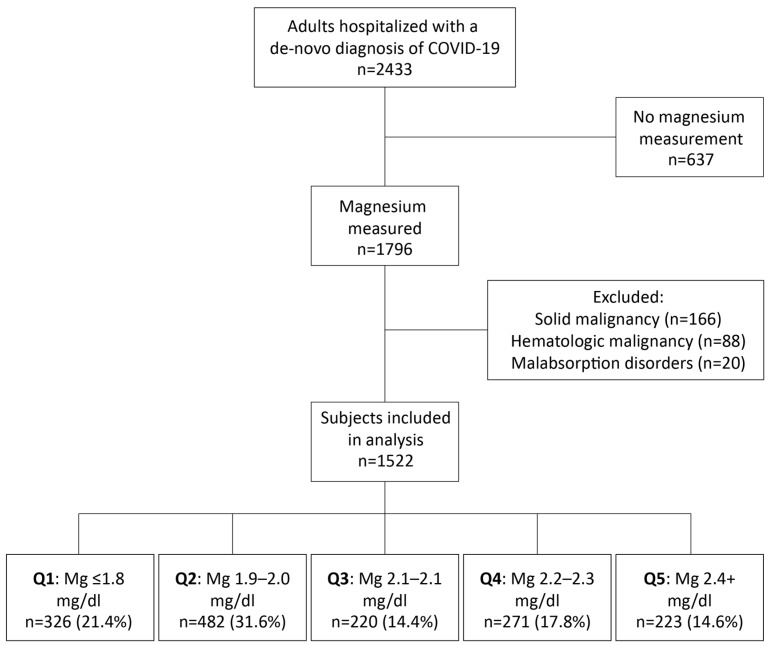
We retrospectively analyzed all patients admitted to a single tertiary center with a primary de novo diagnosis of COVID-19. Patients were followed for a mean of 10 ± 7 months. Demographic, clinical and laboratory data were collected and compared between five groups of patients according to sMg quintiles on hospital admission.
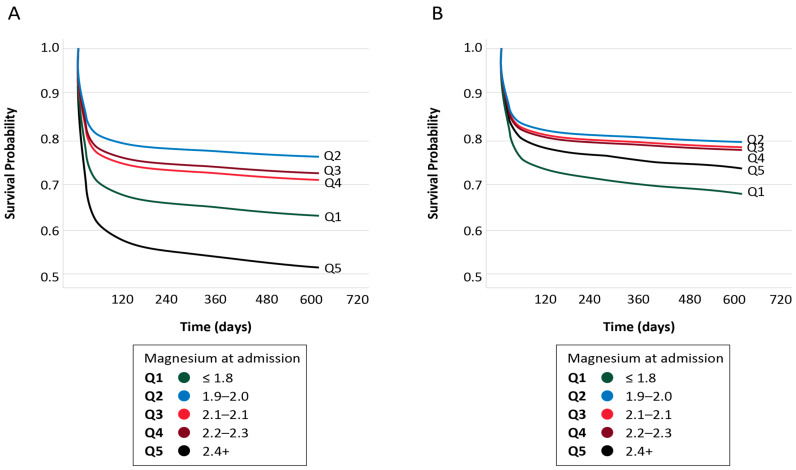
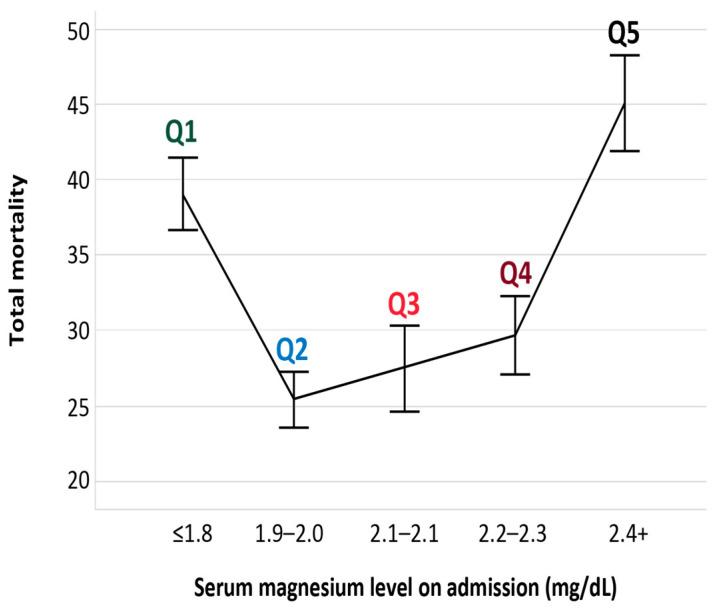
The cohort included 1522 patients (58% male, 69 ± 17 years old). A low sMg level (1st quintile) was associated with higher rates of diabetes and steroid use, whereas a high sMg level (5th quintile) was associated with dyslipidemia, renal dysfunction, higher levels of inflammatory markers and stay in the intensive care unit. All-cause in-hospital and long-term mortality was higher in patients with both low and high sMg levels, compared with mid-range sMg levels (2nd, 3rd and 4th quintiles; 19% and 30% vs. 9.5%, 10.7% and 17.8% and 35% and 45.3% vs. 23%, 26.8% and 27.3% respectively; < 0.001 for all). After adjusting for significant clinical parameters indicating severe disease and renal dysfunction, only low sMg state was independently associated with increased mortality (HR = 1.57, < 0.001).
Both low and high sMg levels were associated with increased mortality in a large cohort of hospitalized COVID-19 patients. However, after correction for renal dysfunction and disease severity, only low sMg maintained its prognostic ability.
面对 2019 年冠状病毒病(COVID-19)造成的全球大流行,现成的预后标志物可能非常有用。
评估入院时血清镁(sMg)水平与住院 COVID-19 患者临床结局的关系。
我们回顾性分析了一家单一的三级中心收治的所有初诊为 COVID-19 的患者。患者平均随访 10±7 个月。收集了人口统计学、临床和实验室数据,并根据入院时 sMg 五分位数将患者分为五组进行比较。
该队列包括 1522 名患者(58%为男性,69±17 岁)。低 sMg 水平(第 1 五分位)与糖尿病和类固醇使用率较高相关,而高 sMg 水平(第 5 五分位)与血脂异常、肾功能不全、炎症标志物水平升高和入住重症监护病房相关。与中范围 sMg 水平(第 2、3 和 4 五分位)相比,低 sMg 和高 sMg 水平的患者院内和长期全因死亡率均较高(19%和 30%比 9.5%、10.7%和 17.8%和 35%和 45.3%比 23%、26.8%和 27.3%;均<0.001)。在校正表明疾病严重程度和肾功能不全的显著临床参数后,只有低 sMg 状态与死亡率增加独立相关(HR=1.57,<0.001)。
在大量住院 COVID-19 患者中,低 sMg 和高 sMg 水平均与死亡率增加相关。然而,在纠正肾功能不全和疾病严重程度后,只有低 sMg 保持了其预后能力。