• 文献检索
  • 文档翻译
  • 深度研究
  • 学术资讯
  • Suppr Zotero 插件Zotero 插件
  • 邀请有礼
  • 套餐&价格
  • 历史记录
应用&插件
Suppr Zotero 插件Zotero 插件浏览器插件Mac 客户端Windows 客户端微信小程序
定价
高级版会员购买积分包购买API积分包
服务
文献检索文档翻译深度研究API 文档MCP 服务
关于我们
关于 Suppr公司介绍联系我们用户协议隐私条款
关注我们

Suppr 超能文献

核心技术专利:CN118964589B侵权必究
粤ICP备2023148730 号-1Suppr @ 2026

文献检索

告别复杂PubMed语法,用中文像聊天一样搜索,搜遍4000万医学文献。AI智能推荐,让科研检索更轻松。

立即免费搜索

文件翻译

保留排版,准确专业,支持PDF/Word/PPT等文件格式,支持 12+语言互译。

免费翻译文档

深度研究

AI帮你快速写综述,25分钟生成高质量综述,智能提取关键信息,辅助科研写作。

立即免费体验

利用血液学标志物进行轻度至中度 COVID-19 诊断的人工智能。

Artificial intelligence for diagnosis of mild-moderate COVID-19 using haematological markers.

机构信息

Department of Computer Science and Engineering, Manipal Institute of Technology, Manipal Academy of Higher Education, Manipal, India.

Department of Biomedical Engineering, Manipal Institute of Technology, Manipal Academy of Higher Education, Manipal, India.

出版信息

Ann Med. 2023 Dec;55(1):2233541. doi: 10.1080/07853890.2023.2233541.

DOI:10.1080/07853890.2023.2233541
PMID:37436038
原文链接:https://pmc.ncbi.nlm.nih.gov/articles/PMC10339777/
Abstract

OBJECTIVE

The persistent spread of SARS-CoV-2 makes diagnosis challenging because COVID-19 symptoms are hard to differentiate from those of other respiratory illnesses. The reverse transcription-polymerase chain reaction test is the current golden standard for diagnosing various respiratory diseases, including COVID-19. However, this standard diagnostic method is prone to erroneous and false negative results (10% -15%). Therefore, finding an alternative technique to validate the RT-PCR test is paramount. Artificial intelligence (AI) and machine learning (ML) applications are extensively used in medical research. Hence, this study focused on developing a decision support system using AI to diagnose mild-moderate COVID-19 from other similar diseases using demographic and clinical markers. Severe COVID-19 cases were not considered in this study since fatality rates have dropped considerably after introducing COVID-19 vaccines.

METHODS

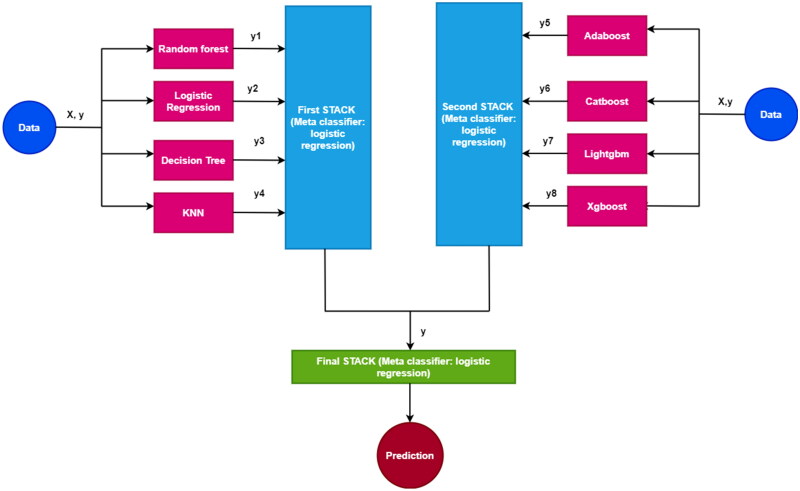
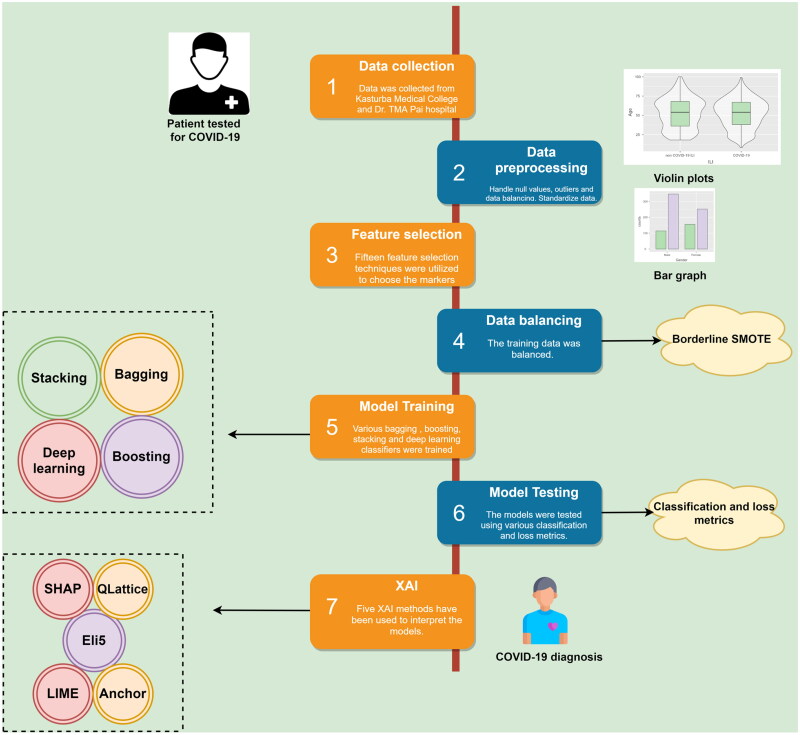
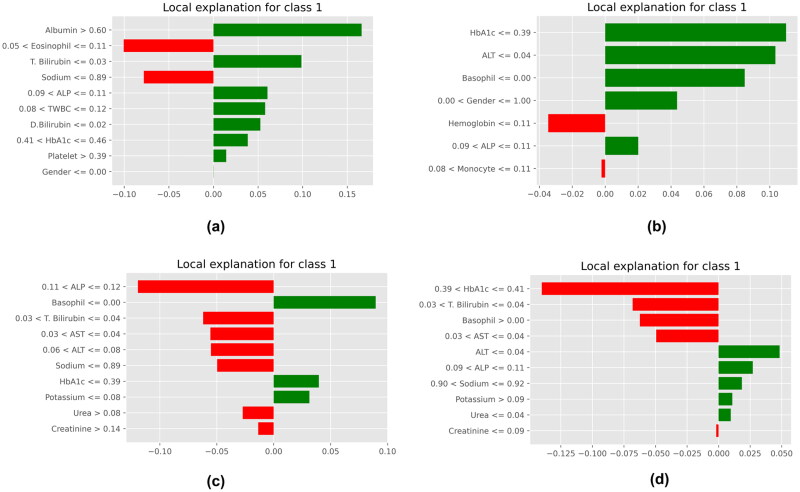
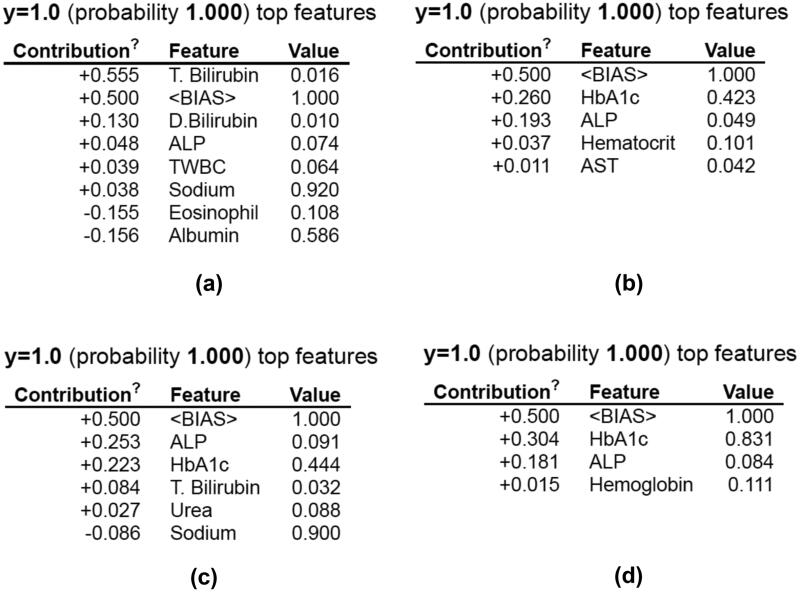
A custom stacked ensemble model consisting of various heterogeneous algorithms has been utilized for prediction. Four deep learning algorithms have also been tested and compared, such as one-dimensional convolutional neural networks, long short-term memory networks, deep neural networks and Residual Multi-Layer Perceptron. Five explainers, namely, Shapley Additive Values, Eli5, QLattice, Anchor and Local Interpretable Model-agnostic Explanations, have been utilized to interpret the predictions made by the classifiers.

RESULTS

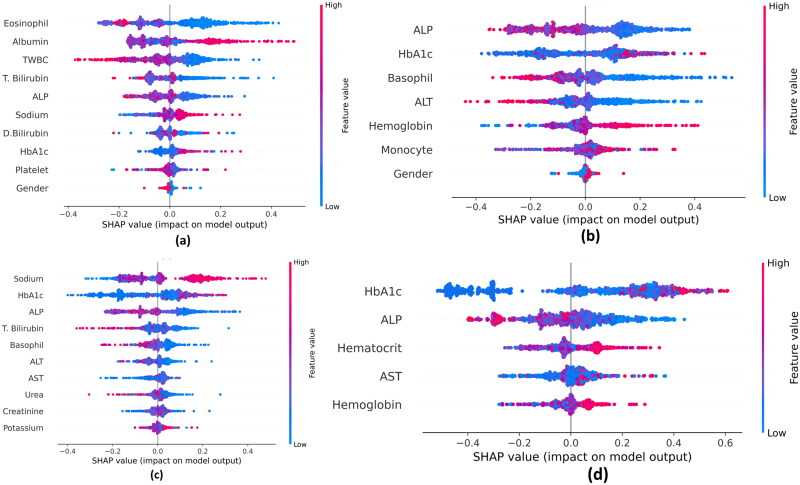
After using Pearson's correlation and particle swarm optimization feature selection, the final stack obtained a maximum accuracy of 89%. The most important markers which were useful in COVID-19 diagnosis are Eosinophil, Albumin, T. Bilirubin, ALP, ALT, AST, HbA1c and TWBC.

CONCLUSION

The promising results suggest using this decision support system to diagnose COVID-19 from other similar respiratory illnesses.

摘要

目的

SARS-CoV-2 的持续传播使得诊断具有挑战性,因为 COVID-19 症状难以与其他呼吸道疾病区分开来。逆转录-聚合酶链反应 (RT-PCR) 测试是目前诊断各种呼吸道疾病(包括 COVID-19)的金标准。然而,这种标准诊断方法容易出现错误和假阴性结果(10%-15%)。因此,寻找一种替代技术来验证 RT-PCR 测试至关重要。人工智能 (AI) 和机器学习 (ML) 应用在医学研究中得到了广泛应用。因此,本研究专注于使用 AI 开发一种决策支持系统,使用人口统计学和临床标志物来诊断轻度至中度 COVID-19 与其他类似疾病。本研究不考虑严重 COVID-19 病例,因为 COVID-19 疫苗推出后死亡率已大幅下降。

方法

使用包含各种异构算法的定制堆叠集成模型进行预测。还测试和比较了四种深度学习算法,例如一维卷积神经网络、长短期记忆网络、深度神经网络和残差多层感知机。使用了五种解释器,即 Shapley Additive Values、Eli5、QLattice、Anchor 和 Local Interpretable Model-agnostic Explanations,来解释分类器的预测结果。

结果

使用 Pearson 相关系数和粒子群优化特征选择后,最终堆栈获得了 89%的最大准确性。对 COVID-19 诊断有用的最重要标志物是嗜酸性粒细胞、白蛋白、总胆红素、碱性磷酸酶、丙氨酸氨基转移酶、天冬氨酸氨基转移酶、糖化血红蛋白和白细胞总数。

结论

有前途的结果表明,可以使用此决策支持系统从其他类似的呼吸道疾病中诊断 COVID-19。
https://cdn.ncbi.nlm.nih.gov/pmc/blobs/fb68/10339777/c2a10b8c8321/IANN_A_2233541_F0015_C.jpg
https://cdn.ncbi.nlm.nih.gov/pmc/blobs/fb68/10339777/c3ba5154b0ee/IANN_A_2233541_F0001_C.jpg
https://cdn.ncbi.nlm.nih.gov/pmc/blobs/fb68/10339777/e85ab251b666/IANN_A_2233541_F0002_C.jpg
https://cdn.ncbi.nlm.nih.gov/pmc/blobs/fb68/10339777/28ecfc2f3219/IANN_A_2233541_F0003_C.jpg
https://cdn.ncbi.nlm.nih.gov/pmc/blobs/fb68/10339777/19b6ddd151e5/IANN_A_2233541_F0004_C.jpg
https://cdn.ncbi.nlm.nih.gov/pmc/blobs/fb68/10339777/b82b415c2c4d/IANN_A_2233541_F0005_C.jpg
https://cdn.ncbi.nlm.nih.gov/pmc/blobs/fb68/10339777/f3c59e184c18/IANN_A_2233541_F0006_C.jpg
https://cdn.ncbi.nlm.nih.gov/pmc/blobs/fb68/10339777/40cf195a13dd/IANN_A_2233541_F0007_C.jpg
https://cdn.ncbi.nlm.nih.gov/pmc/blobs/fb68/10339777/da8ef1d6b24c/IANN_A_2233541_F0008_C.jpg
https://cdn.ncbi.nlm.nih.gov/pmc/blobs/fb68/10339777/b5f7687ce61f/IANN_A_2233541_F0009_C.jpg
https://cdn.ncbi.nlm.nih.gov/pmc/blobs/fb68/10339777/ace36cca24c9/IANN_A_2233541_F0010_C.jpg
https://cdn.ncbi.nlm.nih.gov/pmc/blobs/fb68/10339777/efe65bf2596e/IANN_A_2233541_F0011_C.jpg
https://cdn.ncbi.nlm.nih.gov/pmc/blobs/fb68/10339777/d2e8bb8ab2ca/IANN_A_2233541_F0012_C.jpg
https://cdn.ncbi.nlm.nih.gov/pmc/blobs/fb68/10339777/d3d55ba7bce2/IANN_A_2233541_F0013_C.jpg
https://cdn.ncbi.nlm.nih.gov/pmc/blobs/fb68/10339777/54e3d2bac1a1/IANN_A_2233541_F0014_B.jpg
https://cdn.ncbi.nlm.nih.gov/pmc/blobs/fb68/10339777/c2a10b8c8321/IANN_A_2233541_F0015_C.jpg
https://cdn.ncbi.nlm.nih.gov/pmc/blobs/fb68/10339777/c3ba5154b0ee/IANN_A_2233541_F0001_C.jpg
https://cdn.ncbi.nlm.nih.gov/pmc/blobs/fb68/10339777/e85ab251b666/IANN_A_2233541_F0002_C.jpg
https://cdn.ncbi.nlm.nih.gov/pmc/blobs/fb68/10339777/28ecfc2f3219/IANN_A_2233541_F0003_C.jpg
https://cdn.ncbi.nlm.nih.gov/pmc/blobs/fb68/10339777/19b6ddd151e5/IANN_A_2233541_F0004_C.jpg
https://cdn.ncbi.nlm.nih.gov/pmc/blobs/fb68/10339777/b82b415c2c4d/IANN_A_2233541_F0005_C.jpg
https://cdn.ncbi.nlm.nih.gov/pmc/blobs/fb68/10339777/f3c59e184c18/IANN_A_2233541_F0006_C.jpg
https://cdn.ncbi.nlm.nih.gov/pmc/blobs/fb68/10339777/40cf195a13dd/IANN_A_2233541_F0007_C.jpg
https://cdn.ncbi.nlm.nih.gov/pmc/blobs/fb68/10339777/da8ef1d6b24c/IANN_A_2233541_F0008_C.jpg
https://cdn.ncbi.nlm.nih.gov/pmc/blobs/fb68/10339777/b5f7687ce61f/IANN_A_2233541_F0009_C.jpg
https://cdn.ncbi.nlm.nih.gov/pmc/blobs/fb68/10339777/ace36cca24c9/IANN_A_2233541_F0010_C.jpg
https://cdn.ncbi.nlm.nih.gov/pmc/blobs/fb68/10339777/efe65bf2596e/IANN_A_2233541_F0011_C.jpg
https://cdn.ncbi.nlm.nih.gov/pmc/blobs/fb68/10339777/d2e8bb8ab2ca/IANN_A_2233541_F0012_C.jpg
https://cdn.ncbi.nlm.nih.gov/pmc/blobs/fb68/10339777/d3d55ba7bce2/IANN_A_2233541_F0013_C.jpg
https://cdn.ncbi.nlm.nih.gov/pmc/blobs/fb68/10339777/54e3d2bac1a1/IANN_A_2233541_F0014_B.jpg
https://cdn.ncbi.nlm.nih.gov/pmc/blobs/fb68/10339777/c2a10b8c8321/IANN_A_2233541_F0015_C.jpg

相似文献

1
Artificial intelligence for diagnosis of mild-moderate COVID-19 using haematological markers.利用血液学标志物进行轻度至中度 COVID-19 诊断的人工智能。
Ann Med. 2023 Dec;55(1):2233541. doi: 10.1080/07853890.2023.2233541.
2
A Decision Support System for Diagnosis of COVID-19 from Non-COVID-19 Influenza-like Illness Using Explainable Artificial Intelligence.一种使用可解释人工智能从非新冠流感样疾病中诊断新冠的决策支持系统。
Bioengineering (Basel). 2023 Mar 31;10(4):439. doi: 10.3390/bioengineering10040439.
3
COVID-19 diagnosis using clinical markers and multiple explainable artificial intelligence approaches: A case study from Ecuador.使用临床标志物和多种可解释人工智能方法进行COVID-19诊断:来自厄瓜多尔的案例研究。
SLAS Technol. 2023 Dec;28(6):393-410. doi: 10.1016/j.slast.2023.09.001. Epub 2023 Sep 9.
4
Benchmarking of Machine Learning classifiers on plasma proteomic for COVID-19 severity prediction through interpretable artificial intelligence.基于机器学习的分类器在 COVID-19 严重程度预测血浆蛋白质组学中的基准测试:通过可解释的人工智能。
Artif Intell Med. 2023 Mar;137:102490. doi: 10.1016/j.artmed.2023.102490. Epub 2023 Jan 18.
5
Clinical and Laboratory Approach to Diagnose COVID-19 Using Machine Learning.使用机器学习诊断新冠病毒病的临床与实验室方法
Interdiscip Sci. 2022 Jun;14(2):452-470. doi: 10.1007/s12539-021-00499-4. Epub 2022 Feb 8.
6
Anomaly Identification during Polymerase Chain Reaction for Detecting SARS-CoV-2 Using Artificial Intelligence Trained from Simulated Data.利用模拟数据训练的人工智能进行聚合酶链反应检测 SARS-CoV-2 中的异常识别。
Molecules. 2020 Dec 23;26(1):20. doi: 10.3390/molecules26010020.
7
An Ensemble Learning Model for COVID-19 Detection from Blood Test Samples.基于血液检测样本的 COVID-19 检测的集成学习模型。
Sensors (Basel). 2022 Mar 13;22(6):2224. doi: 10.3390/s22062224.
8
COVID-DSNet: A novel deep convolutional neural network for detection of coronavirus (SARS-CoV-2) cases from CT and Chest X-Ray images.COVID-DSNet:一种新型深度卷积神经网络,用于从 CT 和胸部 X 光图像中检测冠状病毒(SARS-CoV-2)病例。
Artif Intell Med. 2022 Dec;134:102427. doi: 10.1016/j.artmed.2022.102427. Epub 2022 Oct 17.
9
A decision support system for osteoporosis risk prediction using machine learning and explainable artificial intelligence.一种使用机器学习和可解释人工智能的骨质疏松症风险预测决策支持系统。
Heliyon. 2023 Dec 2;9(12):e22456. doi: 10.1016/j.heliyon.2023.e22456. eCollection 2023 Dec.
10
Detection of anemic condition in patients from clinical markers and explainable artificial intelligence.从临床标志物和可解释人工智能检测患者的贫血状况。
Technol Health Care. 2024;32(4):2431-2444. doi: 10.3233/THC-231207.

引用本文的文献

1
Multifractal analysis and support vector machine for the classification of coronaviruses and SARS-CoV-2 variants.用于冠状病毒和SARS-CoV-2变体分类的多重分形分析和支持向量机
Sci Rep. 2025 Apr 29;15(1):15041. doi: 10.1038/s41598-025-98366-5.
2
Machine learning approach for optimizing usability of healthcare websites.用于优化医疗保健网站可用性的机器学习方法。
Sci Rep. 2025 Apr 25;15(1):14450. doi: 10.1038/s41598-025-99449-z.
3
Predicting hepatocellular carcinoma survival with artificial intelligence.利用人工智能预测肝细胞癌的生存期。

本文引用的文献

1
A Decision Support System for Diagnosis of COVID-19 from Non-COVID-19 Influenza-like Illness Using Explainable Artificial Intelligence.一种使用可解释人工智能从非新冠流感样疾病中诊断新冠的决策支持系统。
Bioengineering (Basel). 2023 Mar 31;10(4):439. doi: 10.3390/bioengineering10040439.
2
A Systematic Review and Meta-Analysis on the Real-World Effectiveness of COVID-19 Vaccines against Infection, Symptomatic and Severe COVID-19 Disease Caused by the Omicron Variant (B.1.1.529).关于新冠病毒奥密克戎变异株(B.1.1.529)引起的感染、有症状的新冠病毒疾病及重症新冠病毒疾病,新冠疫苗真实世界有效性的系统评价与荟萃分析
Vaccines (Basel). 2023 Jan 19;11(2):224. doi: 10.3390/vaccines11020224.
3
Sci Rep. 2025 Feb 20;15(1):6226. doi: 10.1038/s41598-025-90884-6.
4
Decision tree-based learning and laboratory data mining: an efficient approach to amebiasis testing.基于决策树的学习与实验室数据挖掘:一种高效的阿米巴病检测方法。
Parasit Vectors. 2025 Jan 29;18(1):33. doi: 10.1186/s13071-024-06618-6.
5
Automatic detection and prediction of COVID-19 in cough audio signals using coronavirus herd immunity optimizer algorithm.使用冠状病毒群体免疫优化算法对咳嗽音频信号中的新冠肺炎进行自动检测和预测。
Sci Rep. 2025 Jan 17;15(1):2271. doi: 10.1038/s41598-025-85140-w.
6
Study on the predictive value of laboratory inflammatory markers and blood count-derived inflammatory markers for disease severity and prognosis in COVID-19 patients: a study conducted at a university-affiliated infectious disease hospital.研究实验室炎症标志物和基于血常规的炎症标志物对 COVID-19 患者疾病严重程度和预后的预测价值:在一家大学附属医院传染病医院进行的研究。
Ann Med. 2024 Dec;56(1):2415401. doi: 10.1080/07853890.2024.2415401. Epub 2024 Oct 24.
7
Construction and validation of a prognostic model of angiogenesis-related genes in multiple myeloma.构建并验证多发性骨髓瘤中与血管生成相关基因的预后模型。
BMC Cancer. 2024 Oct 11;24(1):1269. doi: 10.1186/s12885-024-13024-9.
8
Integrative genomic analysis of the lung tissue microenvironment in SARS-CoV-2 and NL63 patients.新冠病毒和NL63病毒感染患者肺组织微环境的综合基因组分析
Heliyon. 2024 Jun 10;10(12):e32772. doi: 10.1016/j.heliyon.2024.e32772. eCollection 2024 Jun 30.
9
Towards Improved XAI-Based Epidemiological Research into the Next Potential Pandemic.迈向基于可解释人工智能的流行病学研究,以应对下一次潜在的大流行。
Life (Basel). 2024 Jun 21;14(7):783. doi: 10.3390/life14070783.
10
Explainable artificial intelligence and machine learning: novel approaches to face infectious diseases challenges.可解释人工智能和机器学习:应对面部传染病挑战的新方法。
Ann Med. 2023;55(2):2286336. doi: 10.1080/07853890.2023.2286336. Epub 2023 Nov 27.
COVID-19 vaccine literacy: A scoping review.
COVID-19 疫苗素养:范围综述。
Hum Vaccin Immunother. 2023 Dec 31;19(1):2176083. doi: 10.1080/21645515.2023.2176083. Epub 2023 Feb 15.
4
A Cross-Sectional Comparative Characterization of Hematological Changes in Patients with COVID-19 Infection, Non-COVID Influenza-like Illnesses and Healthy Controls.一项关于 COVID-19 感染、非 COVID 流感样疾病与健康对照者血液学变化的横断面对比特征研究。
Viruses. 2022 Dec 31;15(1):134. doi: 10.3390/v15010134.
5
Early prediction of COVID-19 outcome using artificial intelligence techniques and only five laboratory indices.利用人工智能技术和仅五项实验室指标对 COVID-19 结局进行早期预测。
Clin Immunol. 2023 Jan;246:109218. doi: 10.1016/j.clim.2022.109218. Epub 2022 Dec 29.
6
ResMLP: Feedforward Networks for Image Classification With Data-Efficient Training.ResMLP:具有高效数据训练的图像分类前馈网络。
IEEE Trans Pattern Anal Mach Intell. 2023 Apr;45(4):5314-5321. doi: 10.1109/TPAMI.2022.3206148. Epub 2023 Mar 7.
7
An Explainable AI Approach for the Rapid Diagnosis of COVID-19 Using Ensemble Learning Algorithms.一种使用集成学习算法快速诊断 COVID-19 的可解释人工智能方法。
Front Public Health. 2022 Jun 21;10:874455. doi: 10.3389/fpubh.2022.874455. eCollection 2022.
8
COVID-19 Diagnosis: A Comprehensive Review of the RT-qPCR Method for Detection of SARS-CoV-2.新型冠状病毒肺炎的诊断:用于检测严重急性呼吸综合征冠状病毒2的逆转录定量聚合酶链反应方法的全面综述
Diagnostics (Basel). 2022 Jun 20;12(6):1503. doi: 10.3390/diagnostics12061503.
9
A novel explainable COVID-19 diagnosis method by integration of feature selection with random forest.一种通过将特征选择与随机森林相结合的新型可解释性新冠肺炎诊断方法。
Inform Med Unlocked. 2022;30:100941. doi: 10.1016/j.imu.2022.100941. Epub 2022 Apr 6.
10
Review of COVID-19 testing and diagnostic methods.新型冠状病毒检测和诊断方法综述。
Talanta. 2022 Jul 1;244:123409. doi: 10.1016/j.talanta.2022.123409. Epub 2022 Mar 31.