Djientcheu Tientcheu Jean Philippe, Ngueguim Tsofack Florence, Gounoue Racéline Kamkumo, Fifen Rodrigue Ngapout, Dzeufiet Paul Désiré Djomeni, Dimo Théophile
Laboratory of Animal Physiology, Faculty of Science, University of Yaoundé 1, P.O. Box 812, Yaoundé, Cameroon.
Evid Based Complement Alternat Med. 2023 Jul 4;2023:7865919. doi: 10.1155/2023/7865919. eCollection 2023.
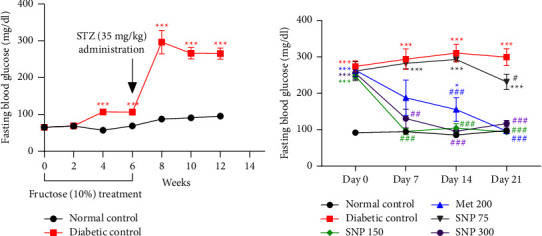
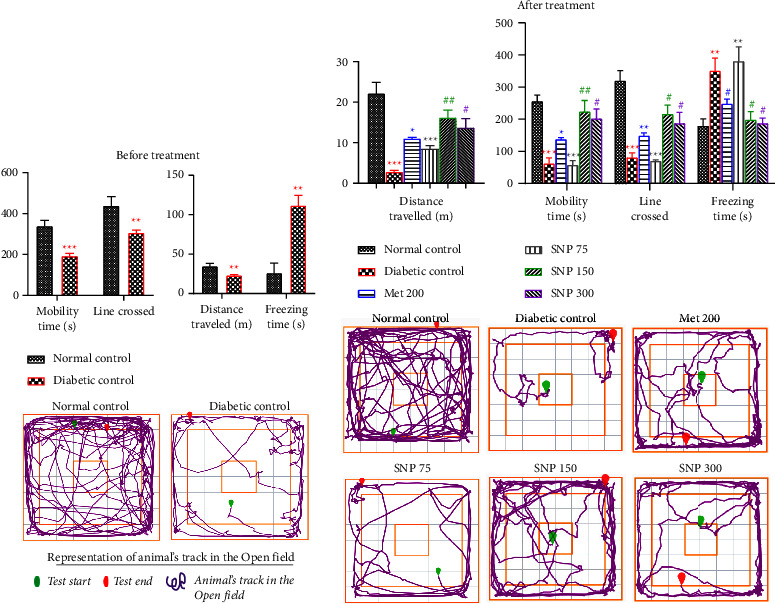
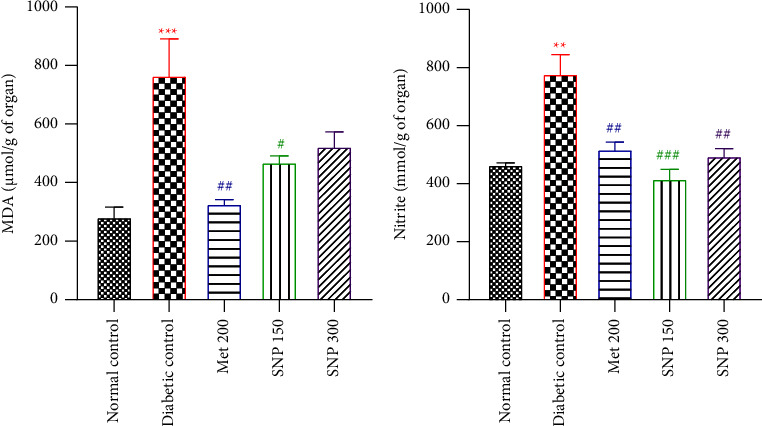
Among the many complications of type 2 diabetes (T2D), locomotor disorders have been poorly studied and understood. Therefore, no disease-modifying treatment is usually considered. The study aimed to investigate the effect of the aqueous extract of , , and (SNP) mixture on locomotor activity in fructose/streptozotocin-induced diabetic rats. T2D was induced by 10% fructose orally (6 weeks) and streptozotocin (STZ, 35 mg/kg, ) in 25 male rats. Diabetic animals received distilled water, metformin (200 mg/kg), or the aqueous extract of the SNP mixture (75, 150, or 300 mg/kg). A 10-minute open field test was performed in diabetic rats (glycemia: 126 and 350 mg/dL) to assess locomotor activity before and after treatment. A group of 5 normal rats (NC) served as controls throughout the study. Rats were sacrificed, and the striatum was removed for biochemical and histological studies. In untreated diabetic rats, fructose/STZ administration resulted in hyperglycemia that altered locomotor function as characterized by increased freezing time, decreased mobility time, number of lines crossed, and total travel time compared to NC. MDA, TNF-, INF-, and nitrite levels were elevated in the striatum of diabetic rats, while catalase activity and GSH levels were decreased, indicating oxidative stress and neuroinflammatory changes. In untreated diabetic rats, the microstructure of the HE-stained striatum revealed lipid vacuolation (hydropic degeneration) of the parenchyma, indicating a loss of neuronal integrity. The locomotor dysfunction was significantly improved by the aqueous extract of the SNP mixture, both biochemically and histologically. As a result, our findings support the mixture's ability to correct diabetes-related locomotion disorders as a glucose-lowering product and antioxidant, anti-inflammatory, and neuroprotective agent. These results justify the use of the aqueous extract of a combination of these three plants to manage diabetes and neuroinflammatory complications in Northern Cameroon.
在2型糖尿病(T2D)的众多并发症中,运动障碍一直未得到充分研究和理解。因此,通常不考虑采用改善疾病的治疗方法。本研究旨在探讨、和混合物的水提取物(SNP)对果糖/链脲佐菌素诱导的糖尿病大鼠运动活性的影响。通过给25只雄性大鼠口服10%果糖(6周)和链脲佐菌素(STZ,35mg/kg,)诱导T2D。糖尿病动物分别接受蒸馏水、二甲双胍(200mg/kg)或SNP混合物的水提取物(75、150或300mg/kg)。对糖尿病大鼠(血糖:126和350mg/dL)进行10分钟的旷场试验,以评估治疗前后的运动活性。一组5只正常大鼠(NC)在整个研究中作为对照。处死大鼠后,取出纹状体进行生化和组织学研究。在未治疗的糖尿病大鼠中,给予果糖/STZ导致血糖升高,改变了运动功能,其特征为与NC相比,冻结时间增加、活动时间减少、穿越线条数和总移动时间减少。糖尿病大鼠纹状体中丙二醛、肿瘤坏死因子-、干扰素-和亚硝酸盐水平升高,而过氧化氢酶活性和谷胱甘肽水平降低,表明存在氧化应激和神经炎症变化。在未治疗的糖尿病大鼠中,HE染色的纹状体微观结构显示实质细胞出现脂质空泡化(水样变性),表明神经元完整性丧失。SNP混合物的水提取物在生化和组织学方面均显著改善了运动功能障碍。因此,我们的研究结果支持该混合物作为一种降糖产品以及抗氧化、抗炎和神经保护剂纠正糖尿病相关运动障碍的能力。这些结果证明了使用这三种植物组合的水提取物来治疗喀麦隆北部的糖尿病和神经炎症并发症是合理的。