Tyczyńska Agata, Krzempek Marcela Krzysława, Cortez Alexander Jorge, Jurczyszyn Artur, Godlewska Katarzyna, Ciepłuch Hanna, Subocz Edyta, Hałka Janusz, Kulikowska de Nałęcz Anna, Wiśniewska Anna, Świderska Alina, Waszczuk-Gajda Anna, Drozd-Sokołowska Joanna, Guzicka-Kazimierczak Renata, Wiśniewski Kamil, Porowska Agnieszka, Knopińska-Posłuszny Wanda, Kłoczko Janusz, Rzepecki Piotr, Woszczyk Dariusz, Symonowicz Hanna, Basak Grzegorz Władysław, Zdziarska Barbara, Jamroziak Krzysztof, Zaucha Jan M
Department of Hematology and Transplantology, Medical University of Gdańsk, 80-214 Gdańsk, Poland.
Department of Biostatistics and Bioinformatics, Maria Sklodowska-Curie National Research Institute of Oncology, Gliwice Branch, 44-102 Gliwice, Poland.
Cancers (Basel). 2023 Jul 2;15(13):3469. doi: 10.3390/cancers15133469.
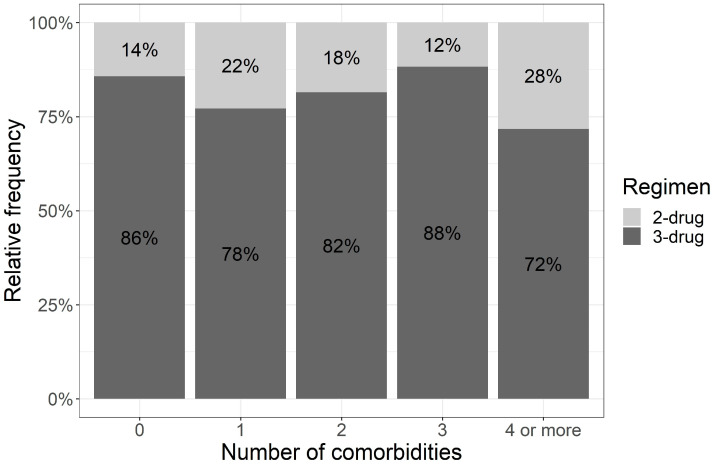
Fragility scales are intended to help in therapeutic decisions. Here, we asked if the fragility assessment in MM patients ≥ 75 years old qualified for treatment by the local physician correlates with the choice of treatment: a two- or three-drug regimens. Between 7/2018 and 12/2019, we prospectively enrolled 197 MM patients at the start of treatment from the 13 Polish Myeloma Group centers. The data to assess fragility were prospectively collected, but centrally assessed fragility was not disclosed to the local center. The activity of daily living (ADL) could be assessed in 192 (97.5%) and was independent in 158 (80.2%), moderately impaired in 23 (11.7%), and 11 (5.6%) in completely dependent. Patients with more than three comorbidities made up 26.9% (53 patients). Thus, according to the Palumbo calculator, 43 patients were in the intermediate fitness group (21.8%), and the rest belonged to the frailty group (153, 77.7%). Overall, 79.7% of patients (157) received three-drug regimens and 20.3% (40) received two-drug regimens. In each ECOG group, more than three out of four patients received three-drug regimens. According to the ADL scale, 82.3% of the independent 65.2% of moderately impaired, and 81.8% of the dependent received three-drug regimens. Out of 53 patients with at least four comorbidities, 71.7% received three-drug regimens, and the rest received two-drug regimens. Thirty-four patients from the intermediate fit group (79.0%), and 123 (79.9%) from the frail group received three-drug regimens. Early mortality occurred in 25 patients (12.7%). No one discontinued treatment due to toxicity. To conclude, MM patients over 75 are mainly treated with triple-drug regimens, not only in reduced doses, regardless of their frailty scores. However, the absence of prospective fragility assessment did not negatively affect early mortality and the number of treatment discontinuations, which brings into question the clinical utility of current fragility scales in everyday practice.
衰弱量表旨在辅助治疗决策。在此,我们探讨了当地医生对≥75岁骨髓瘤(MM)患者进行的衰弱评估与治疗选择(两药或三药方案)之间是否存在关联。在2018年7月至2019年12月期间,我们从波兰骨髓瘤研究组的13个中心前瞻性纳入了197例处于治疗起始阶段的MM患者。评估衰弱的数据是前瞻性收集的,但中心评估的衰弱情况未向当地中心披露。192例(97.5%)患者的日常生活活动能力(ADL)可进行评估,其中158例(80.2%)独立,23例(11.7%)中度受损,11例(5.6%)完全依赖。合并症超过三种的患者占26.9%(53例)。因此,根据帕尔umbo计算器,43例患者处于中等健康组(21.8%),其余属于衰弱组(153例,77.7%)。总体而言,79.7%的患者(157例)接受三药方案,20.3%(40例)接受两药方案。在每个东部肿瘤协作组(ECOG)分组中,超过四分之三的患者接受三药方案。根据ADL量表,82.3%的独立患者、65.2%的中度受损患者以及81.8%的依赖患者接受三药方案。在53例至少有四种合并症的患者中,71.7%接受三药方案,其余接受两药方案。中等健康组的34例患者(79.0%)以及衰弱组的123例患者(79.9%)接受三药方案。25例患者(12.7%)发生早期死亡。无人因毒性而停止治疗。总之,75岁以上的MM患者主要接受三药方案治疗,不仅是减量方案,无论其衰弱评分如何。然而,缺乏前瞻性衰弱评估并未对早期死亡率和治疗中断次数产生负面影响,这使得当前衰弱量表在日常实践中的临床实用性受到质疑。