Department of Biological Sciences, College of Science, King Faisal University, AlAhsa 31982, Saudi Arabia.
Molecules. 2023 Jun 23;28(13):4935. doi: 10.3390/molecules28134935.
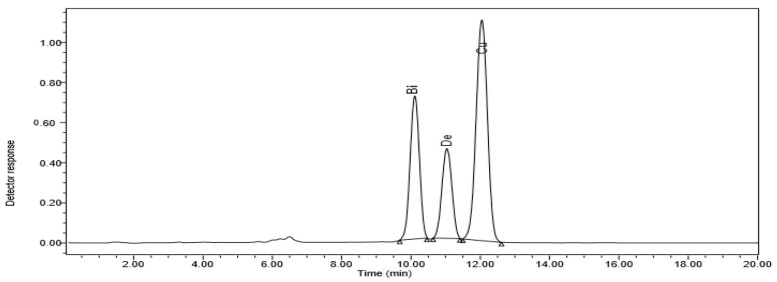
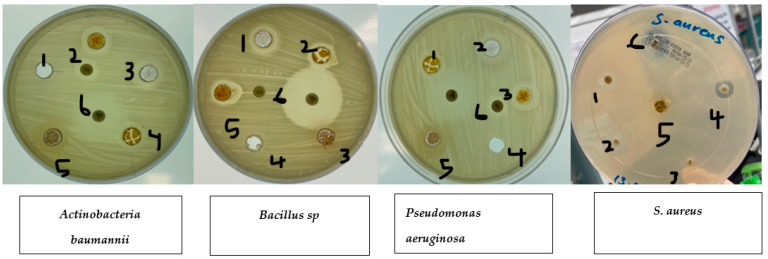
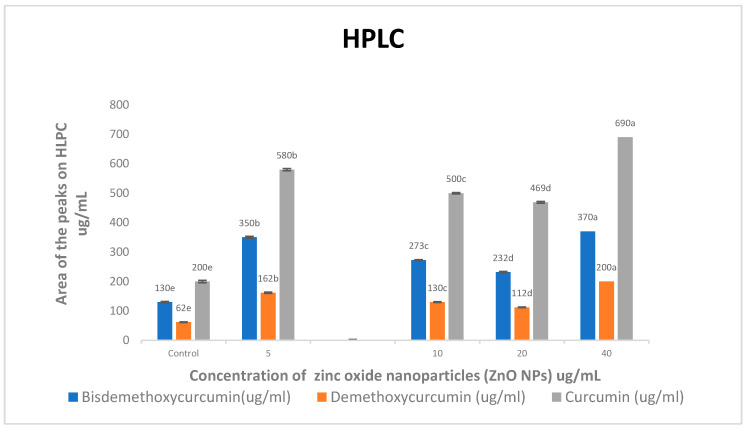
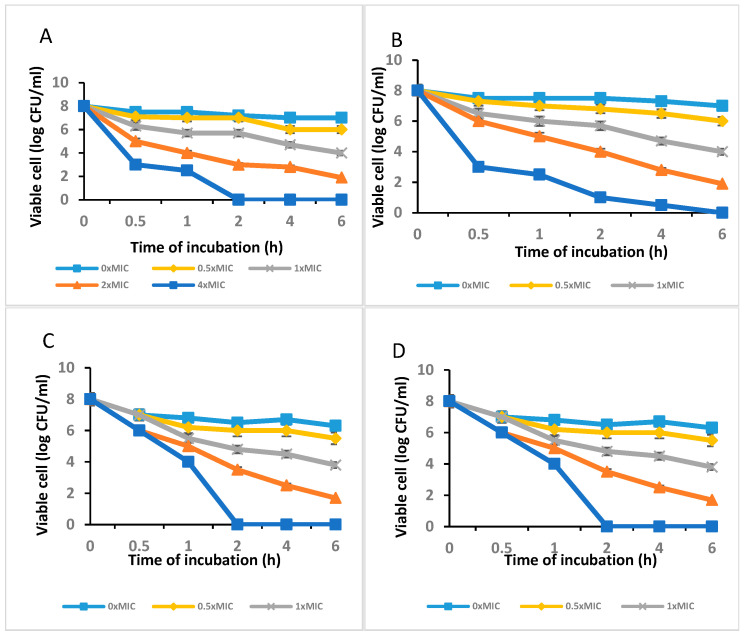
Incorporating nanoparticles into plant cultivation has been shown to improve growth parameters and alter the bioactive component compositions of many plant species, including . The aim of the current study was to investigate the effects of foliar application of zinc oxide nanoparticles on the content of bioactive compounds and their antibacterial activities against potential bacterial pathogens. To this end, leaves were treated with different doses of ZnO NPs to see how this affected their bioactive component composition. The effect of different doses of ZnO NPs on the accumulation of bisdemethoxycurcumin, demethoxycurcumin, and curcumin in ethanolic extracts of rhizomes was evaluated using high-performance liquid chromatography (HPLC). When compared to the control treatment, foliar spraying with (5 and 40 mgL) of ZnO NPs increased bisdemethoxycurcumin, demethoxycurcumin, and curcumin levels approximately (2.69 and 2.84)-, (2.61 and 3.22)-, and (2.90 and 3.45)-fold, respectively. We then checked whether the ethanolic extracts produced from the plantlets changed in terms of their phytochemical makeup and antibacterial properties. Furthermore, the results revealed that -ZnO NPs displayed antibacterial activity against the tested and bacterium strains, but had a few effect against The MIC for was 100 g/mL. The time-kill studies also revealed that ZnO NPs at 4 MIC killed , , and sp. after 2 h, while did not grow when treated with 4 × MIC of the extract for 6 h. The strongest antibacterial activity was seen in the extract from plantlets grown without nanoparticles for , whereas it was seen in the extract from plantlets grown in the presence of 5 mg/L ZnO NPs for , , and . These findings show that ZnO NPs are powerful enhancers of bioactive compound production in a trait that can be used to combat antibiotic resistance in pathogenic bacterial species.
将纳米粒子纳入植物栽培已被证明可以改善许多植物物种的生长参数并改变其生物活性成分的组成,包括 。本研究的目的是研究叶面喷施氧化锌纳米粒子对生物活性化合物含量及其对潜在细菌病原体的抗菌活性的影响。为此,用不同剂量的 ZnO NPs 处理 叶片,以观察这对其生物活性成分组成的影响。使用高效液相色谱法(HPLC)评估不同剂量的 ZnO NPs 对 根茎中双去甲氧基姜黄素、去甲氧基姜黄素和姜黄素在乙醇提取物中的积累的影响。与对照处理相比,叶面喷施(5 和 40 mgL)的 ZnO NPs 使双去甲氧基姜黄素、去甲氧基姜黄素和姜黄素的含量分别增加约(2.69 和 2.84)-、(2.61 和 3.22)-和(2.90 和 3.45)-倍。然后,我们检查了植物产生的乙醇提取物在其植物化学成分和抗菌性能方面是否发生了变化。此外,结果表明,-ZnO NPs 对测试的 和 细菌菌株具有抗菌活性,但对 影响较小。MIC 对 为 100 g/mL。时程杀伤研究还表明,ZnO NPs 在 4 MIC 下 2 小时即可杀死 、 、和 ,而用 4 × MIC 的提取物处理 6 小时后则无法生长。未添加纳米粒子的植物中提取的提取物表现出最强的抗菌活性,为 ,而在添加 5 mg/L ZnO NPs 的植物中提取的提取物表现出最强的抗菌活性,为 、 、和 。这些发现表明,ZnO NPs 是增强 生物活性化合物产生的有力增强剂,这一特性可用于对抗致病性细菌物种的抗生素耐药性。