St. Hedvig Clinical Provincial Hospital, 35-301 Brzozów, Poland.
Institute of Health Sciences, College of Medical Sciences, University of Rzeszów, 35-959 Brzozów, Poland.
Nutrients. 2023 Jun 25;15(13):2869. doi: 10.3390/nu15132869.
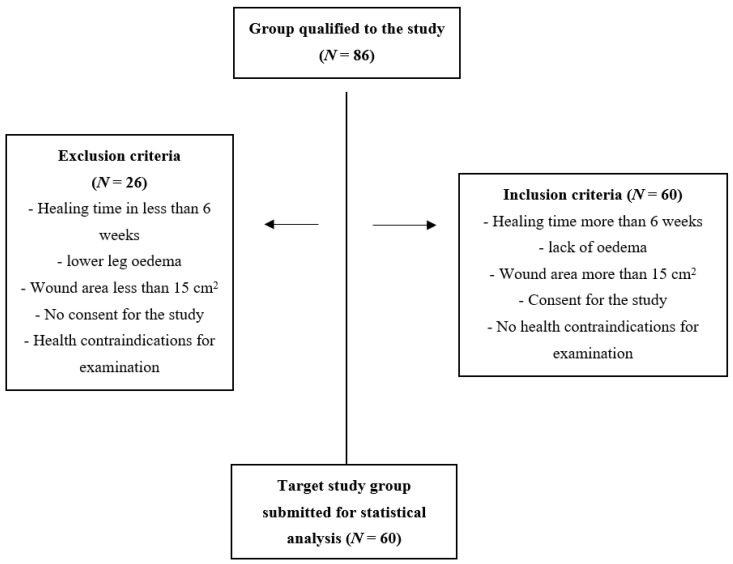
The diagnosis of malnutrition should be one of the pillars of comprehensive patient care, especially in the case of patients with large wounds, prolonged healing, or comorbidities. The condition for a reliable and accurate nutritional diagnosis is to link it with the parameters of nutritional status assessment at the basic level (anthropometric measurements and clinical assessment) and in depth (biochemical tests and bioelectrical impedance). A prospective study included a sample of 60 patients with coexisting chronic wounds (venous ulcers, diabetic foot syndrome, pressure injury) treated at the Wound Treatment Clinic of Fr. B. Markiewicz Podkarpackie Oncology Center (Poland). The method of estimation and diagnostic survey was used; the research tool was a scientific research protocol consisting of four parts. Self-care capacity was assessed based on the Barthel scale, nutritional status using blood biochemical parameters, and electrical bioimpedance. Wounds were classified according to the extent, depth of tissue structures, and potential infection. Subjects with pressure ulcers had statistically significantly lower fat-free mass component indices compared to those with diabetic foot syndrome and venous ulceration. The subjects with pressure ulcers had significantly lower values of body composition components compared to those with diabetic foot syndrome and venous ulcers. In the group of patients with pressure ulcers, the lowest values of albumin (3.20 g/dL), hemoglobin (10.81 g/dL), and nutritional risk index (NRI) (88.13 pts.) scores were confirmed. Subjects with pressure ulcers with limited self-care presented a non-physiological nutritional status, indicating a risk of malnutrition. Local actions related to wound treatment should be preceded by a general examination, considering the state of augmented nutrition with the use of electrical bioimpedance.
营养不良的诊断应该是全面患者护理的支柱之一,特别是对于存在大伤口、愈合时间延长或合并症的患者。进行可靠和准确的营养诊断的条件是将其与基本水平(人体测量学测量和临床评估)和深入水平(生化测试和生物电阻抗)的营养状况评估参数联系起来。一项前瞻性研究纳入了在波兰 Fr. B. Markiewicz 波德拉斯卡肿瘤中心(波兰)的伤口治疗诊所接受治疗的 60 例并存慢性伤口(静脉溃疡、糖尿病足综合征、压力性损伤)患者的样本。采用估计和诊断调查方法;研究工具是由四部分组成的科研方案。自理能力基于巴氏量表进行评估,营养状况使用血液生化参数和电生物阻抗进行评估。伤口根据范围、组织结构深度和潜在感染进行分类。与糖尿病足综合征和静脉溃疡患者相比,压力性溃疡患者的无脂肪质量成分指标具有统计学显著降低。与糖尿病足综合征和静脉溃疡患者相比,压力性溃疡患者的身体成分指标值明显降低。在压力性溃疡患者组中,白蛋白(3.20 g/dL)、血红蛋白(10.81 g/dL)和营养风险指数(NRI)(88.13 分)的最低值得到了证实。自理能力有限的压力性溃疡患者表现出非生理性的营养状态,表明存在营养不良风险。局部与伤口治疗相关的治疗应在进行全身性检查之前进行,考虑到使用电生物阻抗增加营养状态。