Department of Information and Electronic Engineering, Mokpo National University, Muan 58554, Republic of Korea.
Department of Smart Automobile, Pyeongtaek University, Pyeongtaek-si 450-701, Republic of Korea.
Sensors (Basel). 2023 Jun 22;23(13):5808. doi: 10.3390/s23135808.
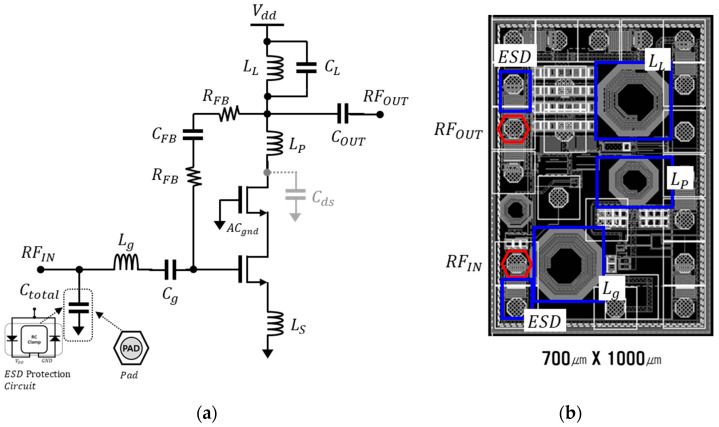
This paper presents a low-noise amplifier (LNA) with an integrated input and output matching network designed using RF-SOI technology. This LNA was designed with a resistive feedback topology and an inductive peaking technology to provide 600 MHz of bandwidth in the N79 band (4.4 GHz to 5.0 GHz). Generally, the resistive feedback structure used in broadband applications allows the input and output impedance to be made to satisfy the broadband conditions through low-impedance feedback. However, feedback impedance for excessive broadband characteristics can degrade the noise performance as a consequence. To achieve a better noise performance for a bandwidth of 600 MHz, the paper provided an optimized noise performance by selecting the feedback resistor value optimized for the N79 band. Additionally, an inductive peaking technique was applied to the designed low-noise amplifier to achieve a better optimized output matching network. The designed low-noise amplifier simulated a gain of 20.68 dB and 19.94 dB from 4.4 to 5.0 GHz, with noise figures of 1.57 dB and 1.73 dB, respectively. The input and output matching networks were also integrated, and the power consumption was designed to be 9.95 mA at a supply voltage of 1.2 V.
本文提出了一种采用 RF-SOI 技术设计的具有集成输入和输出匹配网络的低噪声放大器 (LNA)。该 LNA 采用电阻反馈拓扑结构和电感峰值技术,在 N79 频段(4.4GHz 至 5.0GHz)提供 600MHz 的带宽。通常,用于宽带应用的电阻反馈结构允许通过低阻抗反馈使输入和输出阻抗满足宽带条件。然而,由于过度宽带特性的反馈阻抗会降低噪声性能。为了在 600MHz 的带宽下实现更好的噪声性能,本文通过选择针对 N79 频段优化的反馈电阻值来提供优化的噪声性能。此外,还将电感峰值技术应用于所设计的低噪声放大器,以实现更好的优化输出匹配网络。所设计的低噪声放大器在 4.4GHz 至 5.0GHz 范围内模拟了 20.68dB 和 19.94dB 的增益,噪声系数分别为 1.57dB 和 1.73dB。输入和输出匹配网络也进行了集成,在 1.2V 的电源电压下,功耗设计为 9.95mA。