College of Information Science and Engineering, Xinjiang University, Urumqi 830049, China.
Sensors (Basel). 2023 Jul 7;23(13):6228. doi: 10.3390/s23136228.
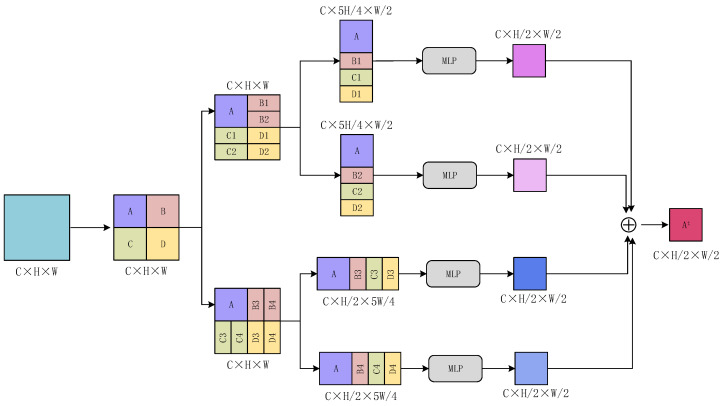
Although convolutional neural networks (CNNs) have produced great achievements in various fields, many scholars are still exploring better network models, since CNNs have an inherent limitation-that is, the remote modeling ability of convolutional kernels is limited. On the contrary, the transformer has been applied by many scholars to the field of vision, and although it has a strong global modeling capability, its close-range modeling capability is mediocre. While the foreground information to be segmented in medical images is usually clustered in a small interval in the image, the distance between different categories of foreground information is uncertain. Therefore, in order to obtain a perfect medical segmentation prediction graph, the network should not only have a strong learning ability for local details, but also have a certain distance modeling ability. To solve these problems, a remote feature exploration (RFE) module is proposed in this paper. The most important feature of this module is that remote elements can be used to assist in the generation of local features. In addition, in order to better verify the feasibility of the innovation in this paper, a new multi-organ segmentation dataset (MOD) was manually created. While both the MOD and Synapse datasets label eight categories of organs, there are some images in the Synapse dataset that label only a few categories of organs. The proposed method achieved 79.77% and 75.12% DSC on the Synapse and MOD datasets, respectively. Meanwhile, the 95 (mm) scores were 21.75 on Synapse and 7.43 on the MOD dataset.
尽管卷积神经网络 (CNN) 在各个领域取得了巨大成就,但许多学者仍在探索更好的网络模型,因为 CNN 存在固有局限性——即卷积核的远程建模能力有限。相比之下,许多学者已经将 Transformer 应用于视觉领域,尽管它具有很强的全局建模能力,但它的近距离建模能力却很平庸。而医学图像中要分割的前景信息通常在图像的小间隔内聚类,不同类别的前景信息之间的距离是不确定的。因此,为了获得完美的医学分割预测图,网络不仅应该具有很强的局部细节学习能力,还应该具有一定的距离建模能力。为了解决这些问题,本文提出了一种远程特征探索 (RFE) 模块。该模块最重要的特点是可以利用远程元素来辅助生成局部特征。此外,为了更好地验证本文创新的可行性,还手动创建了一个新的多器官分割数据集 (MOD)。虽然 Synapse 和 MOD 数据集都对 8 类器官进行了标注,但 Synapse 数据集中的一些图像只标注了少数几类器官。所提出的方法在 Synapse 和 MOD 数据集上的 DSC 分别达到了 79.77%和 75.12%。同时,Synapse 数据集上的 95(mm)评分是 21.75,MOD 数据集上的评分是 7.43。