Wamae Kevin, Ndwiga Leonard, Kharabora Oksana, Kimenyi Kelvin, Osoti Victor, de Laurent Zaydah, Wambua Juliana, Musyoki Jennifer, Ngetsa Caroline, Kalume Peter, Mwambingu Gabriel, Hamaluba Mainga, van der Pluijm Rob, Dondorp Arjen M, Bailey Jeffrey, Juliano Jonathan, Bejon Philip, Ochola-Oyier Lynette
Bioscience, KEMRI-Wellcome Trust Research Programme, Kilifi, Kenya.
Division of Infectious Diseases, Department of Medicine, School of Medicine, University of North Carolina at Chapel Hill, Chapel Hill, North Carolina, 27599, USA.
Wellcome Open Res. 2024 Mar 14;7:95. doi: 10.12688/wellcomeopenres.17736.4. eCollection 2022.
Antimalarial therapeutic efficacy studies are routinely conducted in malaria-endemic countries to assess the effectiveness of antimalarial treatment strategies. Targeted amplicon sequencing (AmpSeq) uniquely identifies and quantifies genetically distinct parasites within an infection. In this study, AmpSeq of apical membrane antigen 1 ( ), and multidrug resistance gene 1 ( ), were used to characterise the complexity of infection (COI) and drug-resistance genotypes, respectively.
-positive samples were obtained from a triple artemisinin combination therapy clinical trial conducted in 30 children under 13 years of age between 2018 and 2019 in Kilifi, Kenya. Nine of the 30 participants presented with recurrent parasitemia from day 26 (624h) onwards. The and genes were amplified and sequenced, while , data were obtained from the original clinical study.
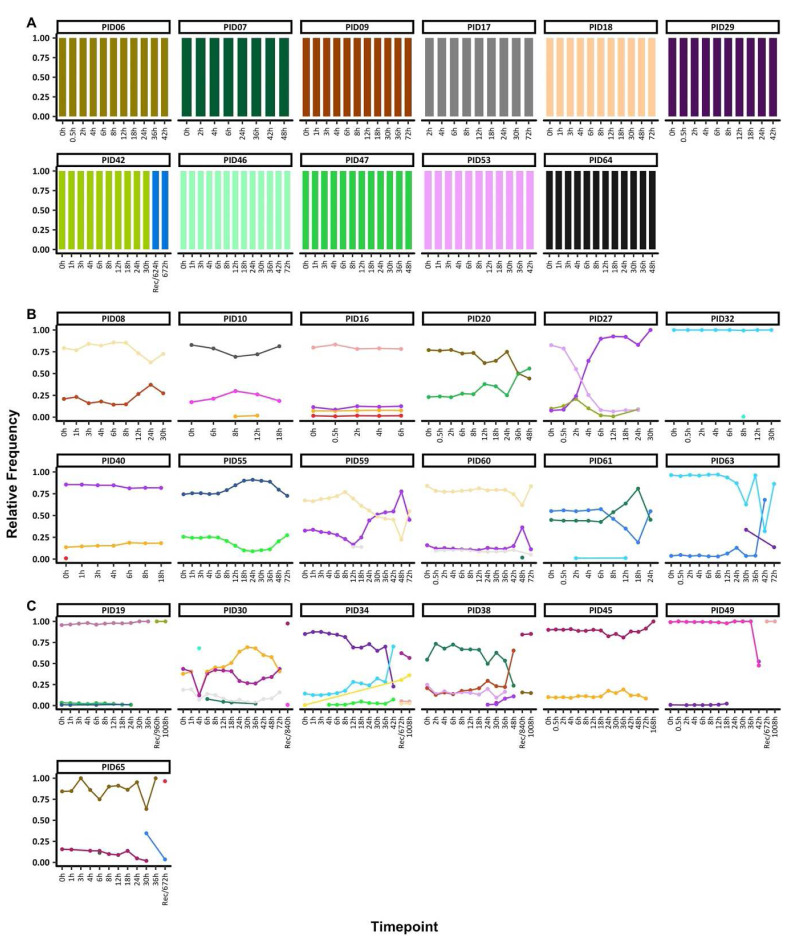
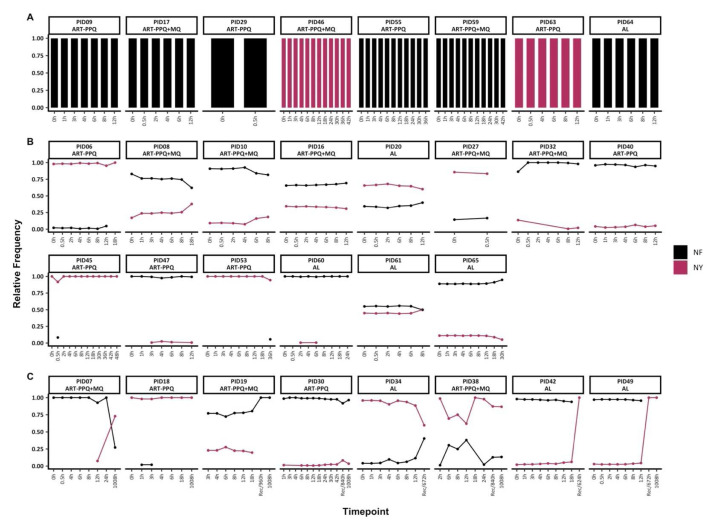
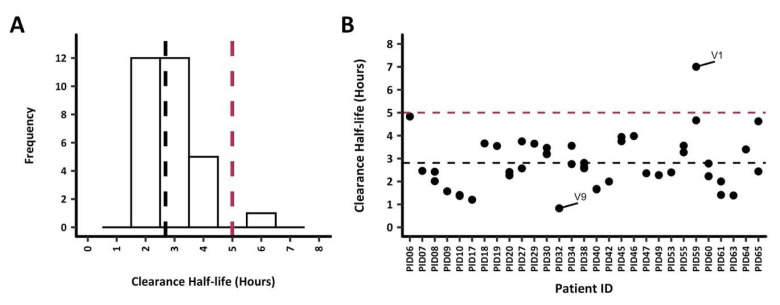
The COI was comparable between and , ; overall, detected more microhaplotypes. Based on ama1, a stable number of microhaplotypes were detected throughout treatment until day 3. Additionally, a recrudescent infection was identified with an microhaplotype initially observed at 30h and later in an unscheduled follow-up visit. Using the relative frequencies of microhaplotypes and parasitemia, we identified a fast (<1h) and slow (>5h) clearing microhaplotype. As expected, only two microhaplotypes (NF and NY) were identified based on the combination of amino acid polymorphisms at codons 86 and 184.
This study highlights AmpSeq as a tool for highly-resolution tracking of parasite microhaplotypes throughout treatment and can detect variation in microhaplotype clearance estimates. AmpSeq can also identify slow-clearing microhaplotypes, a potential early sign of selection during treatment. Consequently, AmpSeq has the capability of improving the discriminatory power to distinguish recrudescences from reinfections accurately.
抗疟治疗效果研究通常在疟疾流行国家进行,以评估抗疟治疗策略的有效性。靶向扩增子测序(AmpSeq)能独特地识别和量化感染中基因不同的寄生虫。在本研究中,分别使用顶端膜抗原1( )和多药耐药基因1( )的AmpSeq来表征感染复杂性(COI)和耐药基因型。
从2018年至2019年在肯尼亚基利菲对30名13岁以下儿童进行的三联青蒿素联合疗法临床试验中获取 阳性样本。30名参与者中有9名从第26天(624小时)起出现复发性寄生虫血症。对 和 基因进行扩增和测序,而 、 数据则从原始临床研究中获取。
COI在 和 、 之间具有可比性;总体而言, 检测到更多微单倍型。基于ama1,在整个治疗过程直至第3天检测到稳定数量的微单倍型。此外,在30小时首次观察到并在计划外随访中后来发现的一种 微单倍型被鉴定为复燃感染。利用 微单倍型的相对频率和寄生虫血症,我们鉴定出一种快速(<1小时)和缓慢(>5小时)清除的微单倍型。正如预期的那样,基于密码子86和184处氨基酸多态性的组合,仅鉴定出两种 微单倍型(NF和NY)。
本研究强调AmpSeq作为一种在整个治疗过程中对寄生虫微单倍型进行高分辨率追踪的工具,并且能够检测微单倍型清除估计值的变化。AmpSeq还可以识别清除缓慢的微单倍型,这是治疗期间选择的一个潜在早期迹象。因此,AmpSeq有能力提高准确区分复燃与再感染的辨别力。