Department of Neurosurgery, Hospital Universitario 12 de Octubre, Madrid, Spain
Universidad Complutense de Madrid, Facultad de Medicina, Departamento de Cirugía, Madrid, Spain.
BMJ Open. 2023 Jul 17;13(7):e071467. doi: 10.1136/bmjopen-2022-071467.
Two blood brain-derived biomarkers, glial fibrillar acidic protein (GFAP) and ubiquitin carboxy-terminal hydrolase L1 (UCH-L1), can rule out intracranial lesions in patients with mild traumatic brain injury (mTBI) when assessed within the first 12 hours. Most elderly patients were excluded from previous studies due to comorbidities. Biomarker use in elderly population could be affected by increased basal levels. This study will assess the performance of an automated test for measuring serum GFAP and UCH-L1 in elderly patients to predict the absence of intracranial lesions on head CT scans after mTBI, and determine both biomarkers reference values in a non-TBI elderly population.
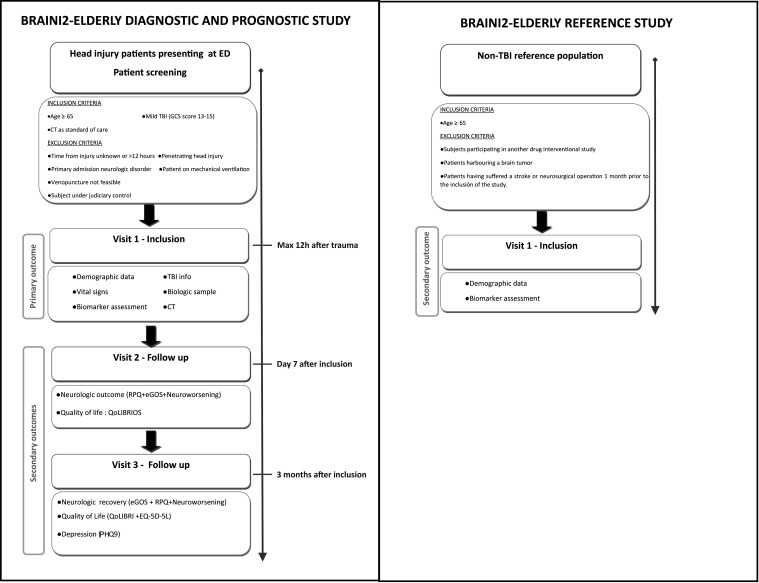
This is a prospective multicentre observational study on elderly patients (≥65 years) that will be performed in Spain, France and Germany. Two patient groups will be included in two independent substudies. (1) A cohort of 2370 elderly patients (1185<80 years and 1185≥80 years; BRAINI2-ELDERLY DIAGNOSTIC AND PROGNOSTIC STUDY) with mTBI and a brain CT scan that will undergo blood sampling within 12 hours after mTBI. The primary outcome measure is the diagnostic performance of GFAP and UCH-L1 measured using an automated assay for discriminating between patients with positive and negative findings on brain CT scans. Secondary outcome measures include the performance of both biomarkers in predicting early (1 week) and midterm (3 months) neurological status and quality of life after trauma. (2) A cohort of 480 elderly reference participants (BRAINI2-ELDERLY REFERENCE STUDY) in whom reference values for GFAP and UCHL1 will be determined.
Ethical approval was obtained from the Institutional Review Boards of Hospital 12 de Octubre in Spain (Re#22/027) and Southeast VI (Clermont Ferrand Hospital) (Re# 22.01782.000095) in France. The study's results will be presented at scientific meetings and published in peer-review publications.
NCT05425251.
两种血脑源性生物标志物,胶质纤维酸性蛋白(GFAP)和泛素羧基末端水解酶 L1(UCH-L1),可在伤后 12 小时内评估排除轻度创伤性脑损伤(mTBI)患者的颅内病变。由于合并症,大多数老年患者被排除在以前的研究之外。生物标志物在老年人群中的使用可能受到基础水平升高的影响。本研究将评估一种用于测量血清 GFAP 和 UCH-L1 的自动检测在 mTBI 后预测老年患者头部 CT 扫描无颅内病变的表现,并确定非 TBI 老年人群中这两种生物标志物的参考值。
这是一项在西班牙、法国和德国进行的前瞻性多中心观察性研究,将纳入老年患者(≥65 岁)。将在两项独立的亚研究中纳入两组患者。(1)一组 2370 例老年 mTBI 患者(<80 岁 1185 例,≥80 岁 1185 例;BRAINI2-ELDERLY DIAGNOSTIC AND PROGNOSTIC STUDY),在 mTBI 后 12 小时内进行颅脑 CT 扫描和采血。主要结局指标是使用自动检测区分颅脑 CT 扫描阳性和阴性患者的 GFAP 和 UCH-L1 的诊断性能。次要结局指标包括两种生物标志物在预测创伤后早期(1 周)和中期(3 个月)神经状态和生活质量方面的表现。(2)一组 480 例老年参考参与者(BRAINI2-ELDERLY REFERENCE STUDY),将确定 GFAP 和 UCHL1 的参考值。
西班牙 12 月 12 日医院的机构审查委员会(Re#22/027)和法国东南部 VI 区(克莱蒙费朗医院)(Re#22.01782.000095)获得了伦理批准。研究结果将在科学会议上报告,并发表在同行评议的出版物上。
NCT05425251。