Toulouse Institute for Infectious and Inflammatory Diseases (Infinity) INSERM UMR1291-CNRS UMR5051-University Toulouse III , Toulouse, France.
Centre for Inflammation Research and Centre for Reproductive Health, Queens Medical Research Institute, University of Edinburgh , Edinburgh, UK.
J Exp Med. 2023 Oct 2;220(10). doi: 10.1084/jem.20230570. Epub 2023 Jul 18.
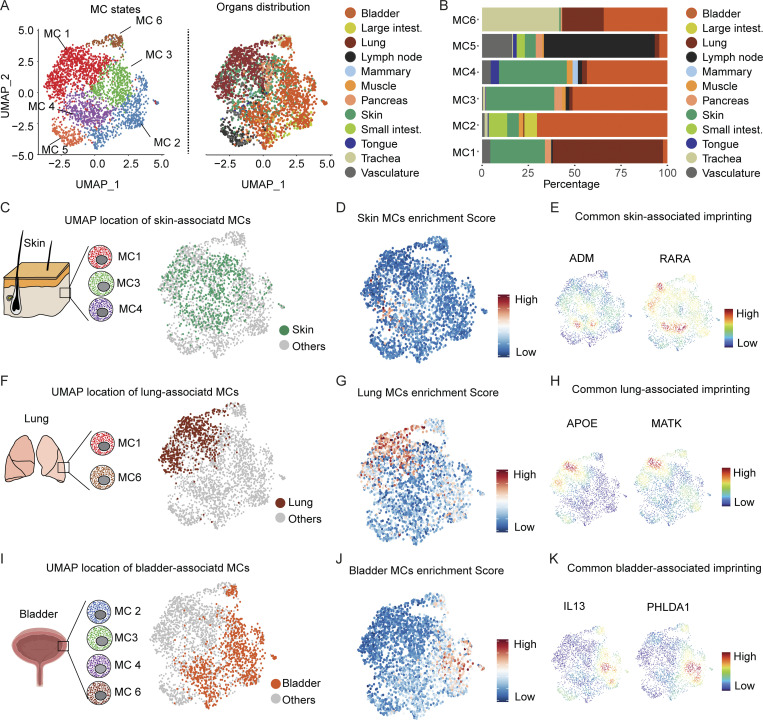
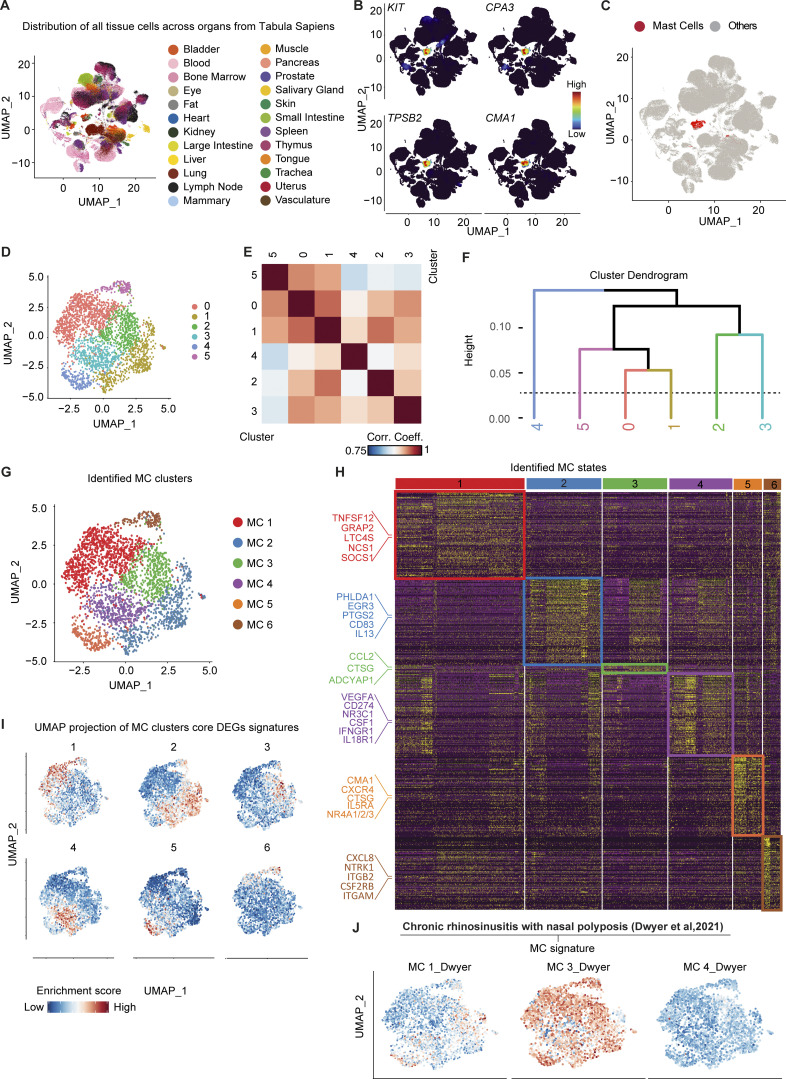
Mast cells (MCs) are tissue-resident immune cells that exhibit homeostatic and neuron-associated functions. Here, we combined whole-tissue imaging and single-cell RNA sequencing datasets to generate a pan-organ analysis of MCs in mice and humans at steady state. In mice, we identify two mutually exclusive MC populations, MrgprB2+ connective tissue-type MCs and MrgprB2neg mucosal-type MCs, with specific transcriptomic core signatures. While MrgprB2+ MCs develop in utero independently of the bone marrow, MrgprB2neg MCs develop after birth and are renewed by bone marrow progenitors. In humans, we unbiasedly identify seven MC subsets (MC1-7) distributed across 12 organs with different transcriptomic core signatures. MC1 are preferentially enriched in the bladder, MC2 in the lungs, and MC4, MC6, and MC7 in the skin. Conversely, MC3 and MC5 are shared by most organs but not skin. This comprehensive analysis offers valuable insights into the natural diversity of MC subtypes in both mice and humans.
肥大细胞(MCs)是组织驻留的免疫细胞,具有稳态和神经元相关的功能。在这里,我们结合全组织成像和单细胞 RNA 测序数据集,对稳态下小鼠和人类的 MC 进行了全面的器官分析。在小鼠中,我们鉴定出两种相互排斥的 MC 群体,MrgprB2+结缔组织型 MC 和 MrgprB2neg 黏膜型 MC,它们具有特定的转录组核心特征。虽然 MrgprB2+MC 在子宫内独立于骨髓发育,但 MrgprB2neg MC 在出生后发育,并由骨髓祖细胞更新。在人类中,我们无偏见地鉴定出分布在 12 个器官中的 7 种 MC 亚群(MC1-7),它们具有不同的转录组核心特征。MC1 优先富集在膀胱中,MC2 在肺部,MC4、MC6 和 MC7 在皮肤中。相反,MC3 和 MC5 存在于大多数器官中,但不存在于皮肤中。这项全面的分析为小鼠和人类 MC 亚型的自然多样性提供了有价值的见解。