Turner Institute for Brain and Mental Health, Monash University, Melbourne, Victoria, Australia.
Harvard T.H. Chan School of Public Health, Massachusetts.
JAMA Netw Open. 2023 Jul 3;6(7):e2325152. doi: 10.1001/jamanetworkopen.2023.25152.
Good sleep is essential for health, yet associations between sleep and dementia risk remain incompletely understood. The Sleep and Dementia Consortium was established to study associations between polysomnography (PSG)-derived sleep and the risk of dementia and related cognitive and brain magnetic resonance imaging endophenotypes.
To investigate association of sleep architecture and obstructive sleep apnea (OSA) with cognitive function in the Sleep and Dementia Consortium.
DESIGN, SETTING, AND PARTICIPANTS: The Sleep and Dementia Consortium curated data from 5 population-based cohorts across the US with methodologically consistent, overnight, home-based type II PSG and neuropsychological assessments over 5 years of follow-up: the Atherosclerosis Risk in Communities study, Cardiovascular Health Study, Framingham Heart Study (FHS), Osteoporotic Fractures in Men Study, and Study of Osteoporotic Fractures. Sleep metrics were harmonized centrally and then distributed to participating cohorts for cohort-specific analysis using linear regression; study-level estimates were pooled in random effects meta-analyses. Results were adjusted for demographic variables, the time between PSG and neuropsychological assessment (0-5 years), body mass index, antidepressant use, and sedative use. There were 5946 participants included in the pooled analyses without stroke or dementia. Data were analyzed from March 2020 to June 2023.
Measures of sleep architecture and OSA derived from in-home PSG.
The main outcomes were global cognitive composite z scores derived from principal component analysis, with cognitive domains investigated as secondary outcomes. Higher scores indicated better performance.
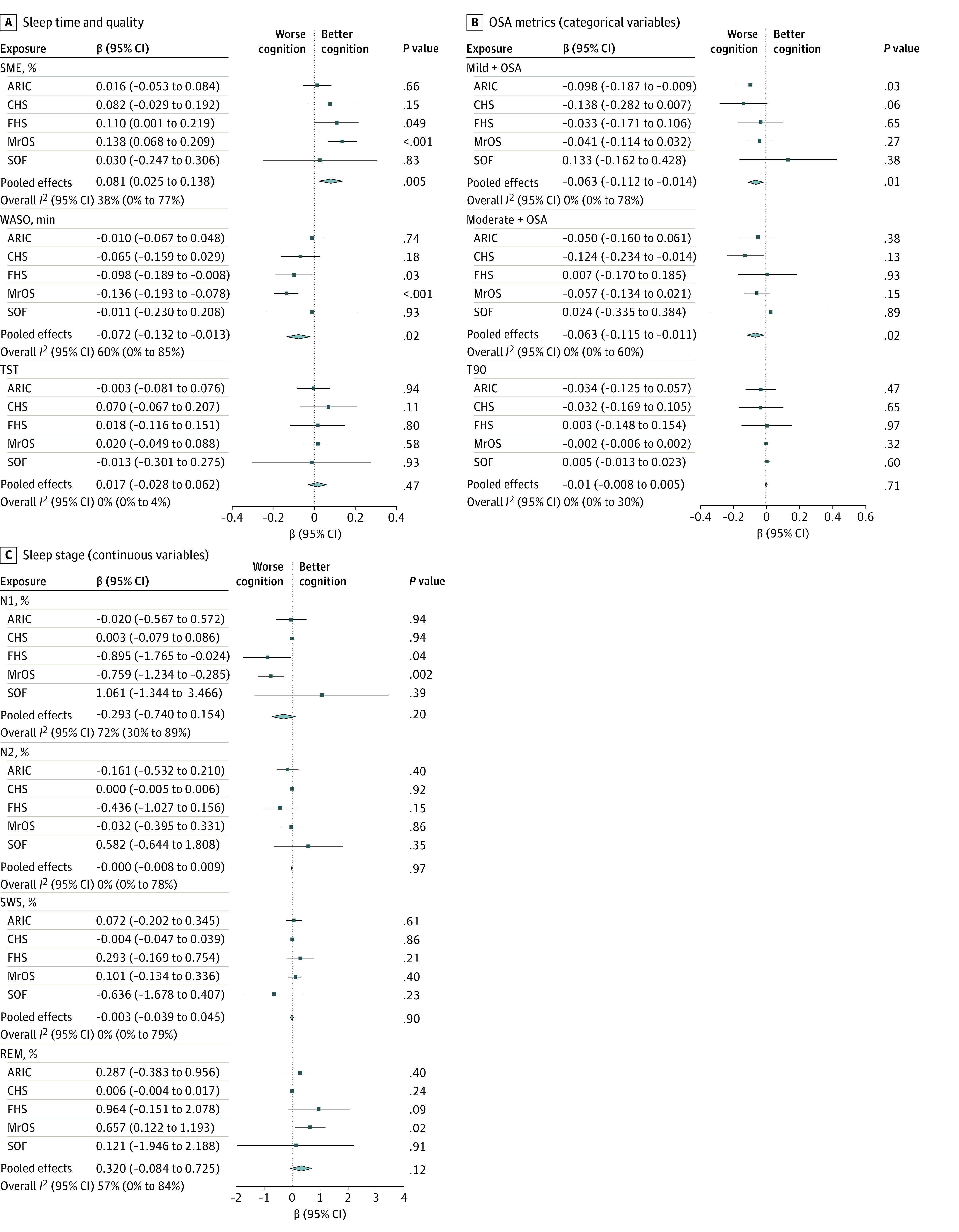
Across cohorts, 5946 adults (1875 females [31.5%]; mean age range, 58-89 years) were included. The median (IQR) wake after sleep onset time ranged from 44 (27-73) to 101 (66-147) minutes, and the prevalence of moderate to severe OSA ranged from 16.9% to 28.9%. Across cohorts, higher sleep maintenance efficiency (pooled β per 1% increase, 0.08; 95% CI, 0.03 to 0.14; P < .01) and lower wake after sleep onset (pooled β per 1-min increase, -0.07; 95% CI, -0.13 to -0.01 per 1-min increase; P = .02) were associated with better global cognition. Mild to severe OSA (apnea-hypopnea index [AHI] ≥5) was associated with poorer global cognition (pooled β, -0.06; 95% CI, -0.11 to -0.01; P = .01) vs AHI less than 5; comparable results were found for moderate to severe OSA (pooled β, -0.06; 95% CI, -0.11 to -0.01; P = .02) vs AHI less than 5. Differences in sleep stages were not associated with cognition.
This study found that better sleep consolidation and the absence of OSA were associated with better global cognition over 5 years of follow-up. These findings suggest that the role of interventions to improve sleep for maintaining cognitive function requires investigation.
良好的睡眠对健康至关重要,但睡眠与痴呆风险之间的关联仍不完全清楚。睡眠与痴呆症联合会的成立旨在研究多导睡眠图(PSG)衍生的睡眠与痴呆症风险以及相关认知和大脑磁共振成像表型之间的关联。
研究睡眠结构和阻塞性睡眠呼吸暂停(OSA)与睡眠与痴呆症联合会认知功能的关系。
设计、地点和参与者:睡眠与痴呆症联合会从美国 5 个基于人群的队列中整理数据,这些队列具有一致的方法学、夜间、家庭式 II 型 PSG 和 5 年随访期间的神经心理学评估:动脉粥样硬化风险社区研究、心血管健康研究、弗雷明汉心脏研究(FHS)、男性骨质疏松性骨折研究和骨质疏松性骨折研究。睡眠指标在中心进行了协调,然后分发给参与队列,以便使用线性回归进行队列特定分析;使用随机效应荟萃分析汇总研究水平的估计值。结果调整了人口统计学变量、PSG 和神经心理学评估之间的时间(0-5 年)、体重指数、抗抑郁药使用和镇静剂使用。共有 5946 名参与者未发生中风或痴呆,纳入汇总分析。数据于 2020 年 3 月至 2023 年 6 月进行分析。
源自家庭 PSG 的睡眠结构和 OSA 测量。
主要结果是从主成分分析中得出的全球认知综合 z 分数,研究了认知域作为次要结果。较高的分数表示更好的表现。
在整个队列中,包括 5946 名成年人(1875 名女性[31.5%];平均年龄范围为 58-89 岁)。睡眠后觉醒时间中位数(IQR)范围为 44(27-73)至 101(66-147)分钟,中重度 OSA 的患病率范围为 16.9%至 28.9%。在整个队列中,睡眠维持效率每增加 1%(β,0.08;95%CI,0.03 至 0.14;P<0.01)和睡眠后觉醒减少(β,-0.07;95%CI,-0.13 至-0.01 每增加 1 分钟;P=0.02)与全球认知能力提高相关。轻度至重度 OSA(呼吸暂停低通气指数 [AHI]≥5)与全球认知能力较差相关(β,-0.06;95%CI,-0.11 至-0.01;P=0.01)与 AHI<5;中度至重度 OSA 也有类似的结果(β,-0.06;95%CI,-0.11 至-0.01;P=0.02)与 AHI<5。睡眠阶段的差异与认知无关。
这项研究发现,睡眠巩固较好且不存在 OSA 与 5 年随访期间的整体认知能力提高有关。这些发现表明,需要研究改善睡眠以维持认知功能的干预措施的作用。