Department of Pathology, University of Pittsburgh School of Medicine, Pittsburgh, PA, USA.
Department of Pediatrics, University of Pittsburgh School of Medicine, Pittsburgh, PA, USA.
Exp Mol Med. 2023 Jul;55(7):1380-1387. doi: 10.1038/s12276-023-01042-9. Epub 2023 Jul 18.
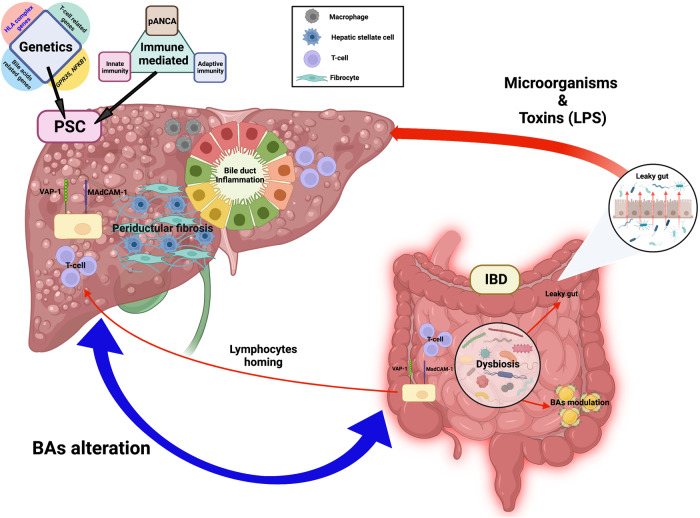
The close relationship between primary sclerosing cholangitis (PSC) and inflammatory bowel disease (IBD) provides a good opportunity to comprehend the gut-liver axis. The gut and the liver have reciprocal interactions, including how gut inflammation influences the liver through immune cells and the microbiota and how the microbiota in the gut modifies bile acids, which are produced and secreted from the liver. PSC-IBD shows distinct clinical findings from classical IBD. In addition, a distinct genetic predisposition and unique microbiota composition suggest that PSC-IBD is an independent disease entity. Understanding the pathogenesis of PSC-IBD helps to develop novel and effective therapeutic agents. Given the high risk of malignancies associated with PSC-IBD, it is critical to identify patients at high risk and implement appropriate surveillance and monitoring strategies. In this review, we provide an overview of PSC-IBD, which exemplifies the gut-liver axis.
原发性硬化性胆管炎 (PSC) 与炎症性肠病 (IBD) 之间的密切关系为理解肠-肝轴提供了一个很好的机会。肠道和肝脏之间存在相互作用,包括肠道炎症如何通过免疫细胞和微生物群影响肝脏,以及肠道中的微生物群如何改变肝脏产生和分泌的胆汁酸。PSC-IBD 与经典 IBD 具有明显不同的临床特征。此外,独特的遗传易感性和独特的微生物群组成表明 PSC-IBD 是一种独立的疾病实体。了解 PSC-IBD 的发病机制有助于开发新的有效治疗药物。鉴于 PSC-IBD 与恶性肿瘤的高风险相关,确定高危患者并实施适当的监测和监测策略至关重要。在这篇综述中,我们概述了 PSC-IBD,它体现了肠-肝轴。