Department of Infectious Diseases, The First Affiliated Hospital of Xi'an Jiaotong University, Xi'an, China.
Department of Scientific Affairs, Hugobiotech Co., Ltd, Beijing, China.
BMC Infect Dis. 2023 Jul 18;23(1):478. doi: 10.1186/s12879-023-08417-3.
Metagenomic next-generation sequencing (mNGS) is a novel nucleic acid method for the detection of unknown and difficult pathogenic microorganisms, and its application in the etiological diagnosis of fever of unknown origin (FUO) is less reported. We aimed to comprehensively assess the value of mNGS in the etiologic diagnosis of FUO by the pathogen spectrum and diagnostic performance, and to investigate whether it is different in the time to diagnosis, length of hospitalization, antibiotic consumption and cost between FUO patients with and without early application of mNGS.
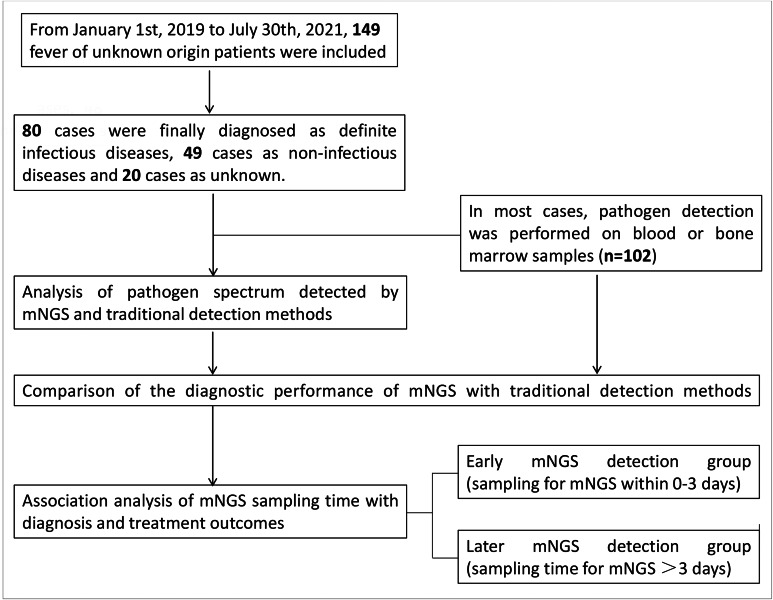
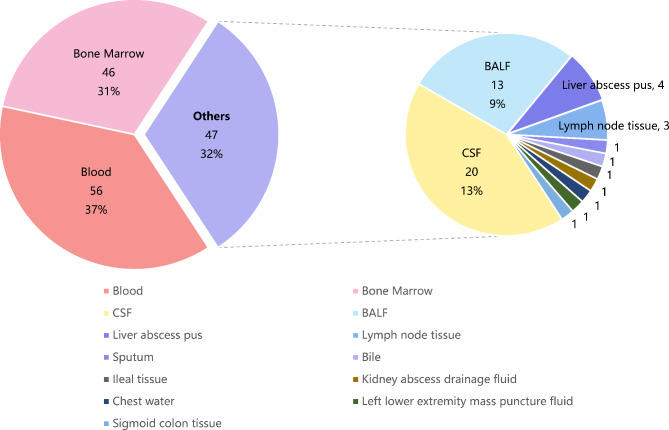
A total of 149 FUO inpatients underwent both mNGS and routine pathogen detection was retrospectively analyzed. The diagnostic performance of mNGS, culture and CMTs for the final clinical diagnosis was evaluated by using sensitivity, specificity, positive predictive value, negative predictive value and total conforming rate. Patients were furtherly divided into two groups: the earlier mNGS detection group (sampling time: 0 to 3 days of the admission) and the later mNGS detection group (sampling time: after 3 days of the admission). The length of hospital stay, time spent on diagnosis, cost and consumption of antibiotics were compared between the two groups.
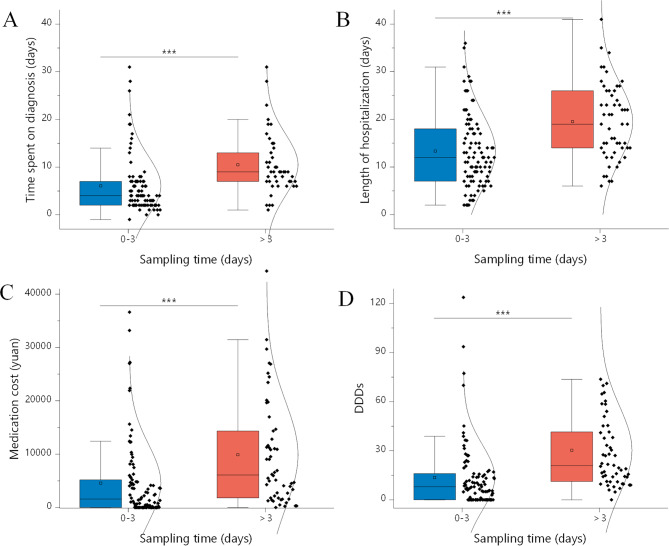
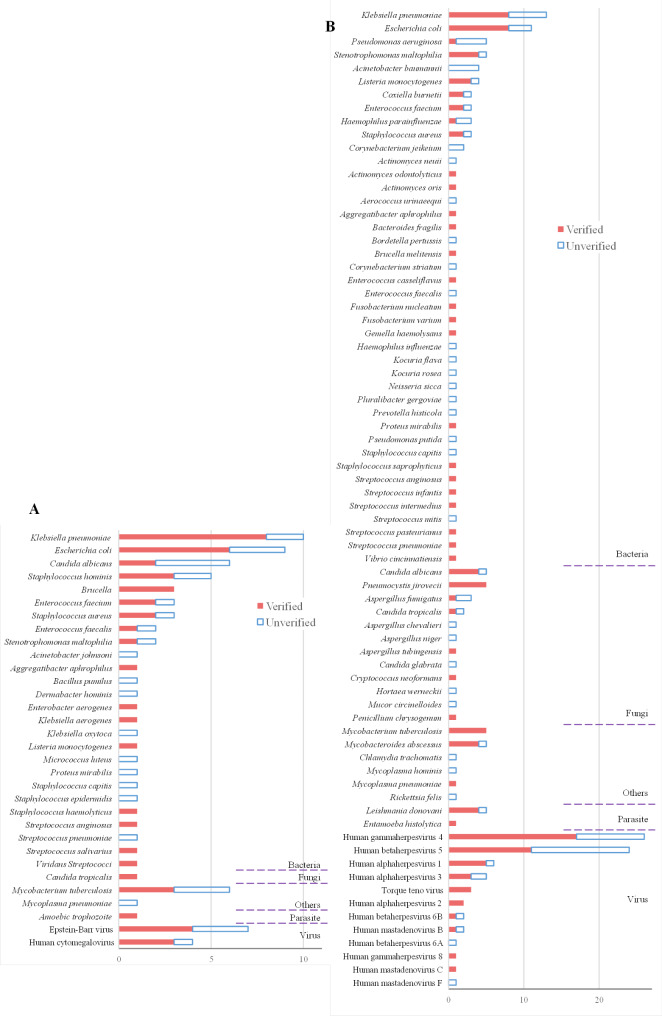
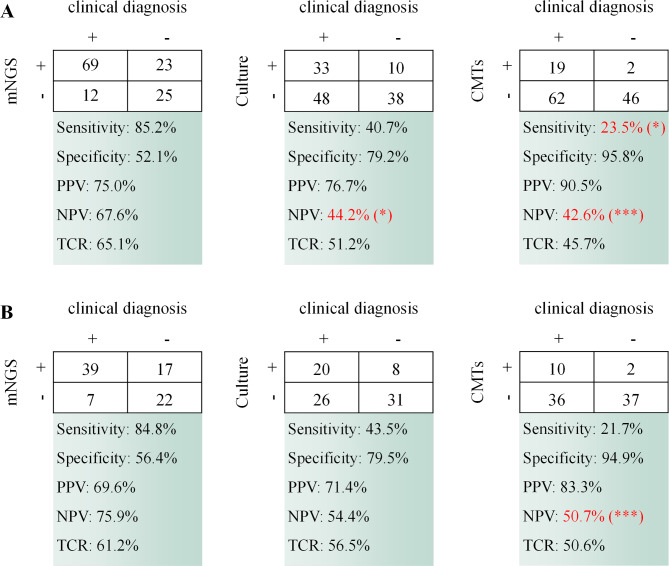
Compared with the conventional microbiological methods, mNGS detected much more species and had the higher negative predictive (67.6%) and total conforming rate (65.1%). Patients with mNGS sampled earlier had a significantly shorter time to diagnosis (6.05+/-6.23 vs. 10.5+/-6.4 days, P < 0.001) and days of hospital stay (13.7+/-20.0 vs. 30.3 +/-26.9, P < 0.001), as well as a significantly less consumption (13.3+/-7.8 vs. 19.5+/-8.0, P < 0.001) and cost (4543+/-7326 vs. 9873 +/- 9958 China Yuan [CNY], P = 0.001) of antibiotics compared with the patients sampled later.
mNGS could significantly improve the detected pathogen spectrum, clinical conforming rate of pathogens while having good negative predictive value for ruling out infections. Early mNGS detection may shorten the diagnosis time and hospitalization days and reduce unnecessary consumption of antibiotics.
宏基因组下一代测序(mNGS)是一种新型核酸方法,用于检测未知和难以检测的致病微生物,其在不明原因发热(FUO)病因诊断中的应用报道较少。我们旨在通过病原体谱和诊断性能全面评估 mNGS 在 FUO 病因诊断中的价值,并探讨 FUO 患者是否在诊断时间、住院时间、抗生素使用量和费用方面存在差异,以及早期应用 mNGS 是否存在差异。
回顾性分析了 149 例 FUO 住院患者同时进行 mNGS 和常规病原体检测。通过灵敏度、特异性、阳性预测值、阴性预测值和总符合率评估 mNGS、培养和 CMTs 对最终临床诊断的诊断性能。患者进一步分为两组:mNGS 检测较早组(采样时间:入院后 0 至 3 天)和 mNGS 检测较晚组(采样时间:入院后 3 天)。比较两组之间的住院时间、诊断时间、费用和抗生素使用量。
与传统微生物学方法相比,mNGS 检测到的物种更多,阴性预测值(67.6%)和总符合率(65.1%)更高。mNGS 采样较早的患者诊断时间明显缩短(6.05+/-6.23 比 10.5+/-6.4 天,P<0.001)和住院天数(13.7+/-20.0 比 30.3 +/-26.9,P<0.001),以及抗生素使用量(13.3+/-7.8 比 19.5+/-8.0,P<0.001)和费用(4543+/-7326 比 9873 +/- 9958 元人民币,P=0.001)明显减少。
mNGS 可以显著提高检测病原体谱的范围,病原体的临床符合率高,阴性预测值好,可排除感染。早期 mNGS 检测可缩短诊断时间和住院时间,减少不必要的抗生素使用。