Villalobos Joel, Payne Sophie C, Ward Glenn M, Andrikopoulos Sofianos, Hyakumura Tomoko, MacIsaac Richard J, Fallon James B
Bionics Institute, East Melbourne, Vic, Australia.
Department of Medical Bionics, University of Melbourne, Parkville, Vic, Australia.
Bioelectron Med. 2023 Jul 18;9(1):16. doi: 10.1186/s42234-023-00117-2.
Autonomic nerve stimulation is used as a treatment for a growing number of diseases. We have previously demonstrated that application of efferent vagus nerve stimulation (eVNS) has promising glucose lowering effects in a rat model of type 2 diabetes. This paradigm combines high frequency pulsatile stimulation to block nerve activation in the afferent direction with low frequency stimulation to activate the efferent nerve section. In this study we explored the effects of the parameters for nerve blocking on the ability to inhibit nerve activation in the afferent direction. The overarching aim is to establish a blocking stimulation strategy that could be applied using commercially available implantable pulse generators used in the clinic.
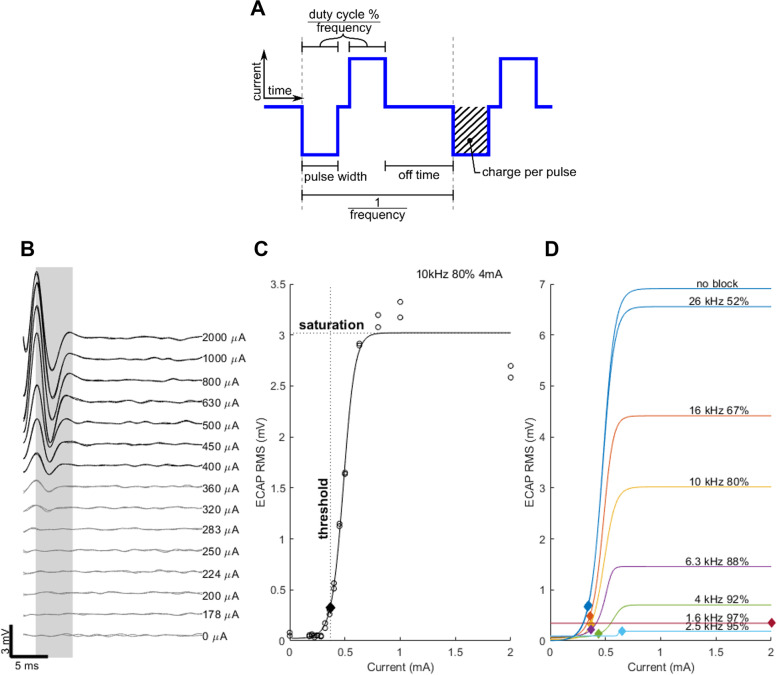
Male rats (n = 20) had the anterior abdominal vagus nerve implanted with a multi-electrode cuff. Evoked compound action potentials (ECAP) were recorded at the proximal end of the electrode cuff. The efficacy of high frequency stimulation to block the afferent ECAP was assessed by changes in the threshold and saturation level of the response. Blocking frequency and duty cycle of the blocking pulses were varied while maintaining a constant 4 mA current amplitude.
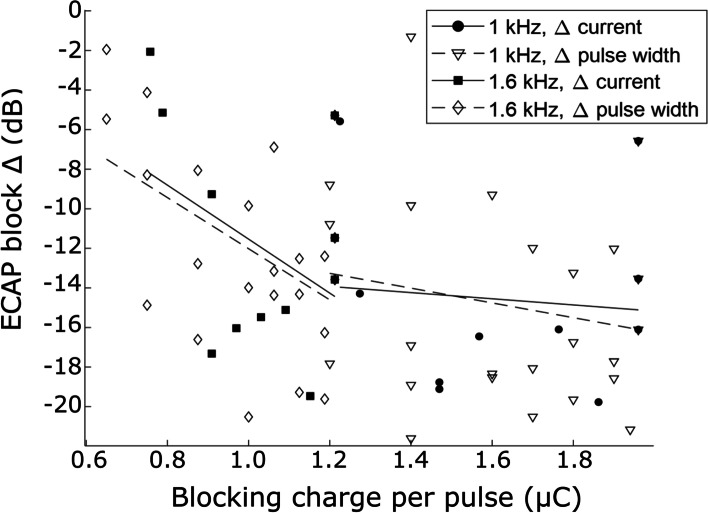
During application of blocking at lower frequencies (≤ 4 kHz), the ECAP threshold increased (ANOVA, p < 0.001) and saturation level decreased (p < 0.001). Application of higher duty cycles (> 70%) led to an increase in evoked neural response threshold (p < 0.001) and a decrease in saturation level (p < 0.001). During the application of a constant pulse width and frequency (1 or 1.6 kHz, > 70% duty cycle), the charge delivered per pulse had a significant influence on the magnitude of the block (ANOVA, p = 0.003), and was focal (< 2 mm range).
This study has determined the range of frequencies, duty cycles and currents of high frequency stimulation that generate an efficacious, focal axonal block of a predominantly C-fiber tract. These findings could have potential application for the treatment of type 2 diabetes.
自主神经刺激正被用于治疗越来越多的疾病。我们之前已经证明,在2型糖尿病大鼠模型中,应用传出迷走神经刺激(eVNS)具有显著的降血糖作用。这种模式将高频脉冲刺激与低频刺激相结合,高频脉冲刺激用于阻断传入方向的神经激活,低频刺激用于激活传出神经部分。在本研究中,我们探讨了神经阻断参数对抑制传入方向神经激活能力的影响。总体目标是建立一种阻断刺激策略,该策略可使用临床上可用的植入式脉冲发生器来应用。
雄性大鼠(n = 20)的腹前迷走神经植入多电极袖带。在电极袖带近端记录诱发复合动作电位(ECAP)。通过反应阈值和饱和水平的变化评估高频刺激阻断传入ECAP的效果。在保持4 mA恒定电流幅度的同时,改变阻断脉冲的频率和占空比。
在较低频率(≤4 kHz)进行阻断时,ECAP阈值升高(方差分析,p < 0.001),饱和水平降低(p < 0.叭)。应用更高的占空比(>70%)导致诱发神经反应阈值升高(p < 0.001),饱和水平降低(p < 0.001)。在应用恒定脉冲宽度和频率(1或1.6 kHz,占空比>70%)时,每个脉冲传递的电荷量对阻断幅度有显著影响(方差分析,p = 0.003),且具有局灶性(范围<2 mm)。
本研究确定了高频刺激的频率、占空比和电流范围,这些参数可产生对主要为C纤维束有效的局灶性轴突阻断。这些发现可能对2型糖尿病的治疗具有潜在应用价值。