Yu Tian, Cai Leon Y, Morgan Victoria L, Goodale Sarah E, Englot Dario J, Chang Catherine E, Landman Bennett A, Schilling Kurt G
Department of Computer Science, Vanderbilt University, Nashville, TN, USA.
Department of Biomedical Engineering, Vanderbilt University, Nashville, TN, USA.
Proc SPIE Int Soc Opt Eng. 2023 Feb;12464. doi: 10.1117/12.2653647. Epub 2023 Apr 3.
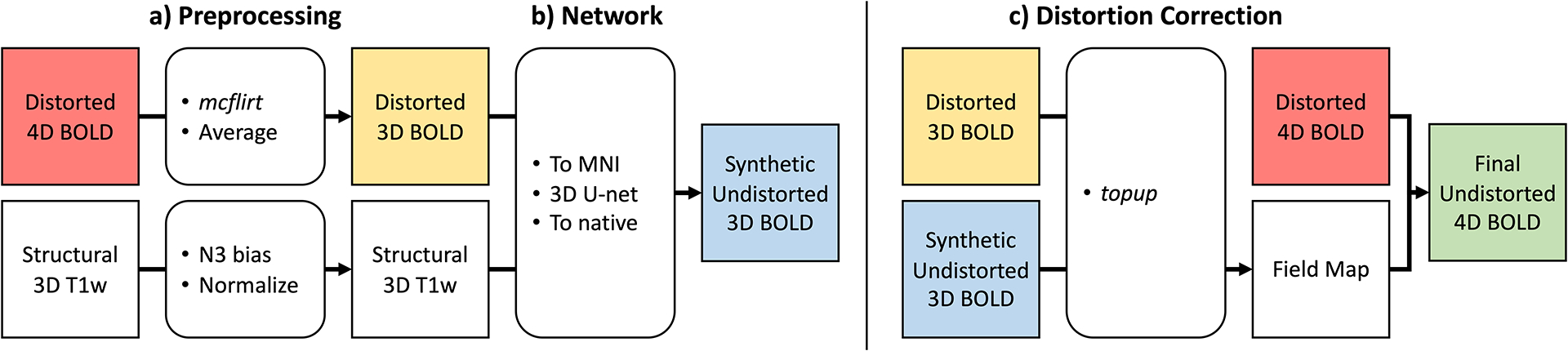
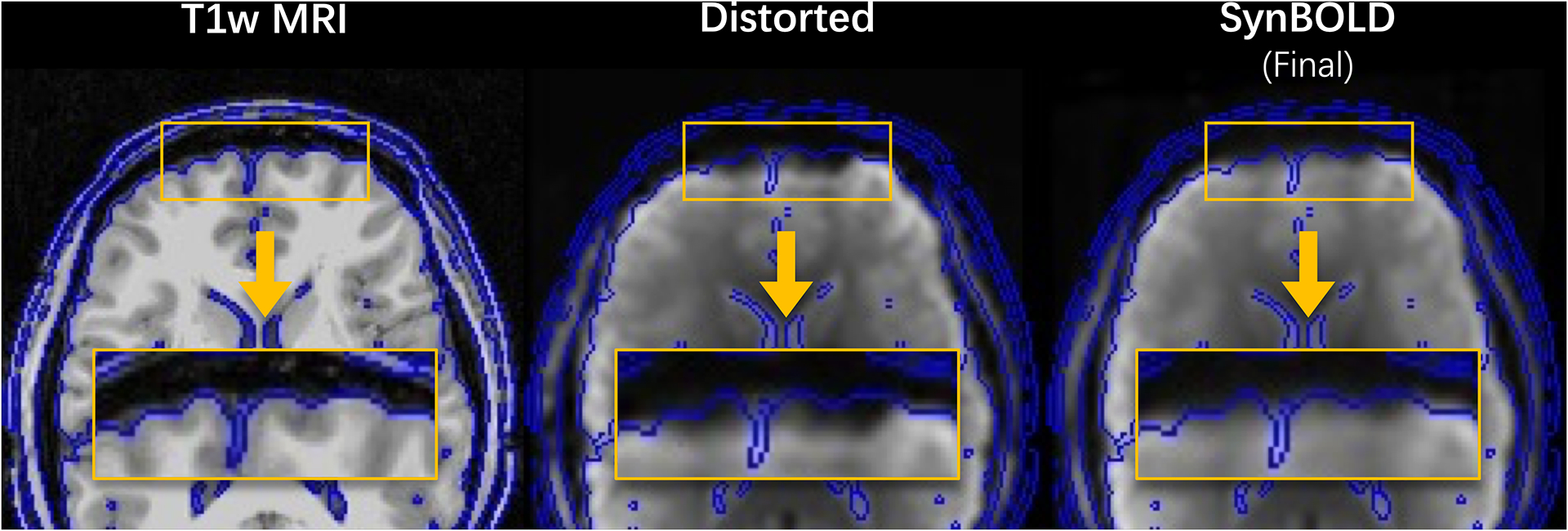
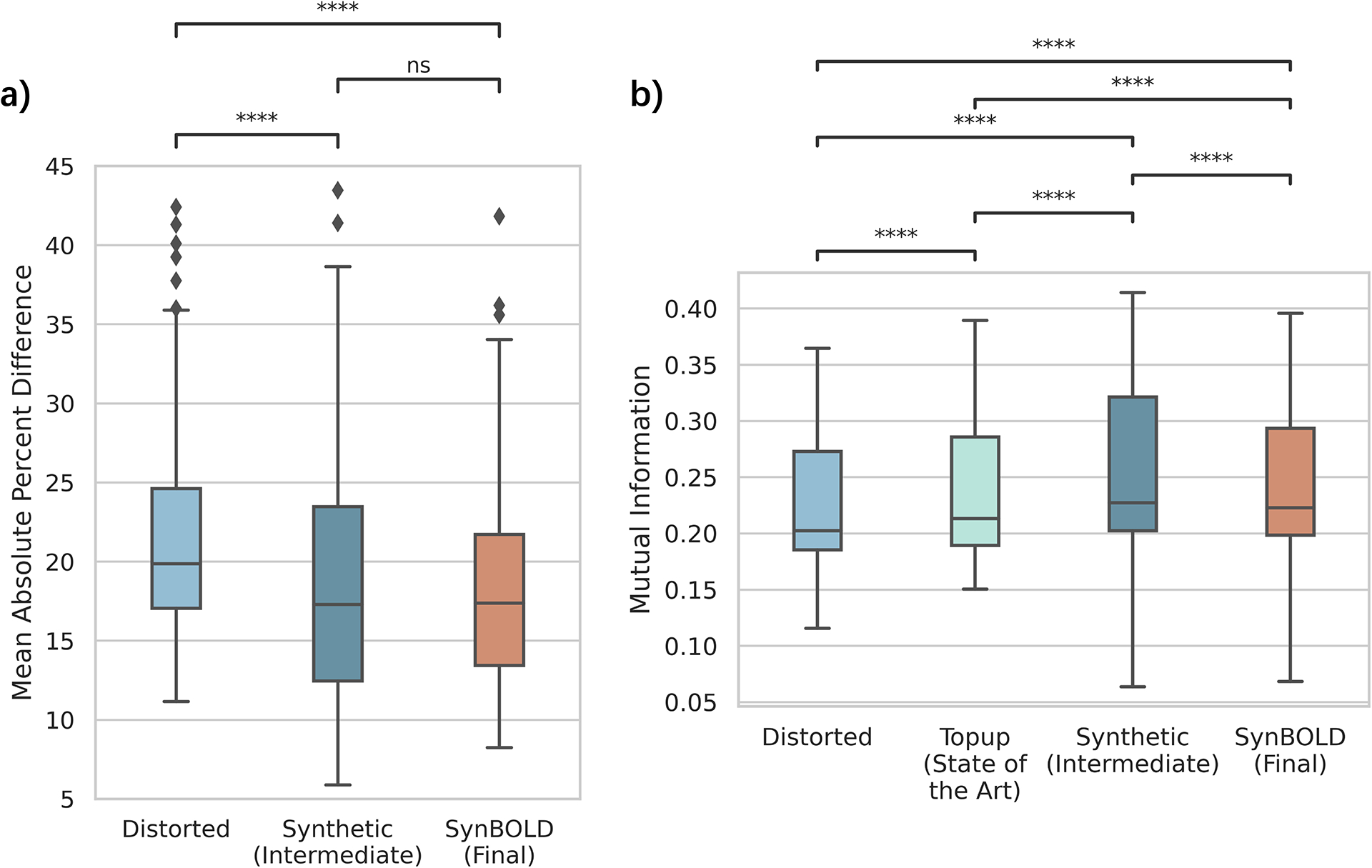
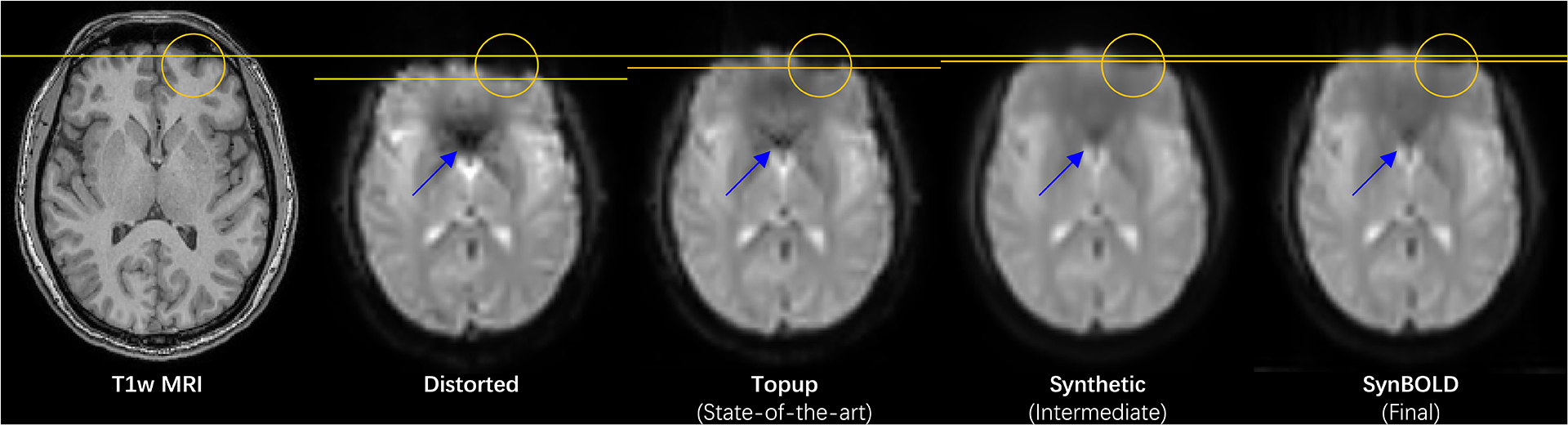
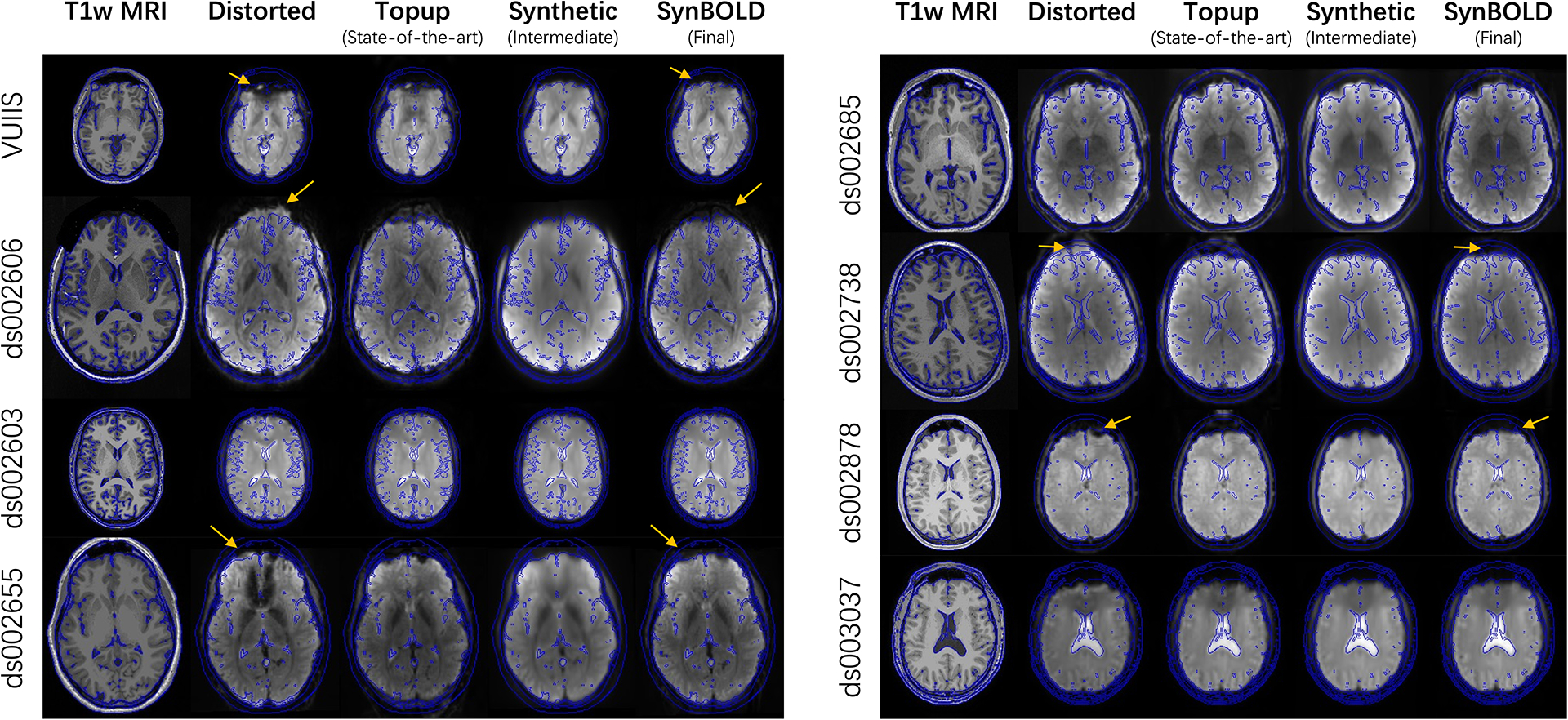
The blood oxygen level dependent (BOLD) signal from functional magnetic resonance imaging (fMRI) is a noninvasive technique that has been widely used in research to study brain function. However, fMRI suffers from susceptibility-induced off resonance fields which may cause geometric distortions and mismatches with anatomical images. State-of-the-art correction methods require acquiring reverse phase encoded images or additional field maps to enable distortion correction. However, not all imaging protocols include these additional scans and thus cannot take advantage of these susceptibility correction capabilities. As such, in this study we aim to enable state-of-the-art distortion correction with FSL's algorithm of historical and/or limited fMRI data that include only a structural image and single phase encoded fMRI. To do this, we use 3D U-net models to synthesize fMRI BOLD contrast images from the structural image and use this undistorted synthetic image as an anatomical target for distortion correction with . We evaluate the efficacy of this approach, named SynBOLD-DisCo (synthetic BOLD images for distortion correction), and show that BOLD images corrected using our approach are geometrically more similar to structural images than the distorted BOLD data and are practically equivalent to state-of-the-art correction methods which require reverse phase encoded data. Future directions include additional validation studies, integration with other preprocessing operations, retraining with broader pathologies, and investigating the effects of spin echo versus gradient echo images for training and distortion correction. In summary, we demonstrate SynBOLD-DisCo corrects distortion of fMRI when reverse phase encoding scans or field maps are not available.
功能磁共振成像(fMRI)中的血氧水平依赖(BOLD)信号是一种非侵入性技术,已广泛应用于研究大脑功能的研究中。然而,fMRI存在由敏感性引起的失谐场,这可能导致几何失真以及与解剖图像的不匹配。最先进的校正方法需要获取反向相位编码图像或额外的场图以实现失真校正。然而,并非所有成像协议都包括这些额外的扫描,因此无法利用这些敏感性校正功能。因此,在本研究中,我们旨在使用FSL算法对仅包括结构图像和单相编码fMRI的历史和/或有限fMRI数据进行最先进的失真校正。为此,我们使用3D U-net模型从结构图像合成fMRI BOLD对比图像,并将此未失真的合成图像用作使用[具体方法]进行失真校正的解剖学目标。我们评估了这种名为SynBOLD-DisCo(用于失真校正的合成BOLD图像)的方法的有效性,并表明使用我们的方法校正的BOLD图像在几何上比失真的BOLD数据更类似于结构图像,并且实际上等同于需要反向相位编码数据的最先进校正方法。未来的方向包括额外的验证研究、与其他预处理操作的集成、针对更广泛病理情况的再训练,以及研究自旋回波与梯度回波图像对训练和失真校正的影响。总之,我们证明了在没有反向相位编码扫描或场图的情况下,SynBOLD-DisCo可以校正fMRI的失真。