Wibowo Ganda, Anggrahini Dyah Wulan, Rismawanti Rochmi Isnaini, Fatimah Vita Arfiana Nurul, Hakim Alhadi, Hidayah Rachmadya Nur, Gharini Putrika Prastuti Ratna
Department of Cardiology and Vascular Medicine, Faculty of Medicine, Public Health, and Nursing, Universitas Gadjah Mada, Yogyakarta, Indonesia.
Integrated Cardiovascular Center, Dr. Sardjito General Hospital, Yogyakarta, Indonesia.
Adv Med Educ Pract. 2023 Jul 13;14:763-771. doi: 10.2147/AMEP.S407629. eCollection 2023.
One of the essential competencies of cardiology trainees is the ability to perform coronary angiography with good projection.
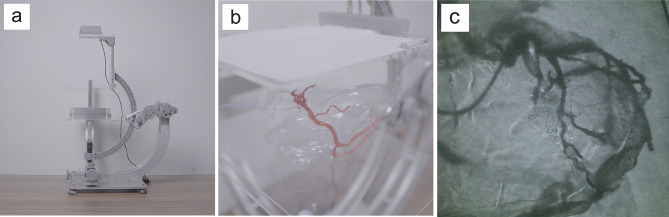
This study is a research and development study aimed at testing the effectiveness of 3D-printing-based fluoroscopic coronary angiography simulator as a learning medium for diagnostic coronary angiogram.
Thirty-four cardiology trainees randomly were divided into two groups. Both groups took a pretest before the intervention. The first group (group A) studied using conventional learning media and underwent the first post-test. Afterward, they switched to a 3D-printing-based fluoroscopic coronary angiography simulator and underwent a second post-test. The second group (group B) studied using a 3D-printing-based fluoroscopic coronary angiography simulator, underwent the first post-test, switched to the conventional learning media, and underwent a second post-test.
The delta between the post-test I and the pretest of group B was 8.53, higher than the delta between the post-test I and the pretest of group A (5.21) with a significant difference (p = 0.003). In group A, the delta between post-test II and pretest was 9.65, higher than the delta between post-test I and pretest (5.21) with a significant difference (p < 0.001).
3D-printing-based fluoroscopic coronary angiography simulator is effective as a learning medium for coronary angiogram diagnostics.
心脏病学实习生的基本能力之一是能够以良好的投照方式进行冠状动脉造影。
本研究是一项研发性研究,旨在测试基于3D打印的荧光透视冠状动脉造影模拟器作为诊断性冠状动脉造影学习媒介的有效性。
34名心脏病学实习生被随机分为两组。两组在干预前均进行了预测试。第一组(A组)使用传统学习媒介进行学习并进行第一次后测试。之后,他们改用基于3D打印的荧光透视冠状动脉造影模拟器并进行第二次后测试。第二组(B组)使用基于3D打印的荧光透视冠状动脉造影模拟器进行学习,进行第一次后测试,改用传统学习媒介,并进行第二次后测试。
B组第一次后测试与预测试之间的差值为8.53,高于A组第一次后测试与预测试之间的差值(5.21),差异有统计学意义(p = 0.003)。在A组中,第二次后测试与预测试之间的差值为9.65,高于第一次后测试与预测试之间的差值(5.21),差异有统计学意义(p < 0.001)。
基于3D打印的荧光透视冠状动脉造影模拟器作为冠状动脉造影诊断的学习媒介是有效的。