Mulvenna Mairi, Adie James W, Tramontano Carlo
Faculty of Arts, Science and Technology, University of Northampton, Northampton, United Kingdom.
Coventry University, Coventry, United Kingdom.
Front Psychol. 2023 Jul 3;14:1017836. doi: 10.3389/fpsyg.2023.1017836. eCollection 2023.
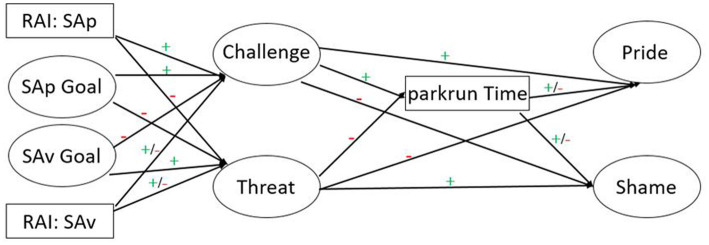
A temporal sequence of hypothesized relationships was tested between self-based goals and their underlying reasons → stress appraisals → performance and emotions, among UK parkrunners. A conditional process model was also examined to ascertain the potential moderating role of self-determined reasons in explaining the indirect relationship of self-based goals predicting performance and emotions via stress appraisals.
Utilizing a prospective design, 324 parkrunners ( = 45.27; SD = 10.73 years) completed online measures of self-based goals, their underlying reasons at 7 days (T1), and stress appraisals at 24 h (T2), prior to their next UK parkrun. Performance data and discrete emotions (pride and shame) were reported 24 h post-parkrun (T3).
Structural Equation Modeling revealed partial support for the hypothesized model. More specifically, findings suggested that: (1) T1 self-determined reasons underpinning a self-approach goal positively predicted T2 challenge appraisals and T3 pride, (2) T1 self-determined reasons for pursuing a self-avoidance goal corresponded to reduced T3 performance and shame, (3) T2 challenge and threat appraisals were found to positively relate to T3 pride, and (4) the slower parkrunners ran, the more shame they felt post-event. T2 challenge and threat appraisals were found to mediate the relationship between T1 self-determined reasons underlying a self-approach goal and T3 pride. Further analysis failed to support a conditional process model.
Our findings suggest the intensity of pursuing a self-based goal does not matter at all, but underlying self-determined reasons are a key driver influencing stress appraisals, performance and subsequent emotions among parkrunners.
在英国公园跑参与者中,对基于自我的目标及其潜在原因→压力评估→表现和情绪之间假设的关系序列进行了时间顺序检验。还检验了一个条件过程模型,以确定自我决定的原因在解释基于自我的目标通过压力评估预测表现和情绪的间接关系方面的潜在调节作用。
采用前瞻性设计,324名公园跑参与者(年龄 = 45.27岁;标准差 = 10.73岁)在下次参加英国公园跑之前,完成了基于自我的目标、7天前(T1)的潜在原因以及24小时后(T2)的压力评估的在线测量。在公园跑后24小时(T3)报告了表现数据和离散情绪(自豪和羞耻)。
结构方程模型对假设模型提供了部分支持。更具体地说,研究结果表明:(1)支持自我进取目标的T1自我决定原因正向预测T2挑战评估和T3自豪,(2)追求自我回避目标的T1自我决定原因与T3表现降低和羞耻感相关,(3)发现T2挑战和威胁评估与T3自豪呈正相关,(4)公园跑者跑得越慢,赛后感到的羞耻感越强。发现T2挑战和威胁评估介导了支持自我进取目标的T1自我决定原因与T3自豪之间的关系。进一步分析未能支持条件过程模型。
我们的研究结果表明,追求基于自我的目标的强度根本不重要,但潜在的自我决定原因是影响公园跑参与者压力评估、表现和后续情绪的关键驱动因素。