School of Informatics, Computing and Engineering, Indiana University, Bloomington, IN 47405.
Department of Psychological and Brain Sciences, Indiana University, Bloomington, IN 47405.
Proc Natl Acad Sci U S A. 2023 Jul 25;120(30):e2300888120. doi: 10.1073/pnas.2300888120. Epub 2023 Jul 19.
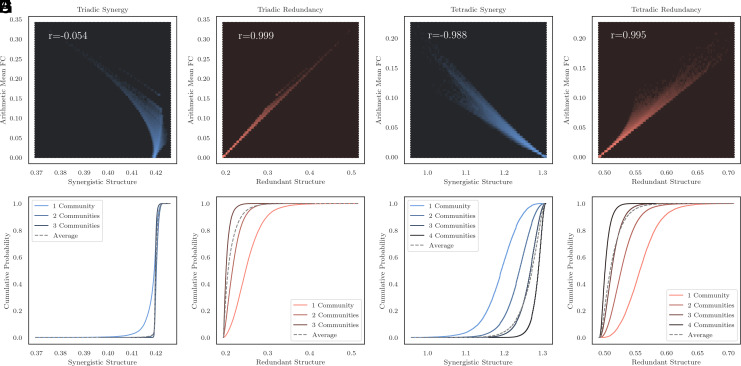
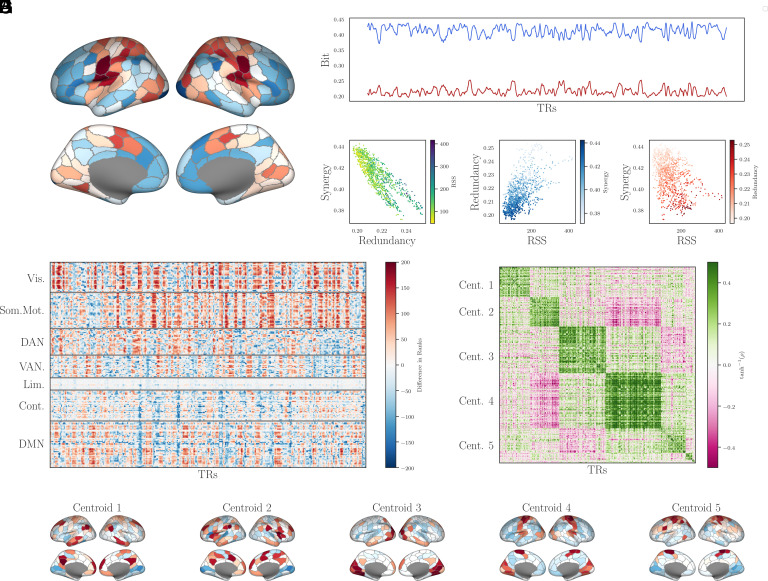
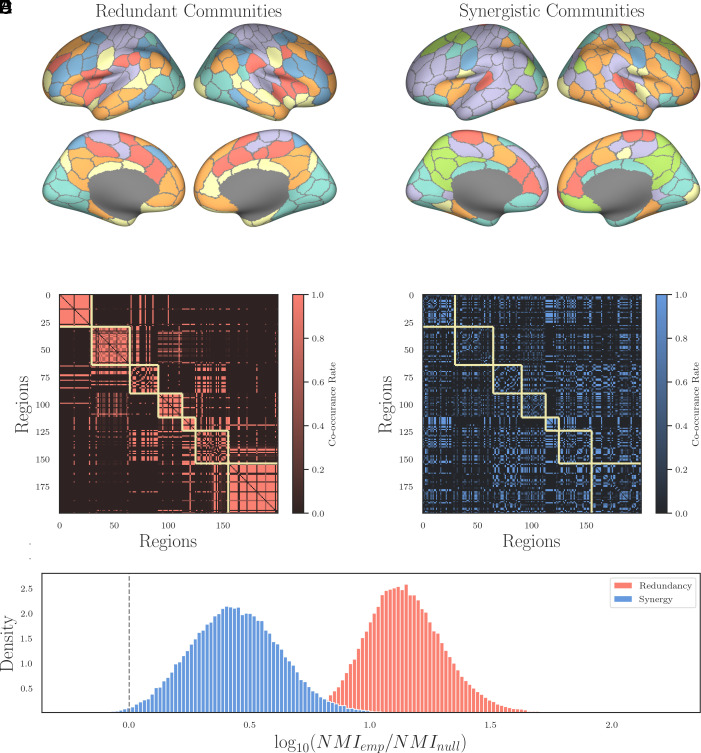
The standard approach to modeling the human brain as a complex system is with a network, where the basic unit of interaction is a pairwise link between two brain regions. While powerful, this approach is limited by the inability to assess higher-order interactions involving three or more elements directly. In this work, we explore a method for capturing higher-order dependencies in multivariate data: the partial entropy decomposition (PED). Our approach decomposes the joint entropy of the whole system into a set of nonnegative atoms that describe the redundant, unique, and synergistic interactions that compose the system's structure. PED gives insight into the mathematics of functional connectivity and its limitation. When applied to resting-state fMRI data, we find robust evidence of higher-order synergies that are largely invisible to standard functional connectivity analyses. Our approach can also be localized in time, allowing a frame-by-frame analysis of how the distributions of redundancies and synergies change over the course of a recording. We find that different ensembles of regions can transiently change from being redundancy-dominated to synergy-dominated and that the temporal pattern is structured in time. These results provide strong evidence that there exists a large space of unexplored structures in human brain data that have been largely missed by a focus on bivariate network connectivity models. This synergistic structure is dynamic in time and likely will illuminate interesting links between brain and behavior. Beyond brain-specific application, the PED provides a very general approach for understanding higher-order structures in a variety of complex systems.
将大脑建模为复杂系统的标准方法是使用网络,其中交互的基本单位是两个大脑区域之间的两两连接。虽然这种方法很强大,但它受到限制,无法直接评估涉及三个或更多元素的高阶交互。在这项工作中,我们探索了一种用于捕获多元数据中高阶相关性的方法:偏熵分解 (PED)。我们的方法将整个系统的联合熵分解为一组非负原子,这些原子描述了构成系统结构的冗余、独特和协同交互。PED 深入了解功能连接的数学及其局限性。当应用于静息态 fMRI 数据时,我们发现了高阶协同作用的有力证据,而这些协同作用在标准功能连接分析中很大程度上是看不见的。我们的方法也可以在时间上本地化,允许逐帧分析冗余和协同作用的分布在记录过程中如何变化。我们发现,不同的区域集合可以暂时从以冗余为主导转变为以协同为主导,并且时间模式是有结构的。这些结果有力地证明了在人类大脑数据中存在大量未被探索的结构,而这些结构在很大程度上被关注二元网络连接模型所忽略。这种协同结构是时间上动态的,可能会揭示大脑和行为之间有趣的联系。除了针对大脑的特定应用外,PED 还为理解各种复杂系统中的高阶结构提供了一种非常通用的方法。