Shan Yongzhi, Wang Hongxing, Yang Yanfeng, Wang Jiahao, Zhao Wenfeng, Huang Yuda, Wang Huang, Han Bing, Pan Na, Jin Xiukun, Fan Xiaotong, Liu Yunyun, Wang Jun, Wang Changming, Zhang Huaqiang, Chen Sichang, Liu Ting, Yan Tianyi, Si Tianmei, Yin Lu, Li Xinmin, Cosci Fiammetta, Zhang Xiangyang, Zhang Guanghao, Gao Keming, Zhao Guoguang
Department of Neurosurgery, Xuanwu Hospital, National Center for Neurological Disorders, National Clinical Research Center for Geriatric Diseases, Capital Medical University, Beijing, 100053, China.
China International Neuroscience Institute (CHINA-INI), Beijing, 100053, China.
Mol Psychiatry. 2023 Dec;28(12):5402-5410. doi: 10.1038/s41380-023-02150-8. Epub 2023 Jul 19.
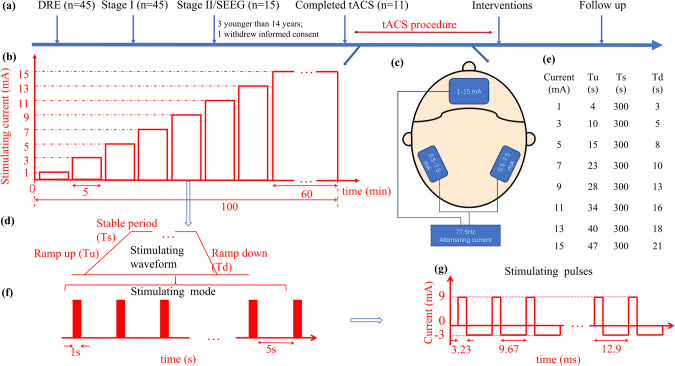
Deep brain regions such as hippocampus, insula, and amygdala are involved in neuropsychiatric disorders, including chronic insomnia and depression. Our recent reports showed that transcranial alternating current stimulation (tACS) with a current of 15 mA and a frequency of 77.5 Hz, delivered through a montage of the forehead and both mastoids was safe and effective in intervening chronic insomnia and depression over 8 weeks. However, there is no physical evidence to support whether a large alternating current of 15 mA in tACS can send electrical currents to deep brain tissue in awake humans. Here, we directly recorded local field potentials (LFPs) in the hippocampus, insula and amygdala at different current strengths (1 to 15 mA) in 11 adult patients with drug-resistant epilepsy implanted with stereoelectroencephalography (SEEG) electrodes who received tACS at 77.5 Hz from 1 mA to 15 mA at 77.5 Hz for five minutes at each current for a total of 40 min. For the current of 15 mA at 77.5 Hz, additional 55 min were applied to add up a total of 60 min. Linear regression analysis revealed that the average LFPs for the remaining contacts on both sides of the hippocampus, insula, and amygdala of each patient were statistically associated with the given currents in each patient (p < 0.05-0.01), except for the left insula of one subject (p = 0.053). Alternating currents greater than 7 mA were required to produce significant differences in LFPs in the three brain regions compared to LFPs at 0 mA (p < 0.05). The differences remained significant after adjusting for multiple comparisons (p < 0.05). Our study provides direct evidence that the specific tACS procedures are capable of delivering electrical currents to deep brain tissues, opening a realistic avenue for modulating or treating neuropsychiatric disorders associated with hippocampus, insula, and amygdala.
海马体、脑岛和杏仁核等深部脑区与神经精神疾病有关,包括慢性失眠和抑郁症。我们最近的报告显示,通过前额和双侧乳突的电极组合施加15毫安电流、77.5赫兹频率的经颅交流电刺激(tACS),在干预慢性失眠和抑郁症方面,经过8周是安全有效的。然而,没有物理证据支持tACS中15毫安的大交流电是否能在清醒的人类中将电流传送到深部脑组织。在此,我们直接记录了11名植入立体脑电图(SEEG)电极的耐药性癫痫成年患者海马体、脑岛和杏仁核在不同电流强度(1至15毫安)下的局部场电位(LFP),这些患者接受了77.5赫兹、从1毫安到15毫安的tACS,每种电流持续5分钟,共40分钟。对于77.5赫兹、15毫安的电流,额外施加55分钟,总计60分钟。线性回归分析显示,除一名受试者的左侧脑岛(p = 0.053)外,每位患者海马体、脑岛和杏仁核两侧其余触点的平均LFP与每位患者给定的电流在统计学上相关(p < 0.05 - 0.01)。与0毫安时的LFP相比,三个脑区中产生LFP显著差异所需的交流电大于7毫安(p < 0.05)。在进行多重比较校正后,差异仍然显著(p < 0.05)。我们的研究提供了直接证据,表明特定的tACS程序能够将电流传送到深部脑组织,为调节或治疗与海马体、脑岛和杏仁核相关的神经精神疾病开辟了一条现实途径。