McAuliffe Graham A, Lynch John, Cain Michelle, Buckingham Sarah, Rees Robert M, Collins Adrian L, Allen Myles, Pierrehumbert Raymond, Lee Michael R F, Takahashi Taro
Net Zero and Resilient Farming, Rothamsted Research, North Wyke, Okehampton, Devon EX20 2SB, United Kingdom.
Nature-based Solutions Initiative, Department of Biology, University of Oxford, Oxford OX1 3SZ, United Kingdom.
Environ Res Lett. 2023 Aug 1;18(8):084014. doi: 10.1088/1748-9326/ace204. Epub 2023 Jul 18.
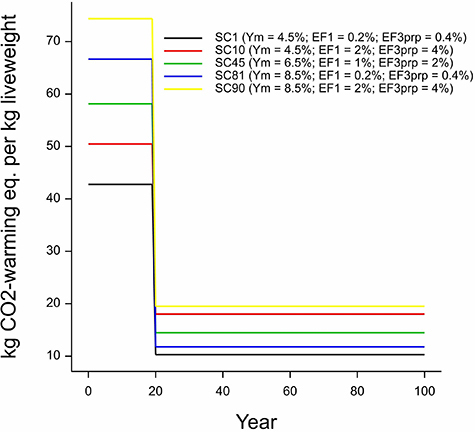
The vast majority of agri-food climate-based sustainability analyses use global warming potential (GWP) as an impact assessment, usually in isolation; however, in recent years, discussions have criticised the 'across-the-board' application of GWP in Life Cycle Assessments (LCAs), particularly of food systems which generate large amounts of methane (CH) and considered whether reporting additional and/or alternative metrics may be more applicable to certain circumstances or research questions (e.g. Global Temperature Change Potential (GTP)). This paper reports a largescale sensitivity analysis using a pasture-based beef production system (a high producer of CH emissions) as an exemplar to compare various climatatic impact assessments: CO-equivalents using GWP and GTP, and 'CO-warming-equivalents' using 'GWP Star', or GWP*. The inventory for this system was compiled using data from the UK Research and Innovation National Capability, the North Wyke Farm Platform, in Devon, SW England. LCAs can have an important bearing on: (i) policymakers' decisions; (ii) farmer management decisions; (iii) consumers' purchasing habits; and (iv) wider perceptions of whether certain activities can be considered 'sustainable' or not; it is, therefore, the responsibility of LCA practitioners and scientists to ensure that subjective decisions are tested as robustly as possible through appropriate sensitivity and uncertainty analyses. We demonstrate herein that the choice of climate impact assessment has dramatic effects on interpretation, with GWP and GTP producing substantially different results due to their different treatments of CH in the context of carbon dioxide (CO) equivalents. Given its dynamic nature and previously proven strong correspondence with climate models, out of the three assessments covered, GWP* provides the most complete coverage of the temporal evolution of temperature change for different greenhouse gas emissions. We extend previous discussions on the limitations of static emission metrics and encourage LCA practitioners to consider due care and attention where additional information or dynamic approaches may prove superior, scientifically speaking, particularly in cases of decision support.
绝大多数基于气候的农业食品可持续性分析都将全球变暖潜能值(GWP)用作影响评估,而且通常是单独使用;然而,近年来,一些讨论批评了GWP在生命周期评估(LCA)中的“一刀切”应用,尤其是在产生大量甲烷(CH₄)的食品系统中,并探讨了报告额外和/或替代指标是否可能更适用于某些情况或研究问题(例如全球温度变化潜能值(GTP))。本文报告了一项大规模敏感性分析,该分析以一个基于牧场的牛肉生产系统(CH₄排放量大的生产系统)为例,比较各种气候影响评估:使用GWP和GTP的CO₂当量,以及使用“GWP星标”或GWP的“CO₂变暖当量”。该系统的清单是使用来自英国研究与创新国家能力项目、位于英格兰西南部德文郡的北威克农场平台的数据编制而成的。生命周期评估可能会对以下方面产生重要影响:(i)政策制定者的决策;(ii)农民的管理决策;(iii)消费者购买习惯;以及(iv)对于某些活动是否可被视为“可持续”的更广泛认知;因此,生命周期评估从业者和科学家有责任确保通过适当的敏感性和不确定性分析尽可能严格地检验主观决策。我们在此证明,气候影响评估的选择对解释结果有巨大影响,由于GWP和GTP在CO₂当量背景下对CH₄的处理方式不同,它们产生了截然不同的结果。鉴于其动态性质以及先前证明的与气候模型的强对应关系,在所涵盖的三种评估中,GWP最全面地涵盖了不同温室气体排放导致的温度变化的时间演变。我们扩展了先前关于静态排放指标局限性的讨论,并鼓励生命周期评估从业者在额外信息或动态方法在科学上可能更具优势的情况下,特别是在决策支持的情况下,予以适当关注。