Cosgrove Tylor J, Murphy Christopher P
Department of Psychology, Faculty of Society and Design, Bond University, Gold Coast, QLD, Australia.
Front Psychol. 2023 Jul 6;14:1164725. doi: 10.3389/fpsyg.2023.1164725. eCollection 2023.
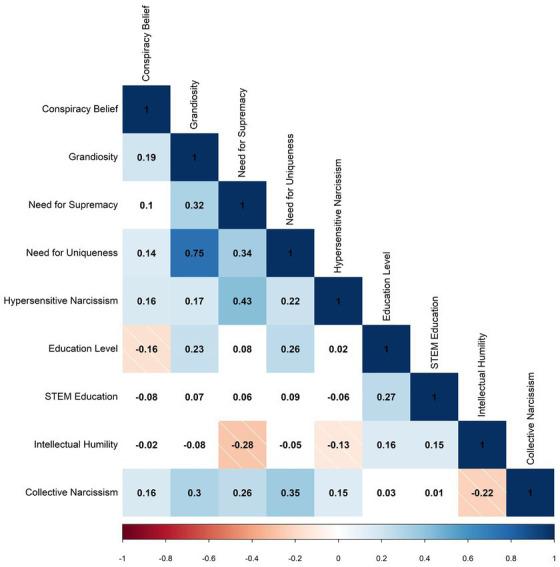
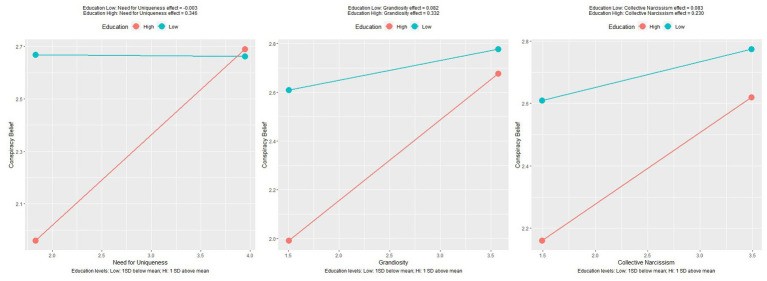
Conspiracy theories are alternate viewpoints of provided explanations; sensational stories revolving around small groups exerting control for nefarious reasons. Recent events and research have outlined myriad negative social and personal outcomes for those who endorse them. Prior research suggests several predictors of susceptibility to conspiracy theories, including narcissistic personality traits (grandiosity, need for uniqueness), cognitive processes (critical thinking, confirmation bias) and lack of education. The aim of the current paper was to explore how facets of narcissism predict susceptibility to conspiracy theories. It was expected that narcissism would be a positive predictor, but education and cognitive reflection would act as protective factors, reducing this effect. Study one utilized an international survey ( = 323) to investigate the role of education as a protective tool in the relationship between narcissistic traits and conspiratorial beliefs. Support was found for the hypotheses that individuals with higher levels of grandiosity, vulnerable narcissism, a strive for uniqueness, and a strive for supremacy predicted higher levels of conspiracy endorsement. Higher education and STEM education were associated with lower levels of conspiracy endorsement, however all significant moderations indicated that for narcissistic individuals, education increased their likelihood of adopting conspiracy beliefs, contrary to expectation. To investigate this further, study two analyzed a large-scale publicly available dataset ( = 51,404) to assess the relationship between narcissism, critical thinking skills (specifically cognitive reflection) and conspiracy beliefs pertaining to the COVID-19 pandemic. As expected, analysis found narcissism and poor cognitive reflection (intuitive thinking) as predictors of conspiracy beliefs. Higher levels of cognitive reflection were found to be protective, moderating and reducing the impact of narcissism on endorsement of conspiracy theories. The findings suggest that cognitive reflection, but not education protect against narcissistic conspiracy belief. Moreover, that cognitive reflection may have a lessened effect against conspiracy theories adopted for social or ideological reasons. These findings improve understanding of both the role and limitations of education/critical thinking skills as protective factors against conspiracy theory endorsement.
阴谋论是对既定解释的不同观点;围绕小团体出于邪恶目的施加控制的耸人听闻的故事。近期的事件和研究概述了那些认同阴谋论的人所面临的无数负面社会和个人后果。先前的研究提出了几个易受阴谋论影响的预测因素,包括自恋型人格特质(夸大、对独特性的需求)、认知过程(批判性思维、证实偏差)以及缺乏教育。本文的目的是探讨自恋的各个方面如何预测对阴谋论的易感性。预计自恋将是一个正向预测因素,但教育和认知反思将起到保护作用,减少这种影响。研究一采用国际调查(N = 323)来探究教育作为一种保护工具在自恋特质与阴谋论信念之间关系中的作用。研究结果支持了以下假设:具有较高夸大程度、脆弱自恋、追求独特性和追求优越感的个体,其阴谋论认同程度更高。高等教育和STEM教育与较低的阴谋论认同程度相关,然而所有显著的调节作用均表明,对于自恋个体而言,教育增加了他们接受阴谋论信念的可能性,这与预期相反。为了进一步探究这一问题,研究二分析了一个大规模公开可用数据集(N = 51,404),以评估自恋、批判性思维技能(特别是认知反思)与关于新冠疫情的阴谋论信念之间的关系。正如预期的那样,分析发现自恋和较差的认知反思(直觉思维)是阴谋论信念的预测因素。较高水平的认知反思具有保护作用,可调节并减少自恋对阴谋论认同的影响。研究结果表明,保护人们免受自恋型阴谋论影响的是认知反思,而非教育。此外,认知反思对于出于社会或意识形态原因而接受的阴谋论可能效果减弱。这些研究结果有助于更好地理解教育/批判性思维技能作为防止认同阴谋论保护因素的作用和局限性。