Forcher Leon, Forcher Leander, Wäsche Hagen, Jekauc Darko, Woll Alexander, Gross Timo, Altmann Stefan
Institute of Sports and Sports Science, Karlsruhe Institute of Technology, Karlsruhe, Germany.
TSG Hoffenheim, Zuzenhausen, Germany.
Front Psychol. 2023 Jul 7;14:1197039. doi: 10.3389/fpsyg.2023.1197039. eCollection 2023.
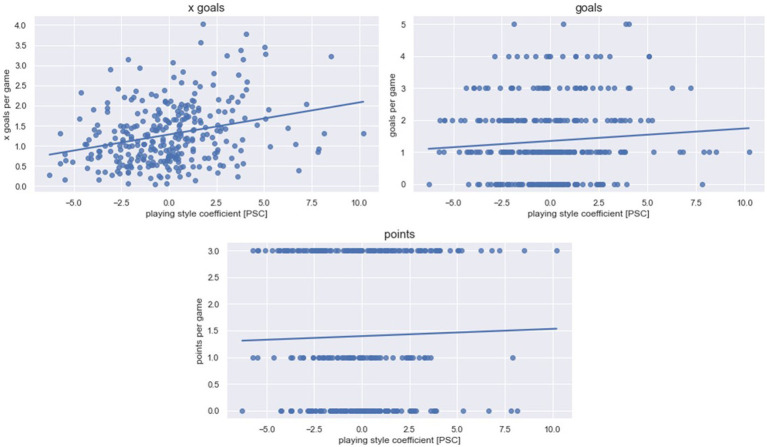
In soccer, the offensive style of play describes characteristic behavioral features of the players at team level during the offensive phase of matches. This study aimed to investigate the effect of offensive playing style (i.e., while in ball possession) on physical and technical match performance during offensive play as well as success-related factors. The sample consisted of official tracking and event data of 153 matches of the 2020/21 German Bundesliga season. For every team in every match an offensive playing style coefficient was calculated to locate teams on a continuum between ball possession and counter-attacking style. This calculation contains 11 technical and physical performance parameters and has already been validated. In addition, dependent physical (e.g., sprinting distance), technical (e.g., passes), and success-related (e.g., goals) variables were examined. A separate linear mixed model was calculated for each dependent variable. While teams with lower playing style coefficient values (= counter-attacking style) covered more high-intensity ( ≤ 0.01; = 0.13) and sprinting distances per second in possession ( ≤ 0.01; = 0.14), teams with higher playing style coefficient values (= ball possession style) were physically more demanded over a whole match (e.g., more accelerations ( ≤ 0.01; = 0.69), decelerations ( ≤ 0.01; = 0.69), high-intensity ( ≤ 0.01; = 0.36), sprint distance ( = 0.03; = 0.08)). Furthermore, teams with higher playing style coefficient values played more horizontal passes ( ≤ 0.01; = 0.73) and revealed better passing success rates ( ≤ 0.01; = 0.17). In contrast, teams with lower playing style coefficient values played more long passes ( < 0.01; = 0.58). The influence of the playing style coefficient on success-related variables was smaller ( ≤ 0.36; = 0.10-0.13). Concluding, offensive playing style affects physical and technical match performance, but has limited influence on success. Hence, coaches can use the findings to optimize training contents to prepare players for the physical demands of a match.
在足球运动中,进攻型比赛风格描述了比赛进攻阶段球队层面球员的典型行为特征。本研究旨在调查进攻型比赛风格(即控球时)对进攻阶段的体能和技术比赛表现以及与成功相关因素的影响。样本包括2020/21赛季德国足球甲级联赛153场比赛的官方追踪和事件数据。为每场比赛中的每支球队计算一个进攻型比赛风格系数,以便将各球队定位在控球和反击风格之间的连续区间上。该计算包含11个技术和体能表现参数,并且已经过验证。此外,还研究了相关的体能(如冲刺距离)、技术(如传球)和与成功相关(如进球)的变量。为每个因变量计算了一个单独的线性混合模型。比赛风格系数值较低的球队(=反击风格)在控球时每秒覆盖更多的高强度距离(≤0.01;β = 0.13)和冲刺距离(≤0.01;β = 0.14),而比赛风格系数值较高的球队(=控球风格)在整场比赛中体能要求更高(如更多的加速(≤0.01;β = 0.69)、减速(≤0.01;β = 0.69)、高强度距离(≤0.01;β = 0.36)、冲刺距离(p = 0.03;β = 0.08))。此外,比赛风格系数值较高的球队更多地进行横向传球(≤0.01;β = 0.73),并且传球成功率更高(≤0.01;β = 0.17)。相比之下,比赛风格系数值较低的球队更多地进行长传(p < 0.01;β = 0.58)。比赛风格系数对与成功相关变量的影响较小(≤0.36;β = 0.10 - 0.13)。总之,进攻型比赛风格会影响体能和技术比赛表现,但对比赛成功的影响有限。因此,教练可以利用这些研究结果优化训练内容,让球员为比赛的体能需求做好准备。