Chair of Performance Analysis and Sports Informatics, Technical University Munich, Munich, Germany.
PLoS One. 2020 Mar 10;15(3):e0230179. doi: 10.1371/journal.pone.0230179. eCollection 2020.
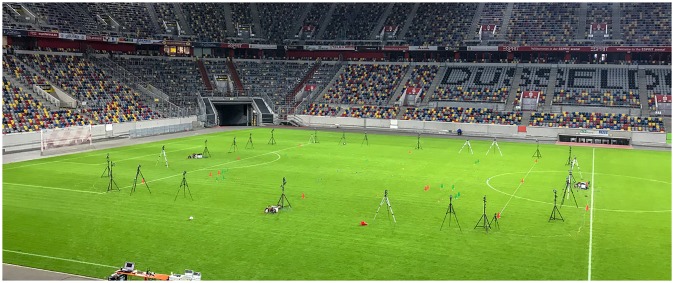
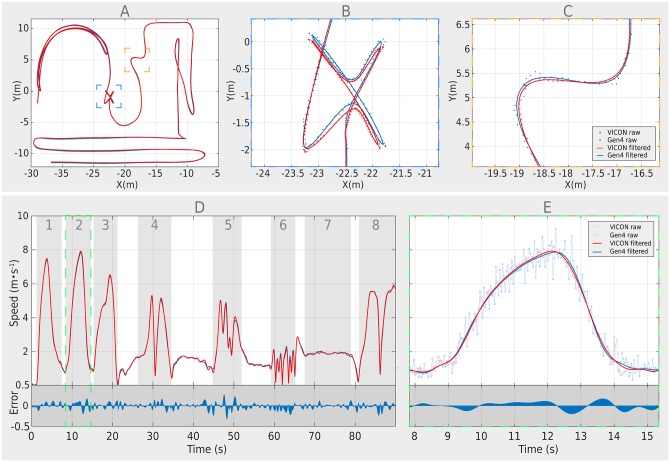
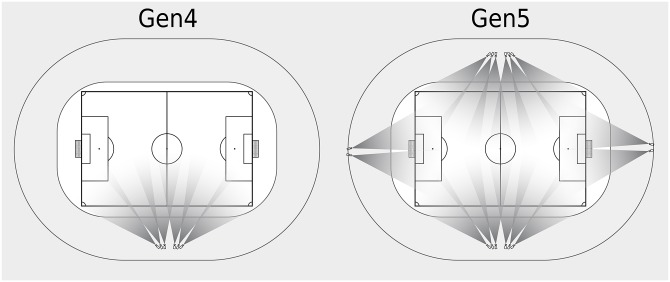
The present study aimed to validate and compare the football-specific measurement accuracy of two optical tracking systems engineered by TRACAB. The "Gen4" system consists of two multi-camera units (a stereo pair) in two locations either side of the halfway line, whereas the distributed "Gen5" system combines two stereo pairs on each side of the field as well as two monocular systems behind the goal areas. Data were collected from 20 male football players in two different exercises (a football sport-specific running course and small-sided games) in a professional football stadium. For evaluating the accuracy of the systems, measures were compared against simultaneously recorded measures of a reference system (VICON motion capture system). Statistical analysis uses RMSE for kinematic variables (position, speed and acceleration) and the difference in percentages for performance indicators (e.g. distance covered, peak speed) per run compared to the reference system. Frames in which players were obviously not tracked were excluded. Gen5 had marginally better accuracy (0.08 m RMSE) for position measurements than Gen4 (0.09 m RMSE) compared to the reference. Accuracy difference in instantaneous speed (Gen4: 0.09 m⋅s-1 RMSE; Gen5: 0.08 m⋅s-1 RMSE) and acceleration (Gen4: 0.26 m⋅s-2 RMSE; Gen5: 0.21 m⋅s-2 RMSE) measurements were significant, but also trivial in terms of the effect size. For total distance travelled, both Gen4 (0.42 ± 0.60%) and Gen5 (0.27 ± 0.35%) showed only trivial deviations compared to the reference. Gen4 showed moderate differences in the low-speed distance travelled category (-19.41 ± 13.24%) and small differences in the high-speed distance travelled category (8.94 ± 9.49%). Differences in peak speed, acceleration and deceleration were trivial (<0.5%) for both Gen4 and Gen5. These findings suggest that Gen5's distributed camera architecture has minor benefits over Gen4's single-view camera architecture in terms of accuracy. We assume that the main benefit of the Gen5 towards Gen4 lies in increased robustness of the tracking when it comes to optical overlapping of players. Since differences towards the reference system were very low, both TRACAB's tracking systems can be considered as valid technologies for football-specific performance analyses in the settings tested as long as players are tracked correctly.
本研究旨在验证和比较由 TRACAB 研发的两种光学跟踪系统在足球专项测量中的准确性。“Gen4”系统由两个位于中线两侧的多摄像机单元(立体对)组成,而分布式的“Gen5”系统则在场地两侧组合了两个立体对以及两个球门区域后面的单目系统。在一个职业足球场上,从 20 名男性足球运动员的两个不同练习(足球专项跑步课程和小场比赛)中收集数据。为了评估系统的准确性,将测量结果与参考系统(VICON 运动捕捉系统)同时记录的测量结果进行比较。统计分析使用均方根误差(RMSE)来比较运动学变量(位置、速度和加速度),并比较每个运行的性能指标(例如覆盖的距离、峰值速度)相对于参考系统的百分比差异。排除明显未被跟踪的球员的帧数。与参考相比,Gen5 在位置测量方面的精度(0.08 m RMSE)略高于 Gen4(0.09 m RMSE)。瞬时速度(Gen4:0.09 m⋅s-1 RMSE;Gen5:0.08 m⋅s-1 RMSE)和加速度(Gen4:0.26 m⋅s-2 RMSE;Gen5:0.21 m⋅s-2 RMSE)测量的准确性差异显著,但从效应大小来看也是微不足道的。对于总行驶距离,Gen4(0.42 ± 0.60%)和 Gen5(0.27 ± 0.35%)与参考相比仅显示出微不足道的偏差。Gen4 在低速行驶距离类别中显示出中等差异(-19.41 ± 13.24%),而在高速行驶距离类别中显示出较小差异(8.94 ± 9.49%)。Gen4 和 Gen5 的峰值速度、加速度和减速度差异均微不足道(<0.5%)。这些发现表明,在准确性方面,Gen5 的分布式摄像机架构相对于 Gen4 的单目摄像机架构具有较小的优势。我们假设,Gen5 相对于 Gen4 的主要优势在于增加了球员光学重叠时跟踪的稳健性。由于与参考系统的差异非常低,只要球员被正确跟踪,这两种 TRACAB 的跟踪系统都可以被认为是在测试设置中进行足球专项性能分析的有效技术。