Dorsey Holliman Brooke, Stransky Michelle, Dieujuste Nathalie, Morris Megan
Department of Family Medicine, University of Colorado School of Medicine, Aurora, CO, United States.
Adult and Child Center for Health Outcomes Research and Delivery Science (ACCORDS), University of Colorado, Aurora, CO, United States.
Front Rehabil Sci. 2023 Jul 6;4:1075775. doi: 10.3389/fresc.2023.1075775. eCollection 2023.
Given the prevalence of discrimination experienced by racial and ethnic minorities living with disabilities, it is likely that racism experienced by Black, Indigenous, and people of color (BIPOC) is compounded by the ableism experienced by people with disabilities, widening disparities in health and healthcare outcomes. To address this, we described unmet healthcare needs of a sample of Black, non-Hispanic, and Hispanic adults with and without disabilities. The following research question was examined exploratively: Are Black and Hispanic adults with disabilities at increased risk of unmet healthcare needs compared to Black and Hispanic adults without disabilities according to the 2018 National Health Interview Survey?
Survey data was examined from the 2018 National Health Interview Survey (NHIS), a nationally representative survey of community-dwelling adults in the United States.
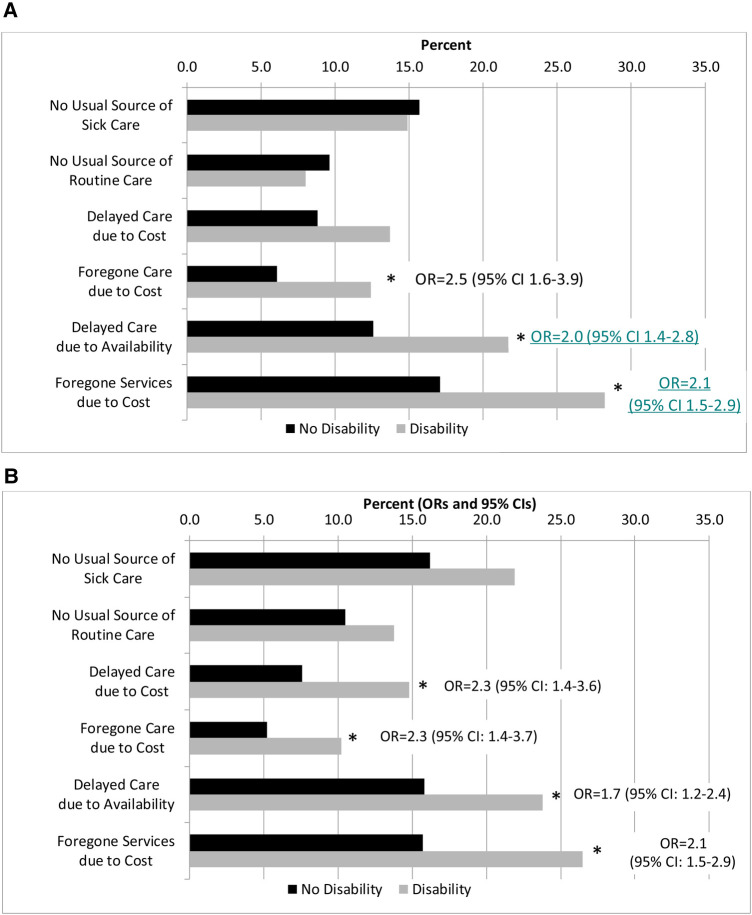
Black and non-Hispanic adults most commonly reported mobility only disabilities. People with disabilities were significantly more likely to delay or forego care than their peers without disabilities within each racial/ethnic group. Among non-Hispanic Black and Hispanic adults, nearly 30% of people with disabilities forewent services due to cost compared to persons without disabilities.
Black and Hispanic adults with disabilities experience greater disparities in access to healthcare than Black and Hispanic adults without disabilities. Therefore, health disparities experienced by racial and ethnic minorities living with disabilities is likely influenced by the dual systemic factors of racism and ableism.
鉴于残疾的少数族裔所经历的歧视普遍存在,黑人、原住民及有色人种(BIPOC)所经历的种族主义很可能因残疾人所经历的能力主义而加剧,从而扩大了健康和医疗结果方面的差距。为解决这一问题,我们描述了一组有残疾和无残疾的非西班牙裔黑人和西班牙裔成年人未满足的医疗需求。对以下研究问题进行了探索性研究:根据2018年全国健康访谈调查,与无残疾的黑人和西班牙裔成年人相比,有残疾的黑人和西班牙裔成年人未满足医疗需求的风险是否更高?
研究数据来自2018年全国健康访谈调查(NHIS),这是一项对美国社区居住成年人具有全国代表性的调查。
非西班牙裔黑人和西班牙裔成年人最常报告仅存在行动不便的残疾。在每个种族/族裔群体中,残疾人比无残疾的同龄人更有可能推迟或放弃治疗。在非西班牙裔黑人和西班牙裔成年人中,近30%的残疾人因费用问题放弃了服务,而无残疾者则不然。
与无残疾的黑人和西班牙裔成年人相比,有残疾的黑人和西班牙裔成年人在获得医疗保健方面的差距更大。因此,残疾的少数族裔所经历的健康差距可能受到种族主义和能力主义这两种系统性因素的影响。