Department of Molecular Medicine and Medical Biotechnology, University of Naples Federico II, Naples 80131, Italy.
Institute of Experimental Endocrinology and Oncology "G. Salvatore"-IEOS, National Research Council of Italy (CNR), Naples 80131, Italy.
Genome Res. 2023 Aug;33(8):1242-1257. doi: 10.1101/gr.277755.123. Epub 2023 Jul 24.
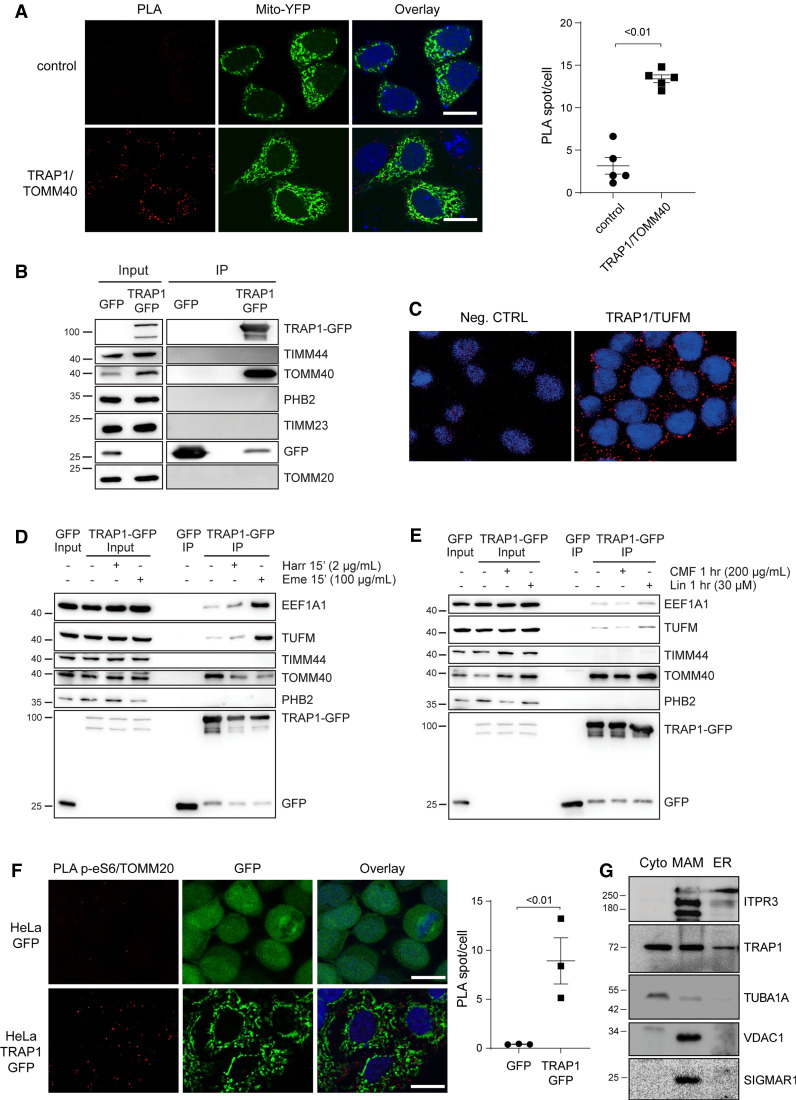
A complex interplay between mRNA translation and cellular respiration has been recently unveiled, but its regulation in humans is poorly characterized in either health or disease. Cancer cells radically reshape both biosynthetic and bioenergetic pathways to sustain their aberrant growth rates. In this regard, we have shown that the molecular chaperone TRAP1 not only regulates the activity of respiratory complexes, behaving alternatively as an oncogene or a tumor suppressor, but also plays a concomitant moonlighting function in mRNA translation regulation. Herein, we identify the molecular mechanisms involved, showing that TRAP1 (1) binds both mitochondrial and cytosolic ribosomes, as well as translation elongation factors; (2) slows down translation elongation rate; and (3) favors localized translation in the proximity of mitochondria. We also provide evidence that TRAP1 is coexpressed in human tissues with the mitochondrial translational machinery, which is responsible for the synthesis of respiratory complex proteins. Altogether, our results show an unprecedented level of complexity in the regulation of cancer cell metabolism, strongly suggesting the existence of a tight feedback loop between protein synthesis and energy metabolism, based on the demonstration that a single molecular chaperone plays a role in both mitochondrial and cytosolic translation, as well as in mitochondrial respiration.
mRNA 翻译与细胞呼吸之间的复杂相互作用最近被揭示出来,但无论是在健康还是疾病状态下,其在人体中的调节都没有得到很好的描述。癌细胞彻底重塑了生物合成和生物能量途径,以维持其异常的生长速度。在这方面,我们已经表明分子伴侣 TRAP1 不仅调节呼吸复合物的活性,表现为癌基因或肿瘤抑制因子,而且还具有伴随的 mRNA 翻译调节的兼职功能。在此,我们确定了所涉及的分子机制,表明 TRAP1(1)结合线粒体和细胞质核糖体以及翻译延伸因子;(2)减缓翻译延伸速度;(3)有利于在靠近线粒体的地方进行局部翻译。我们还提供了证据表明,TRAP1 在人类组织中与负责呼吸复合物蛋白合成的线粒体翻译机制共表达。总的来说,我们的结果显示了对癌细胞代谢进行调节的前所未有的复杂性,强烈表明蛋白质合成和能量代谢之间存在紧密的反馈回路,这是基于证明单个分子伴侣在线粒体和细胞质翻译以及线粒体呼吸中都发挥作用。