Creevey Floyd M, Hill Charles D, Hollenberg Lloyd C L
School of Physics, University of Melbourne, Melbourne, 3010, Australia.
School of Mathematics and Statistics, University of Melbourne, Melbourne, 3010, Australia.
Sci Rep. 2023 Jul 24;13(1):11956. doi: 10.1038/s41598-023-37767-w.
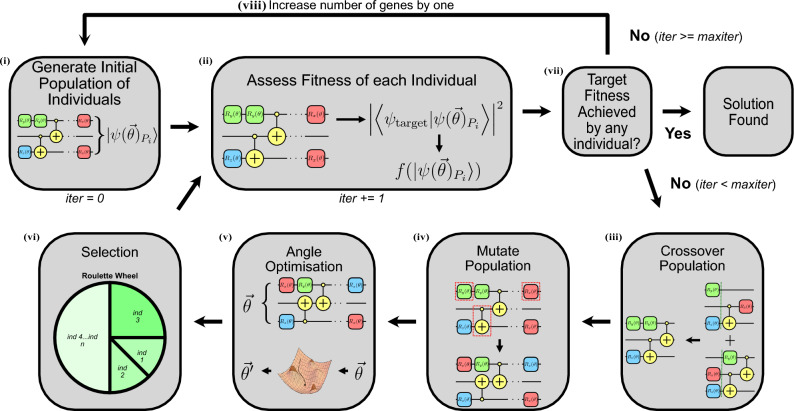
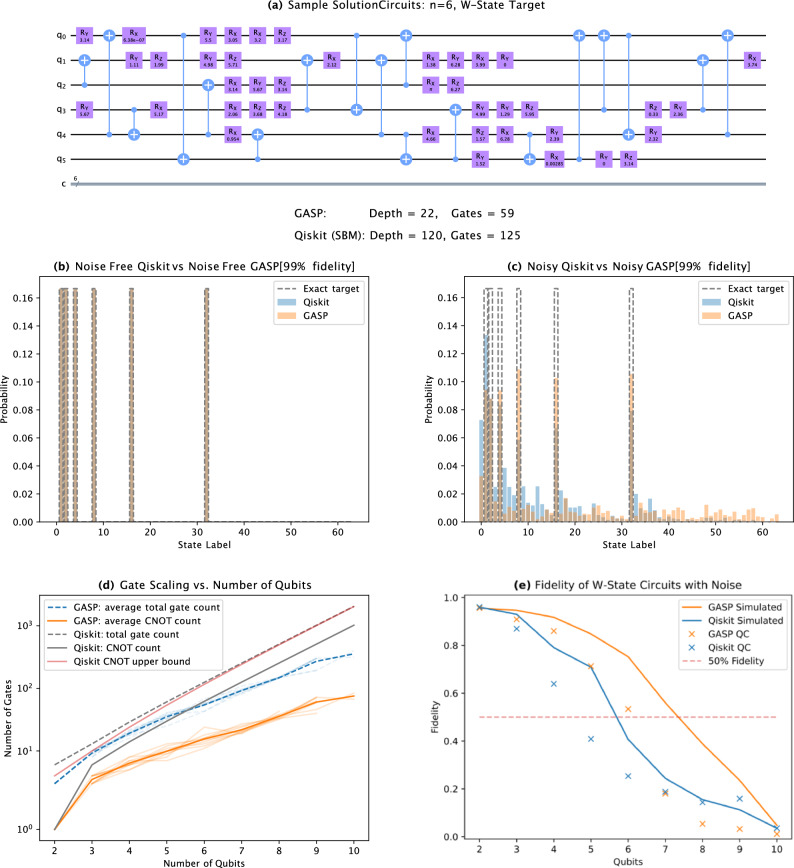
The efficient preparation of quantum states is an important step in the execution of many quantum algorithms. In the noisy intermediate-scale quantum (NISQ) computing era, this is a significant challenge given quantum resources are scarce and typically only low-depth quantum circuits can be implemented on physical devices. We present a genetic algorithm for state preparation (GASP) which generates relatively low-depth quantum circuits for initialising a quantum computer in a specified quantum state. The method uses a basis set of [Formula: see text], [Formula: see text], [Formula: see text], and CNOT gates and a genetic algorithm to systematically generate circuits to synthesize the target state to the required fidelity. GASP can produce more efficient circuits of a given accuracy with lower depth and gate counts than other methods. This variability of the required accuracy facilitates overall higher accuracy on implementation, as error accumulation in high-depth circuits can be avoided. We directly compare the method to the state initialisation technique based on an exact synthesis technique by implemented in IBM Qiskit simulated with noise and implemented on physical IBM Quantum devices. Results achieved by GASP outperform Qiskit's exact general circuit synthesis method on a variety of states such as Gaussian states and W-states, and consistently show the method reduces the number of gates required for the quantum circuits to generate these quantum states to the required accuracy.
量子态的高效制备是许多量子算法执行过程中的重要一步。在有噪声的中等规模量子(NISQ)计算时代,这是一项重大挑战,因为量子资源稀缺,且通常只能在物理设备上实现低深度量子电路。我们提出了一种用于态制备的遗传算法(GASP),它能生成相对低深度的量子电路,以便在指定量子态下初始化量子计算机。该方法使用一组由[公式:见原文]、[公式:见原文]、[公式:见原文]和CNOT门组成的基集以及遗传算法,系统地生成电路,以将目标态合成到所需的保真度。与其他方法相比,GASP能够以更低的深度和门数生成给定精度下更高效的电路。所需精度的这种可变性有助于在实现时整体获得更高的精度,因为可以避免高深度电路中的误差积累。我们通过在有噪声模拟的IBM Qiskit中实现并在物理IBM量子设备上实现,将该方法与基于精确合成技术的态初始化技术直接进行比较。GASP在多种态(如高斯态和W态)上取得的结果优于Qiskit的精确通用电路合成方法,并且始终表明该方法减少了生成这些量子态到所需精度的量子电路所需的门数。