Toussaint Loren L, Bratty Alexandra J
Department of Psychology, Luther College, 700 College Drive, Decorah, IA 52101, USA.
AB Research Consulting, 508 Summer Mesa Drive, Las Vegas, NV 89148, USA.
Evid Based Complement Alternat Med. 2023 Jul 17;2023:7068326. doi: 10.1155/2023/7068326. eCollection 2023.
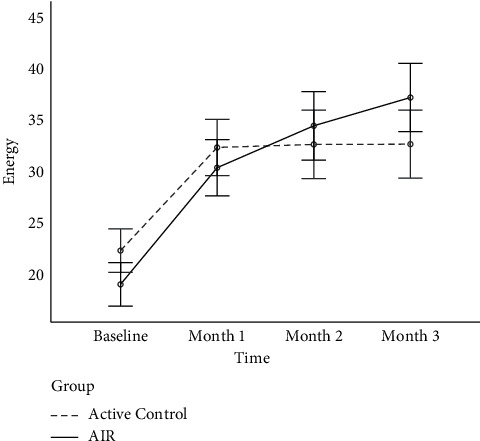
Long COVID affects approximately 10-30% of individuals after an acute COVID-19 infection (Ceban, Ling, et al. 2022; Ortona and Malorni, 2022). Numerous symptoms, including extreme fatigue, can persist for months, resulting in social and economic hardship for individuals and their families (Ortona and Malorni 2022). Therefore, approaches that offer some relief from Long COVID are urgently needed. Research suggests that Long COVID symptoms are akin to those of chronic conditions, such as myalgic encephalomyelitis/chronic fatigue syndrome (ME/CFS) and are likely caused by inflammation and immune dysfunction (Scordo et al., 2021). Amygdala and Insula Retraining (AIR), a neuroplasticity program, has successfully alleviated chronic conditions (Gupta 2010; Sanabria-Mazo et al. 2020; Toussaint et al. 2012). In this randomized controlled trial, AIR was tested against a structurally equivalent health and wellness intervention for its effectiveness in treating the symptom of fatigue among Long COVID sufferers. Results showed a significant decrease in participants' fatigue and a significant increase in their energy after the 3-month AIR intervention. Additionally, the AIR group experienced more significant outcomes than the active control group. The AIR group demonstrated a fatigue reduction effect size four times that of the active control group, and the absolute reduction in mean scores for the AIR group was more than double that of the control group. Furthermore, the AIR group showed an effect size in energy enhancement twice that of the active control group, and the absolute increase in energy mean scores for the AIR group was almost double that of the control group. These novel findings suggest AIR is a viable means of reducing fatigue and increasing energy among Long COVID patients. Limitations and future research are discussed.
在急性新冠病毒感染后,约10%-30%的个体受长新冠影响(塞班、凌等人,2022年;奥尔托纳和马洛尼,2022年)。包括极度疲劳在内的众多症状可能会持续数月,给患者及其家人带来社会和经济困难(奥尔托纳和马洛尼,2022年)。因此,迫切需要能缓解长新冠症状的方法。研究表明,长新冠症状与慢性疾病(如肌痛性脑脊髓炎/慢性疲劳综合征,ME/CFS)的症状相似,可能由炎症和免疫功能障碍引起(斯科尔多等人,2021年)。杏仁核与脑岛再训练(AIR)是一种神经可塑性计划,已成功缓解了慢性疾病(古普塔,2010年;萨纳布里亚-马佐等人,2020年;图桑等人,2012年)。在这项随机对照试验中,对AIR与一种结构等效的健康与保健干预措施进行了测试,以检验其对长新冠患者疲劳症状的治疗效果。结果显示,在为期3个月的AIR干预后,参与者的疲劳感显著降低,精力显著增加。此外,AIR组的效果比积极对照组更显著。AIR组的疲劳减轻效应量是积极对照组的四倍,AIR组平均得分的绝对降低幅度是对照组的两倍多。此外,AIR组在精力增强方面的效应量是积极对照组的两倍,AIR组精力平均得分的绝对增加幅度几乎是对照组的两倍。这些新发现表明,AIR是减轻长新冠患者疲劳感和增加精力的一种可行方法。本文还讨论了研究的局限性和未来研究方向。