Kim Eric K, Seguya Amina, Thaw May Htoo, Tahir Peggy, Formeister Eric J, Waterworth Christopher J, Jaffer Ali F
The Global Otolaryngology-Head and Neck Surgery Initiative, USA.
Department of Otolaryngology - Head and Neck Surgery, University of California, San Francisco, San Francisco, CA, USA.
J Otol. 2023 Jul;18(3):173-184. doi: 10.1016/j.joto.2023.05.003. Epub 2023 May 18.
Vestibular migraine (VM) is a common cause of dizziness that is underrecognized, underdiagnosed, and challenging to effectively treat. The prevalence, appropriate diagnostic workup, and therapies for VM in low- and lower-middle-income countries (LLMICs) remain understudied. The objective of this scoping review is to evaluate the current state of VM research in LLMICs.
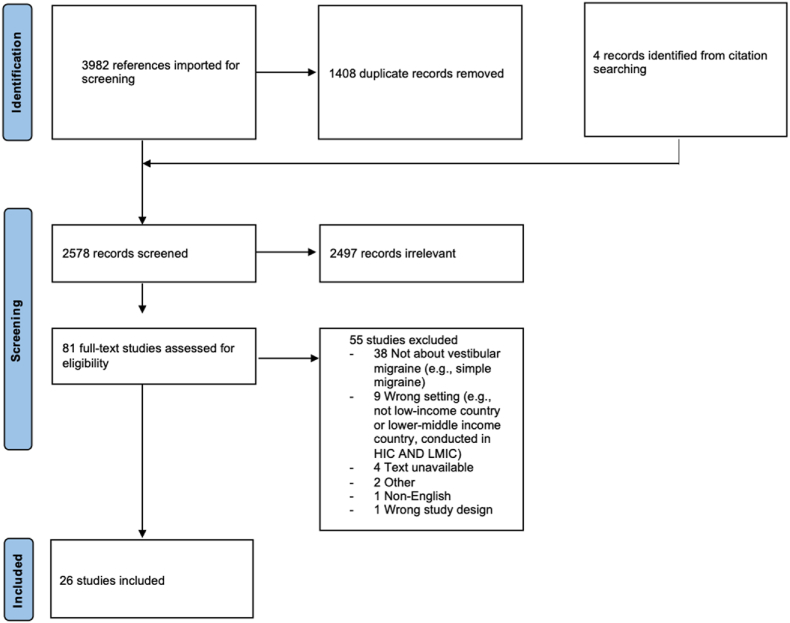
PubMed, Embase, and Web of Science databases were searched to execute a scoping review of VM. Keywords "vestibular diseases" and "vertigo" were used in combination with terms referring to LLMICs as defined by the World Bank. Title and abstract screening, full-text review, and data collection were conducted by two authors independently.
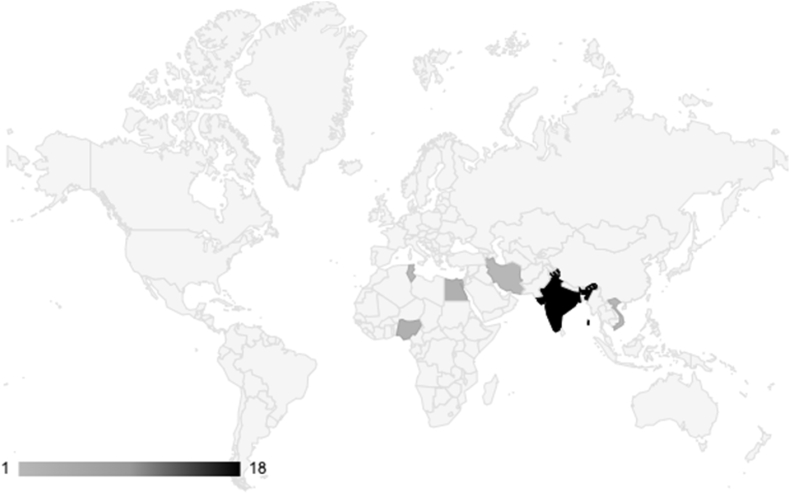
Twenty-six studies were included in the scoping review. Most studies were cross-sectional (57.7%) or case studies/series (23.1%) and were conducted in urban settings only (92.3%). Geographic distribution of studies was skewed, with 65.4% of articles originating from India. The prevalence of VM among clinic patients ranged from 0.3% to 33.3%. VM most frequently presented as headache, nausea and vomiting, and photophobia. Radiographic imaging, audiometry, and electronystagmography/videonystagmography were the three most commonly utilized diagnostic modalities in the dizziness workup. The most studied pharmacotherapies included calcium channel blockers, followed by beta-blockers and antiepileptics. Case studies and series discussed less common VM pharmacotherapies, such as ayurvedic medicine.
There is a need for more VM research in LLMICs, including innovative diagnostic approaches and therapies that can improve VM care globally. Equitable partnerships between LLMIC and high-income country researchers must expand vestibular research capacity and productivity in LLMICs.
前庭性偏头痛(VM)是头晕的常见原因,目前未得到充分认识、诊断不足且难以有效治疗。低收入和中低收入国家(LLMICs)中VM的患病率、适当的诊断检查方法及治疗仍研究不足。本范围综述的目的是评估LLMICs中VM的研究现状。
检索PubMed、Embase和科学网数据库以对VM进行范围综述。使用关键词“前庭疾病”和“眩晕”,并结合世界银行定义的LLMICs相关术语。由两位作者独立进行标题和摘要筛选、全文审查及数据收集。
范围综述纳入了26项研究。大多数研究为横断面研究(57.7%)或病例研究/系列(23.1%),且仅在城市环境中开展(92.3%)。研究的地理分布不均衡,65.4%的文章来自印度。临床患者中VM的患病率在0.3%至33.3%之间。VM最常表现为头痛、恶心和呕吐以及畏光。影像学检查、听力测定和眼震电图/视频眼震电图是头晕检查中最常用的三种诊断方法。研究最多的药物疗法包括钙通道阻滞剂,其次是β受体阻滞剂和抗癫痫药。病例研究和系列讨论了不太常见的VM药物疗法,如阿育吠陀医学。
LLMICs需要开展更多关于VM的研究,包括创新的诊断方法和疗法,以改善全球的VM治疗。LLMICs与高收入国家研究人员之间的公平伙伴关系必须扩大LLMICs的前庭研究能力和生产力。