Takahashi Sei, Naganuma Toru, Kurita Noriaki, Omae Kenji, Ohnishi Tsuyoshi, Yoshioka Takashi, Ito Fumihito, Takeshima Taro, Fukuma Shingo, Hamaguchi Sugihiro, Fukuhara Shunichi
Department of General Internal Medicine, Fukushima Medical University, Fukushima, Japan.
Futaba Emergency and General Medicine Support Center, Fukushima Medical University, Fukushima, Japan.
Innov Aging. 2023 Jun 26;7(6):igad065. doi: 10.1093/geroni/igad065. eCollection 2023.
The relationship between social isolation/loneliness and oral health is unclear. This study investigated the association between social isolation/loneliness and tooth loss in older Japanese adults.
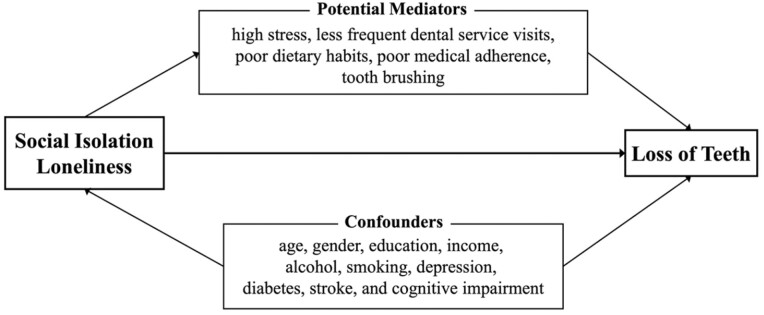
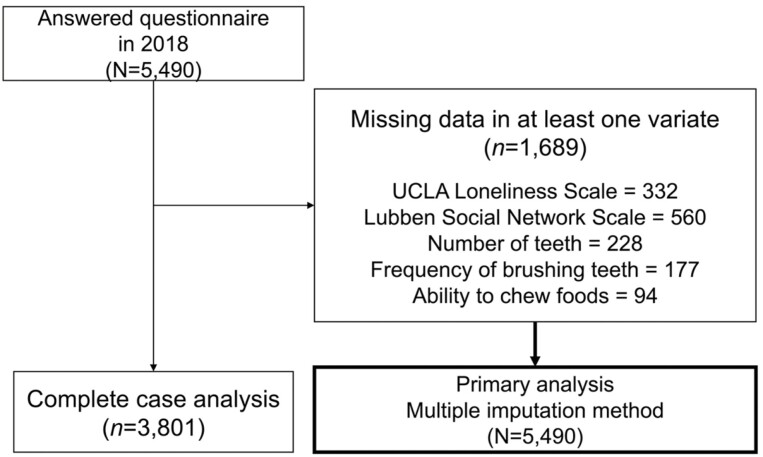
This was a cross-sectional study of a population-based cohort (the Sukagawa Study); 5,490 cohort study participants aged ≥75 years and who were independent answered a self-administered questionnaire in 2018. Social isolation was defined based on the 6-item Japanese version of the Lubben Social Network Scale. Loneliness was measured by the 3-item Japanese version of the University of California, Los Angeles (UCLA) Loneliness Scale version 3. The primary outcome was tooth loss, defined as having fewer than 20 teeth. The secondary outcomes were decreased toothbrushing frequency and diminished ability to chew food. Prevalence ratios (PRs) were estimated using a modified Poisson regression analysis in 2 models-Model 1, which adjusted for age, gender, smoking status, alcohol consumption, low annual income, and short education period, and Model 2, which added history of depression, history of diabetes mellitus, history of stroke, and cognitive impairment to Model 1.
The primary analysis included 4,645 participants. Adjusted PRs of social isolation and loneliness for tooth loss (Model 1) were 0.97 (95% confidence interval [CI] 0.92-1.01) and 1.06 (95% CI 1.01-1.12), respectively; those for decreased toothbrushing frequency were 1.13 (95% CI 0.95-1.36) and 1.56 (95% CI 1.26-1.92), respectively; and those for chewing difficulty were 1.61 (95% CI 1.06-2.43) and 2.94 (95% CI 1.91-4.53), respectively. The adjusted PRs in Model 2 demonstrated results similar to that of Model 1.
Loneliness is associated with tooth loss among older adults, whereas social isolation is not. Our findings can inform plans for policymakers, professionals, and organizations to identify lonely older adults and provide social prescriptions to improve their access to oral health care services.
社会孤立/孤独与口腔健康之间的关系尚不清楚。本研究调查了日本老年人群中社会孤立/孤独与牙齿缺失之间的关联。
这是一项基于人群队列的横断面研究(须贺川研究);2018年,5490名年龄≥75岁且独立生活的队列研究参与者自行填写了问卷。社会孤立根据6项日本版鲁本社会网络量表进行定义。孤独感通过3项日本版加利福尼亚大学洛杉矶分校(UCLA)孤独感量表第3版进行测量。主要结局为牙齿缺失,定义为牙齿数量少于20颗。次要结局为刷牙频率降低和咀嚼食物能力下降。使用改良泊松回归分析在两个模型中估计患病率比(PRs)——模型1,对年龄、性别、吸烟状况、饮酒量、低收入和低教育年限进行了调整;模型2,在模型1的基础上增加了抑郁症病史、糖尿病病史、中风病史和认知障碍。
初步分析纳入了4645名参与者。社会孤立和孤独与牙齿缺失的调整后PRs(模型1)分别为0.97(95%置信区间[CI]0.92 - 1.01)和1.06(95%CI 1.01 - 1.12);与刷牙频率降低相关的PRs分别为1.13(95%CI 0.95 - 1.36)和1.56(95%CI 1.26 - 1.92);与咀嚼困难相关的PRs分别为1.61(95%CI 1.06 - 2.43)和2.94(95%CI 1.91 - 4.53)。模型2中的调整后PRs结果与模型1相似。
孤独与老年人牙齿缺失有关,而社会孤立则不然。我们的研究结果可为政策制定者、专业人员和组织制定计划提供参考,以便识别孤独的老年人并提供社会处方,以改善他们获得口腔保健服务的机会。