Malinzi Joseph, Juma Victor Ogesa, Madubueze Chinwendu Emilian, Mwaonanji John, Nkem Godwin Nwachukwu, Mwakilama Elias, Mupedza Tinashe Victor, Chiteri Vincent Nandwa, Bakare Emmanuel Afolabi, Moyo Isabel Linda-Zulu, Campillo-Funollet Eduard, Nyabadza Farai, Madzvamuse Anotida
Faculty of Science and Engineering, Department of Mathematics, University of Eswatini, Private Bag 4, Kwaluseni, Swaziland.
Institute of Systems Science, Durban University of Technology, Durban 4000, South Africa.
R Soc Open Sci. 2023 Jul 26;10(7):221656. doi: 10.1098/rsos.221656. eCollection 2023 Jul.
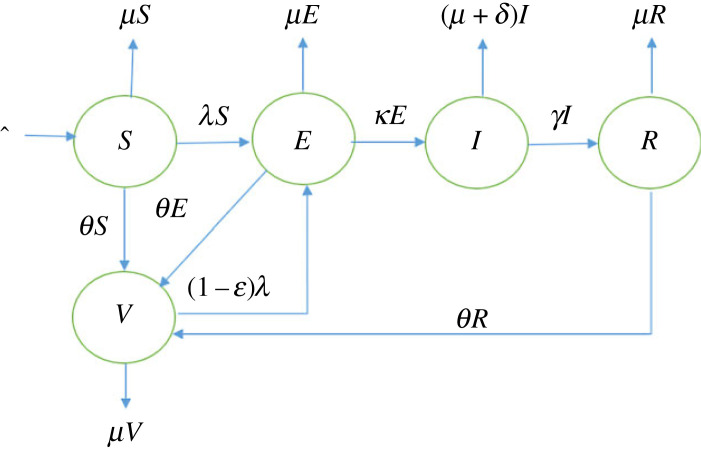
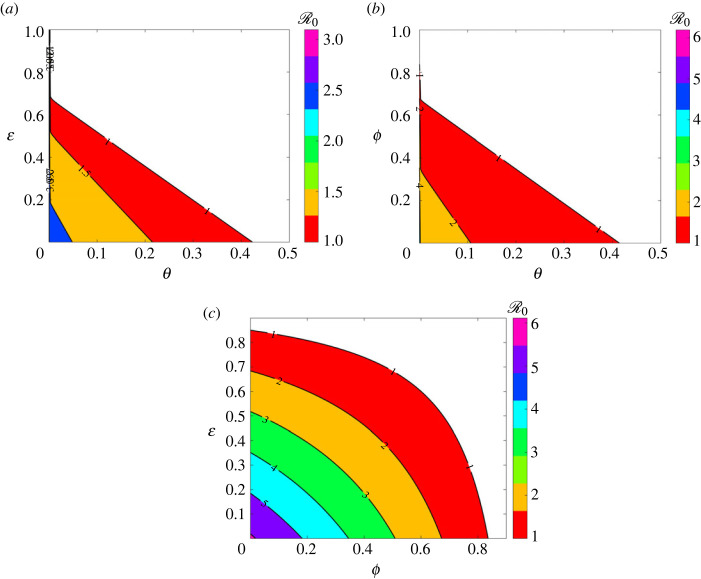
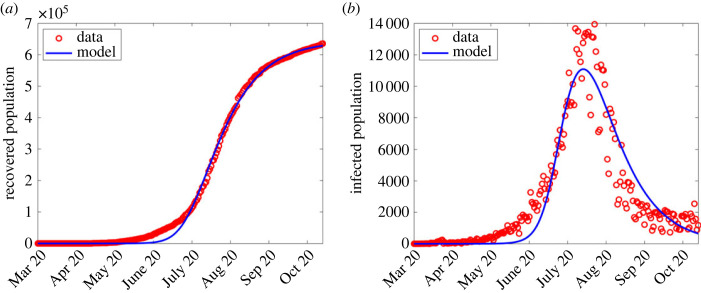
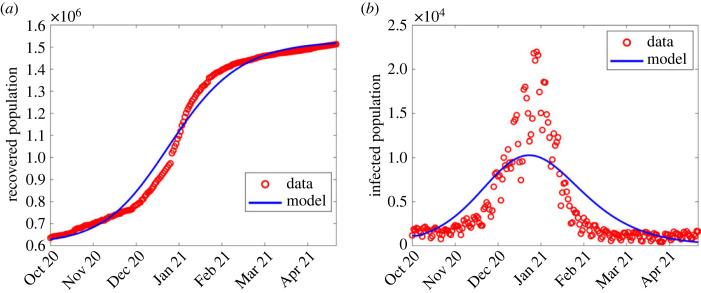
Despite the lifting of COVID-19 restrictions, the COVID-19 pandemic and its effects remain a global challenge including the sub-Saharan Africa (SSA) region. Knowledge of the COVID-19 dynamics and its potential trends amidst variations in COVID-19 vaccine coverage is therefore crucial for policy makers in the SSA region where vaccine uptake is generally lower than in high-income countries. Using a compartmental epidemiological model, this study aims to forecast the potential COVID-19 trends and determine how long a wave could be, taking into consideration the current vaccination rates. The model is calibrated using South African reported data for the first four waves of COVID-19, and the data for the fifth wave are used to test the validity of the model forecast. The model is qualitatively analysed by determining equilibria and their stability, calculating the basic reproduction number and investigating the local and global sensitivity analysis with respect to . The impact of vaccination and control interventions are investigated via a series of numerical simulations. Based on the fitted data and simulations, we observed that massive vaccination would only be beneficial (deaths averting) if a highly effective vaccine is used, particularly in combination with non-pharmaceutical interventions. Furthermore, our forecasts demonstrate that increased vaccination coverage in SSA increases population immunity leading to low daily infection numbers in potential future waves. Our findings could be helpful in guiding policy makers and governments in designing vaccination strategies and the implementation of other COVID-19 mitigation strategies.
尽管新冠疫情限制措施已解除,但新冠疫情及其影响仍是一项全球性挑战,包括撒哈拉以南非洲(SSA)地区。因此,了解新冠疫情动态及其在新冠疫苗接种覆盖率存在差异情况下的潜在趋势,对于SSA地区的政策制定者至关重要,因为该地区的疫苗接种率普遍低于高收入国家。本研究使用一个 compartments 流行病学模型,旨在预测新冠疫情的潜在趋势,并考虑当前的疫苗接种率来确定疫情波可能持续的时间。该模型使用南非报告的前四波新冠疫情数据进行校准,并用第五波疫情数据来检验模型预测的有效性。通过确定平衡点及其稳定性、计算基本再生数 并研究关于 的局部和全局敏感性分析,对模型进行定性分析。通过一系列数值模拟研究疫苗接种和控制干预措施的影响。基于拟合数据和模拟结果,我们观察到,只有使用高效疫苗,特别是与非药物干预措施相结合时,大规模接种疫苗才会有益(避免死亡)。此外,我们的预测表明,SSA地区疫苗接种覆盖率的提高会增强人群免疫力,从而导致未来潜在疫情波中的每日感染人数减少。我们的研究结果可能有助于指导政策制定者和政府制定疫苗接种策略以及实施其他新冠疫情缓解策略。