Hasan Md Jahid, Rahman Muhammad Shajib
Department of Management Studies, Comilla University, Bangladesh.
Department of Accounting and Information Systems, Comilla University, Bangladesh.
Heliyon. 2023 Jul 8;9(7):e18102. doi: 10.1016/j.heliyon.2023.e18102. eCollection 2023 Jul.
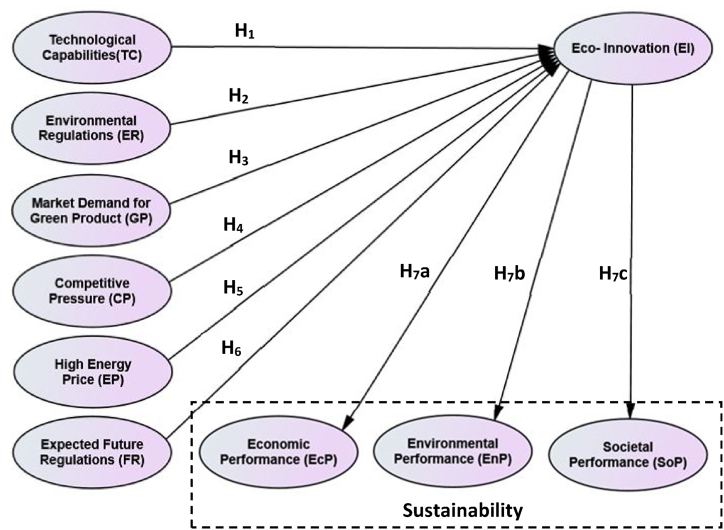
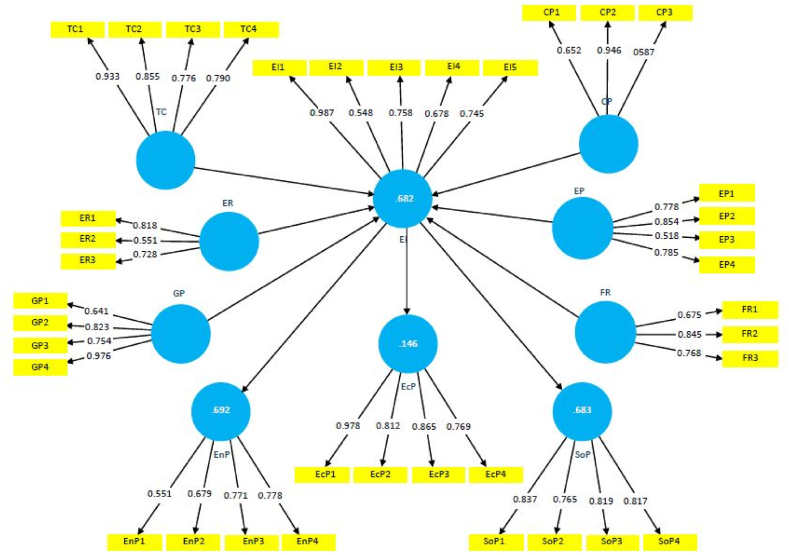
This study identifies the key factors accelerating the eco-innovation initiatives of manufacturing Small & Medium Enterprises (SMEs) in Bangladesh. The study further attempted to measure the impact of eco-innovation on a firm's economic, environmental, and societal performance, broadly called sustainability. Following the convenience sampling technique, data was collected from 876 respondents through a structured questionnaire considering the 7-point Likert scale. The Structural Equation Model (PLS-SEM) has been employed using Smart PLS v3.3 software to simultaneously show the constructs' relationships. Moreover, the study incorporated several tests to check the reliability and validity of the data. Furthermore, the degree to which data collected for this study fits well with the model has been tested by calculating model fit indices- NFI and SRMR. The findings reveal that all other factors Technological Capabilities (TC), Environmental Regulations (ER), Green products (GP), Competitive Pressure (CP), and Energy Price (EP) has a significant positive association with the firm's Eco-innovation initiatives except FR. Moreover, Eco-innovation (EI) greatly enhances the two domains of Sustainability- Environmental Performance (EnP) and Societal Performance (SoP) in manufacturing SMEs in Bangladesh. However, the relationship between EI and EcP was found to be insignificant. Apart from Economic Performance (EcP) andEnvironmental Performance(EnP), Societal Performance (SoP) as a sustainability domain remains unattended in the prior study, which has been incorporated in this research. Thus, the findings of this study will provide some unique implications for business managers and policymakers.
本研究确定了加速孟加拉国制造业中小企业生态创新举措的关键因素。该研究还试图衡量生态创新对企业经济、环境和社会绩效(广义上称为可持续性)的影响。采用便利抽样技术,通过一份采用7点李克特量表的结构化问卷,从876名受访者那里收集了数据。使用Smart PLS v3.3软件采用结构方程模型(PLS-SEM)来同时展示各结构之间的关系。此外,该研究纳入了多项测试以检验数据的可靠性和有效性。此外,通过计算模型拟合指数——NFI和SRMR,对本研究收集的数据与模型的拟合程度进行了测试。研究结果表明,除了FR之外,所有其他因素——技术能力(TC)、环境法规(ER)、绿色产品(GP)、竞争压力(CP)和能源价格(EP)——都与企业的生态创新举措存在显著的正相关关系。此外,生态创新(EI)极大地提升了孟加拉国制造业中小企业可持续性的两个领域——环境绩效(EnP)和社会绩效(SoP)。然而,EI与经济绩效(EcP)之间的关系被发现不显著。除了经济绩效(EcP)和环境绩效(EnP)之外,社会绩效(SoP)作为一个可持续性领域在以往研究中未得到关注,本研究将其纳入其中。因此,本研究的结果将为企业管理者和政策制定者提供一些独特的启示。