College of Mathematics, Jilin University, Changchun, Jilin 130012, China.
State Key Laboratory of Pathogen and Biosecurity, Beijing Institute of Microbiology and Epidemiology, AMMS, Beijing 100071, China.
Viruses. 2023 Jul 15;15(7):1556. doi: 10.3390/v15071556.
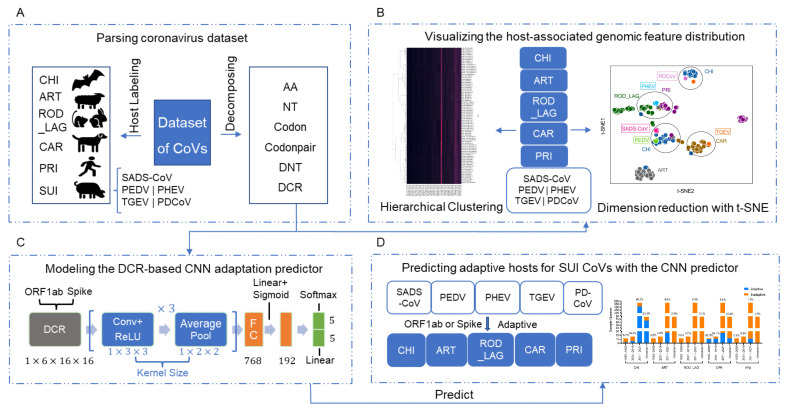
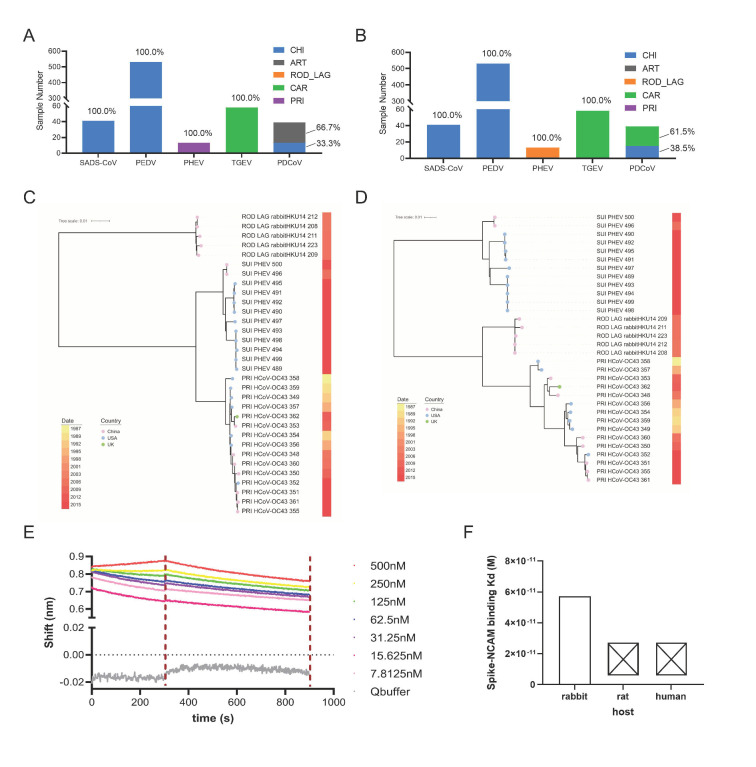
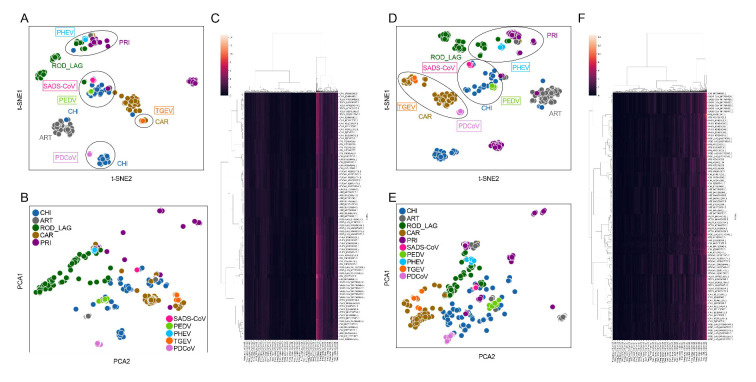
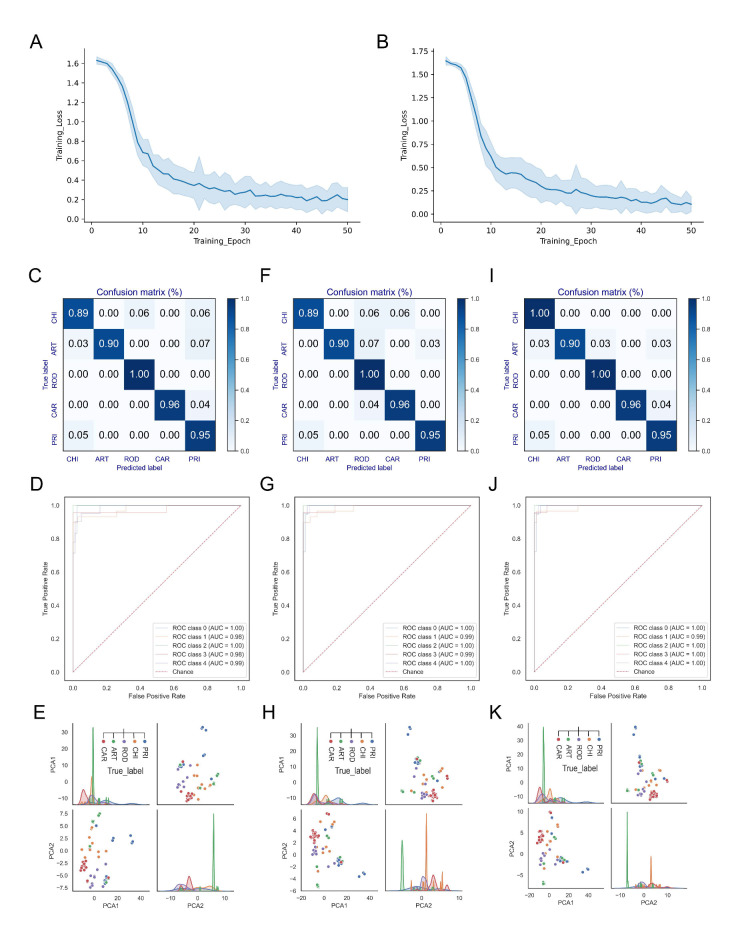
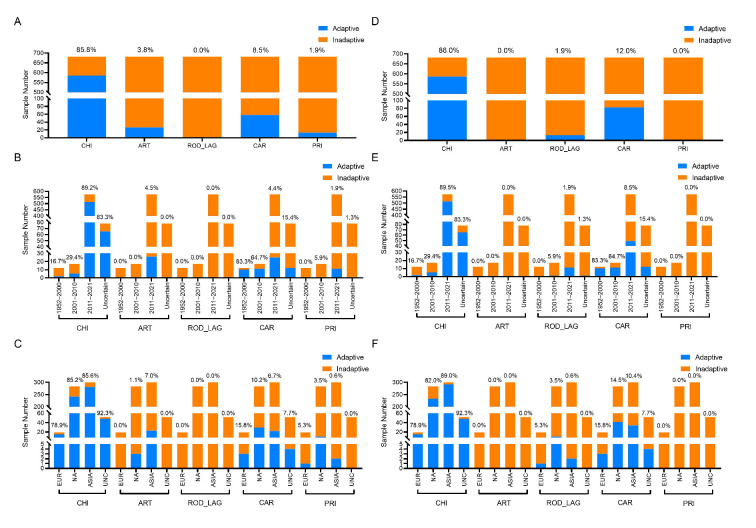
Swine coronaviruses (CoVs) have been found to cause infection in humans, suggesting that Suiformes might be potential intermediate hosts in CoV transmission from their natural hosts to humans. The present study aims to establish convolutional neural network (CNN) models to predict host adaptation of swine CoVs. Decomposing of each and sequence was performed with dinucleotide composition representation (DCR) and other traits. The relationship between CoVs from different adaptive hosts was analyzed by unsupervised learning, and CNN models based on DCR of and were built to predict the host adaptation of swine CoVs. The rationality of the models was verified with phylogenetic analysis. Unsupervised learning showed that there is a multiple host adaptation of different swine CoVs. According to the adaptation prediction of CNN models, swine acute diarrhea syndrome CoV (SADS-CoV) and porcine epidemic diarrhea virus (PEDV) are adapted to Chiroptera, swine transmissible gastroenteritis virus (TGEV) is adapted to Carnivora, porcine hemagglutinating encephalomyelitis (PHEV) might be adapted to Primate, Rodent, and Lagomorpha, and porcine deltacoronavirus (PDCoV) might be adapted to Chiroptera, Artiodactyla, and Carnivora. In summary, the DCR trait has been confirmed to be representative for the CoV genome, and the DCR-based deep learning model works well to assess the adaptation of swine CoVs to other mammals. Suiformes might be intermediate hosts for human CoVs and other mammalian CoVs. The present study provides a novel approach to assess the risk of adaptation and transmission to humans and other mammals of swine CoVs.
猪冠状病毒(CoV)已被发现可感染人类,这表明偶蹄目动物可能是冠状病毒从其自然宿主传播到人类的潜在中间宿主。本研究旨在建立卷积神经网络(CNN)模型,以预测猪 CoV 的宿主适应性。采用二核苷酸组成表示(DCR)和其他特征对每个 和 序列进行分解。通过无监督学习分析来自不同适应性宿主的 CoV 之间的关系,并建立基于 DCR 的 和 CNN 模型来预测猪 CoV 的宿主适应性。通过系统发育分析验证模型的合理性。无监督学习表明,不同的猪 CoV 存在多次宿主适应。根据 CNN 模型的适应预测,猪急性腹泻综合征冠状病毒(SADS-CoV)和猪流行性腹泻病毒(PEDV)适应于翼手目,猪传染性胃肠炎病毒(TGEV)适应于食肉目,猪传染性脑脊髓炎病毒(PHEV)可能适应于灵长目、啮齿目和兔形目,而猪德尔塔冠状病毒(PDCoV)可能适应于翼手目、偶蹄目和食肉目。总之,已经证实 DCR 特征是 CoV 基因组的代表性特征,基于 DCR 的深度学习模型可很好地评估猪 CoV 对其他哺乳动物的适应性。偶蹄目动物可能是人类冠状病毒和其他哺乳动物冠状病毒的中间宿主。本研究为评估猪 CoV 对人类和其他哺乳动物的适应和传播风险提供了一种新方法。