Zhu Yindong, Yang Ying, Liu Yuan, Qian Hongyan, Qu Ganlin, Shi Weidong, Liu Jun
Department of Oncology, Affiliated Hospital of Nantong University, Medical School of Nantong University, Nantong, China.
Cancer Research Center Nantong, Nantong Tumor Hospital, The Affiliated Tumor Hospital of Nantong University, Nantong University, Nantong, China.
J Cancer Res Clin Oncol. 2023 Nov;149(15):13631-13643. doi: 10.1007/s00432-023-05176-1. Epub 2023 Jul 30.
Lung adenocarcinoma (LUAD), the most common subtype of lung cancer, is the primary contributor to cancer-linked fatalities. Dysregulation in the proliferation of cells and death is primarily involved in its development. Recently, tetraspanins, a group of transmembrane proteins, have gained increasing attention for their potential role in the progression of LUAD. Hence, our endeavor involved the development of a novel tetraspanin-based model for the prognostication of lung cancer.
A comprehensive set of bioinformatics tools was utilized to evaluate the expression of tetraspanin-related genes and assess their significance regarding prognosis. Hence, a robust risk signature was established through machine learning. The prognosis-predictive value of the signature was evaluated in terms of clinical application, functional enrichment, and the immune landscape.
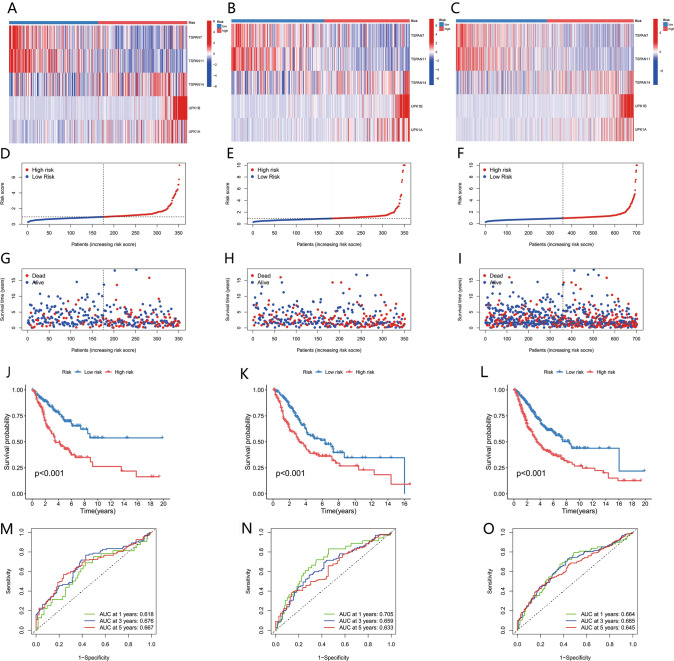
The research first identified differential expression of tetraspanin genes in patients with LUAD via publicly available databases. The resulting data were indicative of the value that nine of them held regarding prognosis. Five distinct elements were utilized in the establishment of a tetraspanin-related model (TSPAN7, TSPAN11, TSPAN14, UPK1B, and UPK1A). Furthermore, as per the median risk scores, the participants were classified into high- and low-risk groups. The model was validated using inner and outer validation sets. Notably, consensus clustering and prognostic score grouping analysis revealed that tetraspanin-related features affect tumor prognosis by modulating tumor immunity. A nomogram based on the tetraspanin gene was constructed with the aim of enhancing the poor prognosis of high-risk groups and facilitating clinical application.
Through machine learning algorithms and in vitro experiments, a novel tetraspanin-associated signature was developed and validated for survival prediction in patients with LUAD that reflects tumor immune infiltration. This could potentially provide new and improved measures for diagnosis and therapeutic interventions for LUAD.
肺腺癌(LUAD)是肺癌最常见的亚型,是癌症相关死亡的主要原因。细胞增殖和死亡的失调主要参与其发展。最近,四跨膜蛋白,一组跨膜蛋白,因其在LUAD进展中的潜在作用而受到越来越多的关注。因此,我们致力于开发一种基于四跨膜蛋白的新型肺癌预后模型。
利用一套全面的生物信息学工具来评估四跨膜蛋白相关基因的表达,并评估它们对预后的意义。因此,通过机器学习建立了一个强大的风险特征。从临床应用、功能富集和免疫格局方面评估了该特征的预后预测价值。
该研究首先通过公开可用的数据库确定了LUAD患者中四跨膜蛋白基因的差异表达。所得数据表明其中九个基因对预后具有价值。在建立四跨膜蛋白相关模型(TSPAN7、TSPAN11、TSPAN14、UPK1B和UPK1A)时使用了五个不同的因素。此外,根据中位风险评分,将参与者分为高风险和低风险组。使用内部和外部验证集对模型进行了验证。值得注意的是,共识聚类和预后评分分组分析表明,四跨膜蛋白相关特征通过调节肿瘤免疫影响肿瘤预后。构建了一个基于四跨膜蛋白基因的列线图,以改善高风险组的不良预后并促进临床应用。
通过机器学习算法和体外实验,开发并验证了一种新型的四跨膜蛋白相关特征,用于预测LUAD患者的生存情况,该特征反映了肿瘤免疫浸润。这可能为LUAD的诊断和治疗干预提供新的、改进的措施。